
Most of what gets called a loophole is a provision working exactly as intended, used by somebody who knew it was there.
Using one is legal. What makes a position fail is not the concept but the file behind it: an arrangement that plainly happened, was never documented, and cannot be evidenced years later when somebody asks.
This covers where legitimate planning ends, the strategies most commonly available to a small business, what each depends on, and what a position needs behind it to survive being questioned.
What Is a Tax Loophole, and Is Using One Legal?
A 'tax loophole' is commonly used to describe a legal provision in the tax code that allows taxpayers to reduce their tax liability, often in a way Congress may not have fully intended, but that is nonetheless explicitly permitted by existing law. Every strategy in this article is legal, supported by IRS code, and used by millions of small business owners. The key is implementing them correctly.
What these positions need is a file, not a clever argument. A contract, a resolution, timesheets, a valuation, a market comparison, created at the time. The commonest failure is not the concept but an arrangement that plainly happened and was never documented.
Anu Gupta, CA, EA, B.Tech · LinkedInLoophole 1: S-Corp Reasonable Compensation Split
Self-employment tax (15.3%) applies to all net profit for a sole proprietor. An S-corp pays FICA only on the owner-employee's salary. Profit above the salary is distributed as dividends, no SE tax.
Approximate annual savings: 15.3% of the difference between net profit and reasonable salary. On $100,000 above a $70,000 reasonable salary: ~$15,300 saved.
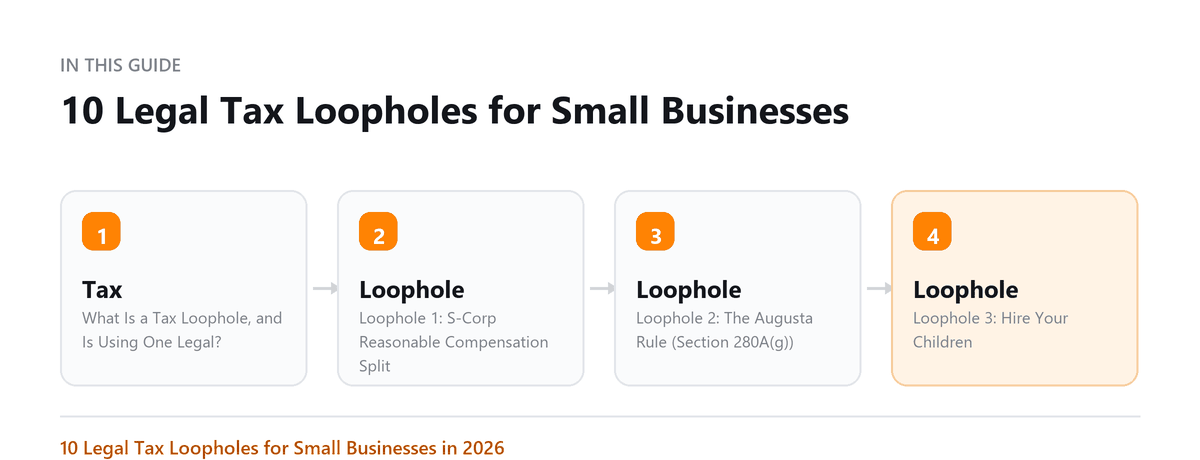
Loophole 2: The Augusta Rule (Section 280A(g))
Rent your personal home to your business for 14 days or fewer per year. The rental income you receive is 100% tax-free to you personally. Your business deducts the rent paid. Net effect: you move money from the business (where it would be taxed) to yourself (where it is tax-free).
Charge a market rate (document with comparables from event venues or short-term rental sites). Use the meetings for genuine business purposes, strategy sessions, board meetings, training. Keep minutes.
Loophole 3: Hire Your Children
Wages paid to your children under 18 who work in your sole proprietorship (or a partnership where both partners are parents):
- Exempt from FICA (Social Security and Medicare) and FUTA.
- Deductible business expense for you.
- Taxed at the child's rate, typically much lower, or zero (up to the standard deduction: $15,000 in 2025).
- Wages must be for real work at a reasonable market rate.
Example: pay your 16-year-old $14,000/year to do social media, data entry, or inventory management. You save $14,000 x your marginal rate (say 32%) = $4,480. The child pays zero federal income tax on the first $15,000.
Loophole 4: Solo 401(k) Mega Backdoor
A Solo 401(k) allows two types of contributions: employee deferral (up to $23,500 in 2025) and employer profit-sharing contribution (up to 25% of compensation). Together, the combined limit is $69,000 (2025).
If your plan allows after-tax contributions (not all do), you can contribute additional after-tax dollars and then convert them to Roth, the mega backdoor Roth. This creates a bucket of future tax-free growth and withdrawals far larger than a standard Roth IRA allows.
Loophole 5: Section 179 + Bonus Depreciation
Instead of depreciating a $100,000 piece of equipment over 5-7 years, Section 179 lets you deduct the entire cost in year 1 (up to the annual limit). Bonus depreciation covers additional eligible property.
Approximate savings: purchasing $80,000 of equipment at a 24% tax rate saves $19,200 in tax in year 1 versus ~$2,743/year over 7 years under straight-line depreciation.
Loophole 6: R&D Tax Credit for Software Development
The Section 41 Research and Development credit is a dollar-for-dollar reduction in tax liability, more powerful than a deduction. Many small businesses do not realize that internal software development qualifies if it:
- Involves technological uncertainty (you did not know the approach would work when you started)
- Is experimental in nature (testing alternatives)
- Creates a new or improved product, process, or software for use in your business
Even companies building their own SaaS product, internal tools, or business process automation may qualify. Startups with no income tax liability can apply up to $250,000 of R&D credit against payroll taxes (Form 6765, payroll tax election).
Loophole 7: Home Office + Vehicle Combo
If your home is your principal place of business, trips from home to client sites are deductible business miles, not commuting. Claiming a legitimate home office transforms what would be non-deductible commuting into a deductible business drive.
Combined with the home office deduction itself, this strategy can be particularly powerful for freelancers, consultants, and home-based businesses.
Loophole 8: Self-Employed Health Insurance Deduction
100% of health, dental, and vision insurance premiums for yourself, your spouse, and your dependents are deductible as an above-the-line deduction (Schedule 1). This reduces your income tax (though not SE tax). It is available even if you take the standard deduction.
A self-employed person in the 24% bracket paying $15,000/year in premiums saves $3,600 in federal income tax, effectively making health insurance 24% cheaper.
Loophole 9: 50% Business Meals Deduction
Business meals with clients, prospects, employees, or business partners are 50% deductible when you discuss business. Document: who attended, what was discussed, the business connection. The meal must not be lavish or extravagant.
Pro Tip: Use a notes app to record meal participants and business topic immediately after eating, takes 30 seconds and is invaluable if audited.
Loophole 10: Cost Segregation for Real Estate
If you purchased commercial real estate, a cost segregation study breaks the building into components with shorter depreciable lives (5, 7, or 15 years instead of 39 years). This dramatically front-loads depreciation.
Example: a $1,000,000 building generates $25,641/year of depreciation over 39 years ($1,000,000 / 39). After cost segregation, $300,000 of components may be reclassified to 5-7 year property, generating $60,000+/year in depreciation in early years instead. Present value of the tax savings is significant.
Book a free consultation and we will take the return off your desk.
Frequently Asked Questions
Will using these strategies trigger an audit?
No single strategy automatically triggers an audit. The IRS uses statistical models to flag returns that deviate significantly from norms for similar businesses. The best protection is accurate documentation and implementing strategies correctly, not avoiding them.
Do I need a CPA to implement these?
Several of these (home office, mileage, meal deductions) you can implement yourself with good record-keeping. S-corp election, cost segregation, R&D credits, and mega backdoor Roth require professional guidance to do correctly.
Does using these strategies increase the chance of being examined?
Using a provision as it was intended does not, but the way a position is documented and presented certainly affects how it is viewed. The strategies that attract attention are the ones where the amounts look disproportionate to the business, or where the paperwork does not match what actually happened. A well-documented position applied to a business it plainly fits is not an aggressive filing.
What does it take to support one of these if questioned?
Evidence that the arrangement is real, created at the time. Depending on the provision that might be a contract, a board resolution, timesheets, an independent valuation, or a market comparison supporting an amount. The common failure is not the concept but the file: an arrangement that plainly happened but was never documented is hard to defend years later.
How many of these should a business actually use?
A few that genuinely fit, applied properly, rather than as many as possible. Each one carries administration, and several only pay off above a certain size or in a particular structure. Stacking provisions that were not designed to interact is also where positions become fragile. Two or three implemented well will usually deliver more than eight implemented loosely.

Written by
Anu Gupta, CA, EA, B.Tech
Anu works with US businesses on tax and entity questions at Profitjets, from choosing a structure to the filings that follow it. She writes about the decisions owners make once and then live with for years. Connect on LinkedIn
Free consultation
Want the Filing Handled?
Book a free consultation and we will take the return off your desk.