
Firms that outsource preparation are solving a capacity problem: more returns arriving in a short season than the people available can absorb.
The work moves. The responsibility does not. The firm whose name goes on the return still carries the professional obligation, the duty of care and the review that sits between a draft and a signature.
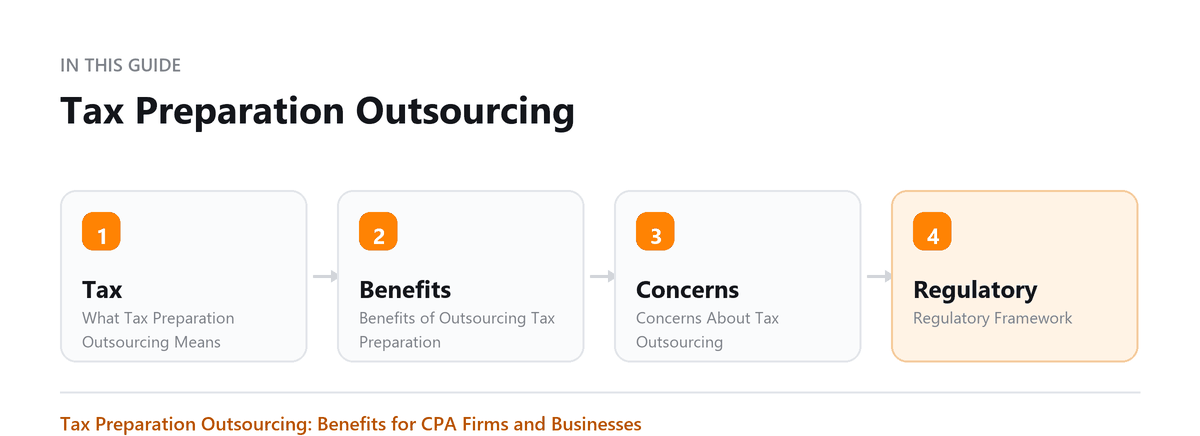
This covers what outsourcing preparation actually means, the benefits firms see, the concerns worth taking seriously, the regulatory framework around client data and consent, and how to evaluate a provider.
Tax preparation outsourcing, sending return preparation work to offshore or third-party vendors, has become mainstream among US CPA firms over the past decade. When done correctly, it reduces cost, scales peak capacity, and lets your licensed CPAs focus on the judgment-intensive work that only they can do.
What Tax Preparation Outsourcing Means
A CPA firm (or a business filing its own returns) contracts with an external service provider to prepare tax returns or supporting workpapers. The outsourced team receives the source documents, prepares the draft return, and sends it back for the CPA's review and signature. The signing CPA remains responsible for the return. The outsourced team prepares; they do not sign.
Delegating preparation does not delegate the professional obligation, the duty of care to the client, or the review that should sit between the draft and the signature. That is not an argument against the arrangement. It is the reason the review has to be resourced during the busiest part of the year.
Anu Gupta, CA, EA, B.Tech · LinkedInBenefits of Outsourcing Tax Preparation
Cost Reduction
Offshore tax preparation typically costs 70-80% less than in-house preparation. For a CPA firm processing 500 individual or business returns, this represents significant labor savings that can be reinvested in advisory services or profit margin.
Peak-Season Scalability
The April 15 and October 15 peaks create extreme workload spikes that are difficult to staff for internally. Outsourcing partners can ramp capacity up and down with the filing season, eliminating the need to hire seasonal staff who require training and may not return next year.
Qualified Preparers
Established outsourcing firms employ CPAs, Enrolled Agents, and trained tax professionals in their own right. The work quality, when properly reviewed, can match or exceed what a stretched internal junior staff produces under deadline pressure.
Focus on Advisory and Client Relationships
If your senior CPAs are preparing Form 1040 after Form 1040, they are not doing the tax planning, business advisory, and client relationship work that generates referrals and premium fees. Outsourcing the preparation frees licensed professionals for higher-value work.
Concerns About Tax Outsourcing
Data Security
Client tax data is extremely sensitive. Any outsourcing arrangement requires ironclad data security: encrypted file transfer, access controls, non-disclosure agreements, and a vendor security review. Ask for the vendor's SOC 2 report or equivalent security certification.
Client Confidentiality
Clients may not be comfortable with their returns being prepared offshore. Transparency is the right approach. Some CPA firms disclose this in their engagement letters; others inform clients on request.
Quality Control
The signing CPA is legally responsible for the return. A cursory review of an outsourced return is inadequate. Build a structured review process: check source document tie-outs, verify key calculations, confirm all elections are correctly made. The time saved on preparation should be partially reinvested in rigorous review.
Regulatory Framework
Circular 230
Treasury Department Circular 230 governs practice before the IRS. The signing CPA remains the practitioner of record regardless of who prepared the return. Supervisory responsibility for outsourced preparers remains with the signing CPA.
Client Consent: IRC Section 7216
Internal Revenue Code Section 7216 requires a signed consent from the client before disclosing their return information to a third party for tax preparation purposes. This consent must be obtained in writing before sending client data to an outsourcing vendor. It is a legal requirement, not optional.
How Profitjets Can Help
Profitjets offers outsourced bookkeeping and accounting services that integrate directly with CPA firms' client relationships. Our team handles the transactional bookkeeping so that your CPA clients arrive at tax time with clean, reconciled books, reducing the preparation time, cleanup work, and extension risk that messy client records create.
Pro Tip: The best outsourcing relationships are built on clear SOPs, a well-defined review process, and regular quality feedback. Start with a small pilot batch before committing full volume to a new vendor.
Book a free consultation and we will take the return off your desk.
Frequently Asked Questions
Is it legal to outsource tax return preparation to an offshore firm?
Yes, provided you comply with IRC Section 7216 client consent requirements, Circular 230 supervisory obligations, and applicable state CPA board rules (some states have additional requirements). Consult your state board if you are unsure.
Which forms can be outsourced?
Individual returns (1040 series), business returns (1120, 1120S, 1065), payroll returns (940, 941), and information returns (1099 series) are all commonly outsourced. The judgment-intensive work, tax planning, IRS correspondence, audit representation, should stay in-house.
How do I evaluate an outsourcing vendor?
Ask for: client references from US CPA firms, security certifications (SOC 2 Type II preferred), sample workflow and turnaround time commitments, error rate data, and a pilot engagement before committing your full book of business. Review their PTIN registration and preparer credentials.
Who remains responsible for the return?
The firm whose name goes on it and the person who signs it. Delegating preparation does not delegate the professional obligation, the duty of care to the client, or the review that should sit between the draft and the signature. That is not an argument against the arrangement; it is the reason the review step has to be real and has to be resourced during the busiest part of the year.
What should the contract with a provider cover?
Confidentiality, what may be done with client data and where it is held, who has access, retention and deletion, security standards, and what happens on termination. Add the practical terms too: turnaround, the review workflow, how queries are handled and who carries the cost of rework. The obligations are on the firm, so the agreement should reflect them rather than the provider's standard wording.

Written by
Anu Gupta, CA, EA, B.Tech
Anu works with US businesses on tax and entity questions at Profitjets, from choosing a structure to the filings that follow it. She writes about the decisions owners make once and then live with for years. Connect on LinkedIn
Free consultation
Want the Filing Handled?
Book a free consultation and we will take the return off your desk.