
Gig Driver Financial Case Study: What Uber/Lyft Drivers Actually Earn
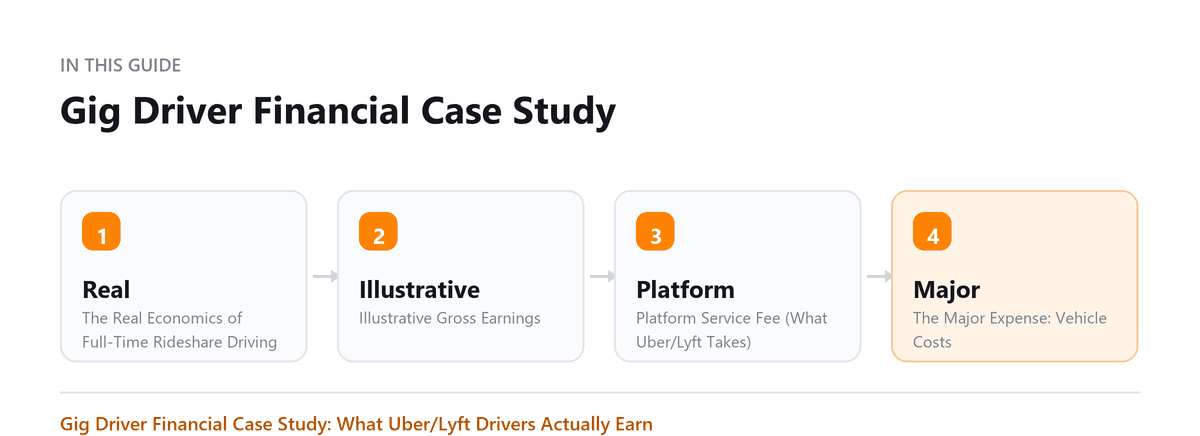
The Real Economics of Full-Time Rideshare Driving, Illustrative Gross Earnings, and Platform Service Fee (What

Driving for a platform looks like a simple trade of hours for money, and the economics are considerably less simple than the earnings screen suggests.
What the screen does not show is the vehicle. Depreciation, maintenance, commercial insurance and the eventual replacement are all real costs incurred per mile, and none of them arrives as a weekly bill, which is why drivers who track only fuel consistently overstate what they are making.
This covers how the gross earnings break down, what the platform deducts, the full cost of running the vehicle, the self-employment charge, and what the position looks like once all of it is accounted for.
The Real Economics of Full-Time Rideshare Driving
Gross earnings figures from Uber and Lyft look appealing. The reality after all expenses is more sobering. This case study walks through the complete financial picture for a hypothetical full-time rideshare driver working 40+ hours/week.
The cost drivers underestimate is the vehicle, and specifically the part of it that is not fuel. Depreciation, maintenance, tyres, commercial insurance and the eventual replacement are all incurred per mile and none arrives as a weekly bill. Tracking fuel alone consistently overstates earnings.
Anu Gupta, CA, EA, B.Tech · LinkedInIllustrative Gross Earnings
A full-time Uber/Lyft driver in a mid-to-large US city working 40-50 hours/week might gross $45,000-$75,000/year from the platforms. Earnings vary enormously by:
- City: high-demand metro areas (NYC, LA, Chicago, Miami) yield more per hour
- Hours: peak hours (Friday/Saturday nights, morning commute, events) earn 2-3x off-peak
- Platform bonuses and quests: completing ride minimums in a week unlocks bonuses
- Vehicle type: Uber XL and Black earn higher fares but require qualifying vehicles
For this case study, assume gross platform earnings of $60,000/year for a full-time driver in a major metro.
Platform Service Fee (What Uber/Lyft Takes)
Uber and Lyft charge drivers a service fee, their cut of each fare. Historically this has been 20-30% of the gross fare, though it varies by market and product type.
Gross fares: $80,000 (what passengers pay) less platform fee (25%): $20,000 = Net to driver: $60,000.
The Major Expense: Vehicle Costs
The vehicle is where gig driving economics often break down. Most drivers fail to account for true vehicle cost.
IRS Standard Mileage Method
If our driver drives 40,000 miles/year for Uber/Lyft (a reasonable full-time estimate), and the 2026 mileage rate is approximately 70 cents/mile:
40,000 miles x $0.70 = $28,000 mileage deduction. This deduction covers fuel, maintenance, tires, and depreciation in one number.
Actual Cost Method (Alternative)
| Actual Vehicle Expense | Annual Estimate (Illustrative) |
|---|---|
| Fuel (10,000 gallons at avg efficiency + deadhead) | $6,000 - $10,000 |
| Insurance (rideshare-rated commercial rider) | $3,000 - $6,000 |
| Maintenance and repairs | $3,000 - $5,000 |
| Tires (high mileage wears tires fast) | $800 - $1,500 |
| Vehicle depreciation (IRS limits) | $3,000 - $8,000 |
| Total vehicle expense | $15,800 - $30,500 |
Use whichever method produces the larger deduction. For high-mileage drivers, standard mileage often wins.
Other Deductible Expenses
- Phone data plan (pro-rated for business use): $800-$1,200/year
- Phone mount, car charger, aux cord (driver supplies): $200
- Water bottles and mints for passengers: $200-$400
- Dash cam: $200 (depreciated)
- Self-employment health insurance (if applicable): deductible as an adjustment to income
Self-Employment Tax: The Hidden Tax Burden
Gig workers are treated as self-employed for tax purposes. They owe self-employment (SE) tax at 15.3% on net earnings (employer + employee share of Social Security and Medicare).
SE tax is in addition to income tax. A gig driver earning $30,000 net profit owes approximately $4,239 in SE tax (15.3% x $27,700, the first $400 of self-employment income is excluded) before federal income tax.
Pro Tip: The 50% of SE tax you pay is deductible as an adjustment to gross income on your Form 1040. This reduces your taxable income slightly.
Full P&L Analysis: Illustrative Full-Time Driver
| Line Item | Amount (Illustrative) |
|---|---|
| Gross platform earnings (net of platform fees) | $60,000 |
| Less: mileage deduction (40,000 mi x $0.70) | ($28,000) |
| Less: phone and supplies | ($1,500) |
| Net profit (taxable self-employment income) | $30,500 |
| Self-employment tax (15.3% x 92.35%) | ($4,310) |
| Deduction for 50% SE tax | $2,155 off income |
| Adjusted net profit after SE tax | $26,190 |
| Federal income tax (assume 12% bracket) | ($3,143) |
| State income tax (varies) | ($1,500 estimate) |
| Net take-home after all taxes | ~$21,547 |
On $60,000 in gross platform earnings, a full-time driver may take home approximately $21,000-$24,000 in net annual income after expenses and taxes. That is roughly $10-$12/hour for 40-hour weeks.
Vehicle ROI: Owned vs. Leased
Leasing a vehicle for rideshare may make sense if you want to avoid maintenance uncertainty, but:
- Leased vehicles: you lose the depreciation deduction; you deduct actual lease payments (business portion)
- Owned vehicles: you can depreciate the vehicle and deduct all actual expenses (or use standard mileage)
- Uber/Lyft vehicle age limits: platforms typically require vehicles 10-15 years old or newer
- Resale value: high mileage rideshare vehicles depreciate rapidly and may have limited resale value
Is Full-Time Gig Driving Financially Viable?
For most full-time drivers, the math is marginal. Rideshare driving works best as:
- Supplemental income alongside another job or income stream
- Bridge income during a job transition
- Part-time work in peak periods (weekends, events, surge hours)
- A business owner who rents vehicles to drivers and takes the spread
Book a free consultation and we will scope it with you.
Frequently Asked Questions
What form do I use to report Uber/Lyft income?
Schedule C (Profit or Loss from Business) attached to your Form 1040. You report gross income, subtract all deductible expenses, and calculate your net profit. Net profit is then subject to self-employment tax on Schedule SE.
Do I need to pay quarterly estimated taxes?
Yes. With no employer withholding, you are responsible for making quarterly estimated tax payments (federal and state) to avoid penalties. Deadlines: April 15, June 15, September 15, January 15.
Can I track my mileage with an app?
Yes. MileIQ, Everlance, and Hurdlr are popular mileage tracking apps. The Uber/Lyft driver apps also provide mileage reports, but those only capture on-trip miles. You may also be able to deduct miles driven to pickup location and deadhead miles, check the rules with your CPA.
What is the most commonly underestimated cost?
The vehicle, and specifically the part of it that is not fuel. Depreciation, maintenance, tyres, insurance at a commercial rate and the eventual replacement are real costs incurred per mile, and none of them arrives as a weekly bill. Drivers who track only fuel against earnings will consistently overstate what they are making, and the gap appears when the vehicle needs replacing.
What records should be kept from day one?
Mileage, separated between work and personal use, and every expense with the document behind it. Mileage is the record most often reconstructed later and least convincingly, so capturing it contemporaneously, by app or by log, is worth more than any other habit. Keep the platform statements too, since they reconcile what you earned to what was paid after the platform's deductions.

Written by
Anu Gupta, CA, EA, B.Tech
Anu works with US businesses on tax and entity questions at Profitjets, from choosing a structure to the filings that follow it. She writes about the decisions owners make once and then live with for years. Connect on LinkedIn
Free consultation
Want This Handled Properly?
Book a free consultation and we will scope it with you.