
Texas has no personal income tax and comparatively high property taxes, and for most owners here the second is the larger annual bill.
It is also one of the few taxes an owner can genuinely argue about. The assessment is an opinion of value, there is a formal process for challenging it, and the deadlines are short and strictly applied.
This covers why the burden falls where it does, how the assessment and the rate combine, the exemptions available, how the protest process works, and what evidence actually changes an outcome.
Why Texas Property Taxes Are High
Texas has no state income tax, the tradeoff is higher property taxes to fund local government services, public schools, and infrastructure. Texas consistently ranks among the highest property-tax states in the US, with average effective rates of approximately 1.6-1.8% of assessed value.
A challenge based on the amount being too high rarely succeeds. One based on specific evidence frequently does: recent sales nearby, the assessed values of comparable properties, or a factual error in the recorded characteristics. Gather that before the deadline, which is short and strictly applied.
Anu Gupta, CA, EA, B.Tech · LinkedInHow Texas Property Tax Works
Texas property taxes are entirely local, there is no statewide property tax. Each county has an Appraisal District (CAD) that determines market value. Multiple taxing entities (county, city, school district, special districts) then apply their own tax rates to that value.
| Step | What Happens |
|---|---|
| 1. Annual appraisal | County Appraisal District (CAD) estimates market value of your property as of January 1. |
| 2. Exemptions applied | Homestead, over-65, disabled, veteran, and other exemptions reduce the taxable value. |
| 3. Tax rates set | Each taxing entity (school district, county, city, MUD, etc.) adopts a tax rate. |
| 4. Tax bill calculated | Taxable value x combined tax rate = annual property tax bill. |
| 5. Bill issued | Tax bills are typically mailed in October; due January 31 of the following year. |
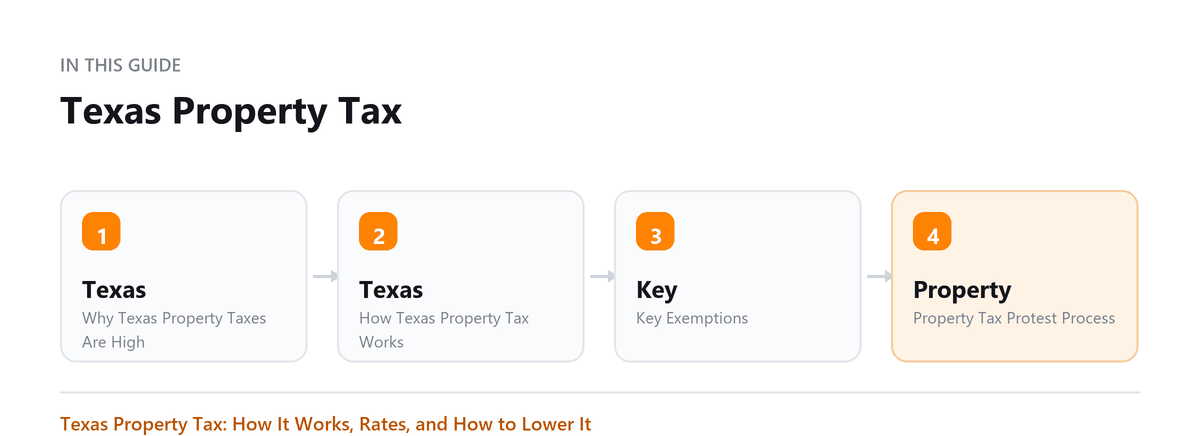
Key Exemptions
Homestead Exemption
If the property is your primary residence, you qualify for the homestead exemption:
- School district homestead exemption: $100,000 reduction in appraised value (SB 2, 2023).
- County optional exemption: up to 20% of appraised value (county must adopt this, not all do).
- City/special district optional exemption: varies by jurisdiction.
Over-65 and Disabled Person Exemption
- Additional $10,000 exemption on the school district portion (on top of homestead exemption).
- Tax Freeze (Ceiling): once you turn 65 or qualify as disabled, the school district property tax amount is frozen, it cannot increase even if appraised value rises.
- The freeze transfers to a surviving spouse who is 55+ years old.
- Optional county/city exemption (at least $3,000 reduction, if adopted by the entity).
Veterans and Disabled Veterans
- 100% disabled veteran: complete exemption from all property taxes.
- Partial disability ratings: percentage exemption (10-90%) on a portion of the assessed value.
- Surviving spouses of veterans killed in action: full exemption.
Property Tax Protest Process
Every Texas property owner has the right to protest their appraised value. The process:
- Receive the Notice of Appraised Value (typically April-May).
- File a protest with the CAD by May 15 or within 30 days of the notice date, whichever is later.
- First step: Informal hearing with an appraiser, you can often settle without going to the board.
- If not resolved: Formal hearing before the Appraisal Review Board (ARB), a panel of citizens.
- If still not resolved: Appeal to district court or binding arbitration (for residential under $5M in value) or State Office of Administrative Hearings (SOAH) for commercial.
Pro Tip: Come to your protest with evidence: recent comparable sales in your neighborhood (pull from Zillow, Realtor.com, or the CAD's own data), photos of condition issues, independent appraisal if warranted. The burden is on you to show the CAD's value is wrong.
How the ARB Works
The Appraisal Review Board is an independent panel, not CAD employees, that hears protests. Key facts:
- ARB hearings are informal but follow structured procedures.
- The CAD presents its value evidence first; you then present your evidence.
- You can have an agent (property tax consultant) represent you, many work on contingency.
- ARB decisions can be appealed to district court within 60 days.
Payment Deadlines and Discounts
| Payment Date | Result |
|---|---|
| November 30 (if paid by) | 2% discount in most jurisdictions |
| December 31 (if paid by) | No discount, no penalty |
| January 31 (final deadline) | Last day to pay without penalty |
| February 1 and later | 7% penalty + 1% per month interest; delinquent |
| July 1 and later | Additional 15-20% attorney fees added (lawsuit filed) |
Installment Payment Option
Property owners with a homestead exemption can pay in four installments: January 31 (25%), March 31 (25%), May 31 (25%), and July 31 (25%). Each installment must be on time, missing one triggers penalties.
Commercial and Business Property
Business personal property (equipment, furniture, inventory) is also taxed in Texas. Business owners must file a Rendition (Form 22.15) by April 15 with the CAD listing all business personal property. Failure to render results in a 10% penalty added to the assessed value.
How to Lower Your Texas Property Tax Bill
- Claim all exemptions you qualify for (homestead, over-65, veteran), file with the CAD, not the tax office.
- Protest your appraised value every year, even successful CADs sometimes over-appraise.
- Hire a property tax consultant for commercial or high-value residential properties (many work on contingency, no savings, no fee).
- Check for errors in the CAD's property records (wrong square footage, bedroom count, improvements not yet built).
- Monitor comparable sales in your area, the strongest protest argument is lower comparable sales prices.
Book a free consultation and we will take the return off your desk.
Frequently Asked Questions
Can Texas take my home if I do not pay property taxes?
Yes. Unpaid property taxes become a lien on the property. After sufficient delinquency (typically 2+ years), the taxing authority can initiate a tax sale to recover the debt. However, homestead properties receive additional protections and the process typically takes longer.
What happens to my property taxes when I turn 65?
You should immediately file for the over-65 exemption with your CAD. This provides an additional exemption AND freezes your school district tax. You do not automatically receive the exemption, you must apply.
Is property tax deductible on my federal return?
Yes, up to $10,000 total for all state and local taxes (SALT cap, property tax + income tax combined) if you itemize deductions on Schedule A. Since Texas has no income tax, Texans can apply the full $10,000 SALT cap to property tax.
What should be gathered before challenging an assessment?
Evidence about the property itself and about comparable ones: recent sale prices nearby, the assessed values of similar properties, photographs and estimates for any condition issues, and any error in the recorded characteristics such as square footage or the number of rooms. A challenge based on the amount being too high rarely succeeds; one based on specific evidence about value or about a factual error frequently does.
Who deals with this when a property is owned through an entity?
Whoever the entity nominates, and the notices go to the address on record, which is a common reason deadlines are missed. Where properties are held across several entities, keep one calendar of assessment notices and challenge deadlines by property rather than relying on post arriving at different addresses. The deadlines here are short and generally strict.

Written by
Anu Gupta, CA, EA, B.Tech
Anu works with US businesses on tax and entity questions at Profitjets, from choosing a structure to the filings that follow it. She writes about the decisions owners make once and then live with for years. Connect on LinkedIn
Free consultation
Want the Filing Handled?
Book a free consultation and we will take the return off your desk.