
The LLC that is Limited Liability Companies is the most widespread in the US, usually the simplest to establish for a small business, offers the best protection, is subject to taxation only at the entity level, and is less formal than a corporation.
The most common misconception about LLCs is that they provide absolute liability protection. In reality, an LLC shields the owner’s assets in proportion to their separation from the business. Thus, misusing the same bank account for personal and business expenses entirely negates the benefits of an LLC as the assets are no longer separate.
Another frequent misunderstanding relates to taxation. An LLC typically has a straightforward taxation process, but there is an option to change the structure to S-Corp for more considerable benefits. The choice depends on the expected profit: the higher the income, the more advantageous it is to elect S-Corp. However, many overlook this possibility and remain unaware of the details of taxation.
The question of how much it costs to create an LLC is also frequent. In addition to taxes, an LLC requires payment of formation fees. Moreover, an LLC owner must perform a series of organizational tasks after registration. The current article dissects the details of an LLC, from the definition to the costs and subsequent steps.
What Is an LLC?
An LLC is a legally separate business entity created under state law. The key features that make it popular:
- Limited liability: members (owners) are generally not personally liable for the LLC's debts or legal judgments, personal assets are protected as long as the corporate veil is maintained
- Pass-through taxation: by default, LLC income flows through to members' personal tax returns, no entity-level federal income tax (unlike a C-Corp)
- Flexible ownership and management: no board meetings, no stock certificates, no annual meeting requirements, governed by an operating agreement that can be customised
- Unlimited members: one person can own an LLC (single-member LLC) or multiple people can (multi-member LLC); there is no cap on membership
The misconception is that liability protection is a property of the entity. It's a property of how you run it. An LLC won't shield you from your own negligence, from anything you've personally guaranteed, or from unpaid payroll taxes and it won't shield you at all if your business and personal money live in the same account, because at that point a court has every reason to say there was never a separate business to protect.
Anu Gupta, CA, EA, B.Tech · LinkedInAdvantages of Forming an LLC
- Liability protection: separates personal and business assets, essential if the business faces lawsuits, product liability claims, or unpaid debts
- Pass-through taxation: avoids the double taxation that C-Corporations face (corporate tax + shareholder dividend tax)
- Tax election flexibility: LLCs can elect to be taxed as sole proprietors, partnerships, S-Corps, or C-Corps at the federal level, significant planning opportunity
- Simple formation: most states allow online formation in under 24 hours for $50-$500
- Professional credibility: a registered LLC adds credibility with suppliers, banks, and customers
- Privacy: in most states, member names are not in public state records
Disadvantages of an LLC
- Self-employment tax: single-member LLC owners pay self-employment tax (15.3% on net earnings up to the SS wage base) on all business profit, not just salary. This is corrected with an S-Corp election once profitable enough
- Not ideal for venture capital: VCs prefer Delaware C-Corps for preferred stock, liquidation preferences, and anti-dilution provisions, if you plan to raise institutional capital, an LLC may need to be converted
- State-by-state variation: LLC laws differ significantly by state, what is permitted in Wyoming may not apply in California
- Annual fees: most states charge annual report fees or franchise taxes, ongoing even when the LLC has little or no revenue
How to Start an LLC
- Step 1: Choose your state, your home state for simplicity; Delaware or Wyoming for privacy/asset protection; your operating state if you have physical presence
- Step 2: Choose a name, must be unique in your state and should not infringe on existing trademarks
- Step 3: File Articles of Organisation, submit to the Secretary of State with the filing fee ($50-$500)
- Step 4: Appoint a registered agent, a person or service with a physical address in the state, available during business hours to receive legal documents
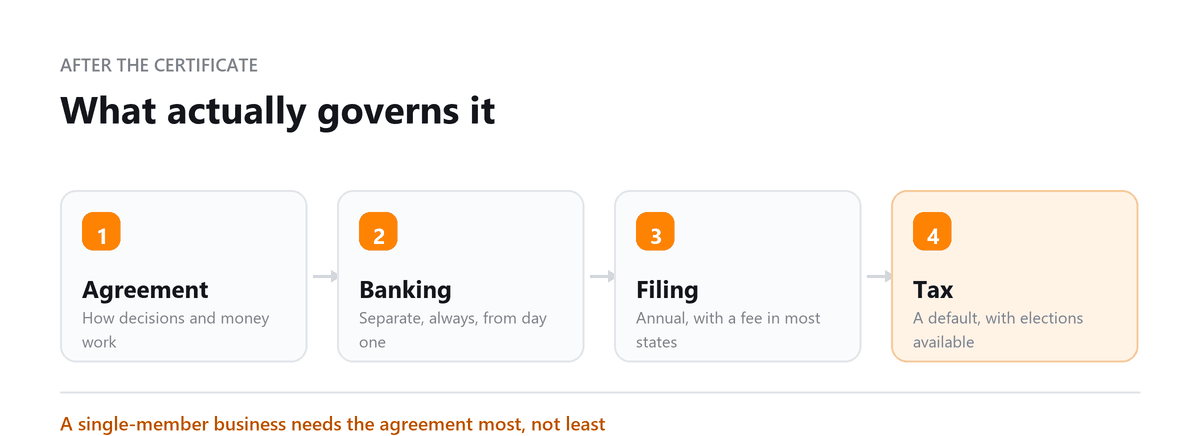
- Step 5: Draft an Operating Agreement, documents ownership percentages, management structure, profit distribution, and what happens if a member leaves. Not always legally required but always advisable
- Step 6: Get an EIN, Employer Identification Number from the IRS, required to open a business bank account and hire employees. Free and instant at irs.gov
- Step 7: Open a business bank account, essential for maintaining the corporate veil; mixing personal and business funds is the most common reason courts pierce LLC liability protection
Tax Considerations for LLCs
| LLC Type | Default Tax Treatment | Best For |
|---|---|---|
| Single-member LLC | Sole proprietor (Schedule C), self-employment tax on all net profit | Solo founders, freelancers, low-to-medium revenue businesses |
| Multi-member LLC | Partnership (Form 1065), each member pays tax on their share | Two or more owners with pass-through income needs |
| LLC taxed as S-Corp | Owner pays payroll tax on 'reasonable salary'; distributions not subject to self-employment tax | Profitable LLCs where SE tax savings justify S-Corp compliance costs |
| LLC taxed as C-Corp | Entity pays 21% corporate tax; distributions taxed again as dividends | Rare, typically for LLCs that will raise VC or need retained earnings at corporate rate |
Maintaining Compliance for Your LLC
- File annual reports with your state Secretary of State (due dates vary by state)
- Pay annual franchise tax or report fee
- Keep operating agreement current, update when members join, leave, or change ownership percentages
- Maintain a separate business bank account and credit card, never mix personal and business funds
- Keep basic business records, meeting notes (even for single-member LLCs), bank statements, tax filings
Book a free consultation and we will set it up to run properly.
Frequently Asked Questions
How is an LLC different from a sole proprietorship?
A sole proprietorship has no legal separation between you and the business, so debts and judgments reach your personal assets directly. An LLC creates that separation, along with a registered name, an EIN and a state filing. The practical difference only holds if you maintain the separation in how you operate an LLC run out of a personal account provides considerably less protection than its owner assumes.
Can one person own an LLC?
Yes. A single-member LLC gets the same liability treatment as a multi-member one and is taxed as a sole proprietorship by default. Write an operating agreement anyway, it's part of demonstrating the entity is genuinely separate, and it matters if you ever bring in a partner.
Do I need an operating agreement?
Not legally required in every state, but always advisable and close to essential with co-owners. Without one, your state's default rules decide what happens when someone wants out, when members disagree, or when one dies, and those defaults rarely match what anyone intended. The time to write it is before there's a disagreement.
When should I elect S-Corp status?
Once profit is high enough that the self-employment tax saving on distributions exceeds the added payroll and filing costs, which is usually well into six figures rather than at the $40,000 figure often quoted. It also requires paying yourself a defensible salary and being eligible, non-resident owners generally aren't. Model it with an accountant using your actual numbers.
Does an LLC protect me from everything?
No. It doesn't cover your own negligent or wrongful acts, anything you've personally guaranteed, or unpaid payroll taxes, which the IRS can pursue against responsible individuals personally. And it protects nothing if you haven't maintained the separation. Insurance and an LLC do different jobs and most businesses need both.

Written by
Anu Gupta, CA, EA, B.Tech
Anu works with US businesses on tax and entity questions at Profitjets, from choosing a structure to the filings that follow it. She writes about the decisions owners make once and then live with for years. Connect on LinkedIn
Free consultation
Forming an LLC?
Book a free consultation and we will set it up to run properly.