
The first tax season after leaving a salaried job surprises a lot of people. They set aside enough for income tax, file their return, and discover a second tax on the same profit, often adding thousands of dollars to the bill. That second tax is self-employment tax, and for many freelancers and small business owners it's larger than their federal income tax.
It exists because Social Security and Medicare still have to be funded when there's no employer. An employee pays 7.65 percent of wages through payroll, and the employer quietly pays another 7.65 percent. When you work for yourself, you're both the employee and the employer, so you pay both halves: 15.3 percent on most of your net earnings.
Unlike income tax, self-employment tax starts from almost the first dollar of profit and isn't reduced by the standard deduction, itemized deductions, or most retirement contributions. That's why the strategies that work for income tax don't always help here
. Understanding what actually changes the number, and what doesn't, is the difference between planning for it and being caught off guard.
Expert Perspective
For sole proprietors and single-member LLC owners, the strategy that makes the biggest dent in self-employment tax is claiming every legitimate business expense, because that's what lowers the profit the tax is calculated on.
Retirement contributions and health insurance premiums help your income tax, but they don't touch self-employment tax. Once profit is consistently in the low six figures, an S corporation election becomes worth modeling. Below that, the payroll and compliance costs usually eat most of the savings.
Ankit Sarawagi, CPA, CA, MBA · LinkedInThis guide explains what self-employment tax is, who has to pay it, how it's calculated, how the self-employment tax deduction works, how it applies to LLCs and partnerships, and the legitimate ways to reduce it.
What Is Self-Employment Tax?
Self-employment tax consists of:
- Social Security tax: 12.4% on net self-employment income up to $176,100 (TY2025 wage base)
- Medicare tax: 2.9% on all net self-employment income (no cap)
- Total SE tax rate: 15.3% on income up to the Social Security wage base
- Above $176,100: only the 2.9% Medicare portion applies
If net SE income exceeds $200,000 (single) or $250,000 (MFJ), an additional 0.9% Medicare surtax applies.
Who Has to Pay Self-Employment Tax?
You generally owe self-employment tax if your net earnings from self-employment are $400 or more for the year. That includes:
Sole proprietors and single-member LLC owners, taxed as sole proprietorships by default.
Independent contractors and freelancers, including anyone receiving Form 1099-NEC for their work.
General partners, on their share of partnership business income and any guaranteed payments.
Gig workers and side hustlers, such as rideshare drivers, delivery workers, consultants, and online sellers running a business.
The $400 threshold applies to your self-employment earnings, not your total income. A W-2 employee with a small side business still owes self-employment tax once that business produces $400 or more in net earnings.
Income That Generally Isn't Subject to Self-Employment Tax
Several kinds of income usually fall outside self-employment tax, even for business owners:
Wages from a job, which have FICA withheld instead.
Most rental income from real estate, unless you provide substantial services to tenants, as a hotel or short-term rental operator offering hotel-like services might.
Investment income, such as interest, dividends, and capital gains.
S corporation distributions, although the salary paid to an owner-employee is subject to payroll taxes.
A limited partner's share of partnership income, other than guaranteed payments for services.
How to Calculate Self-Employment Tax
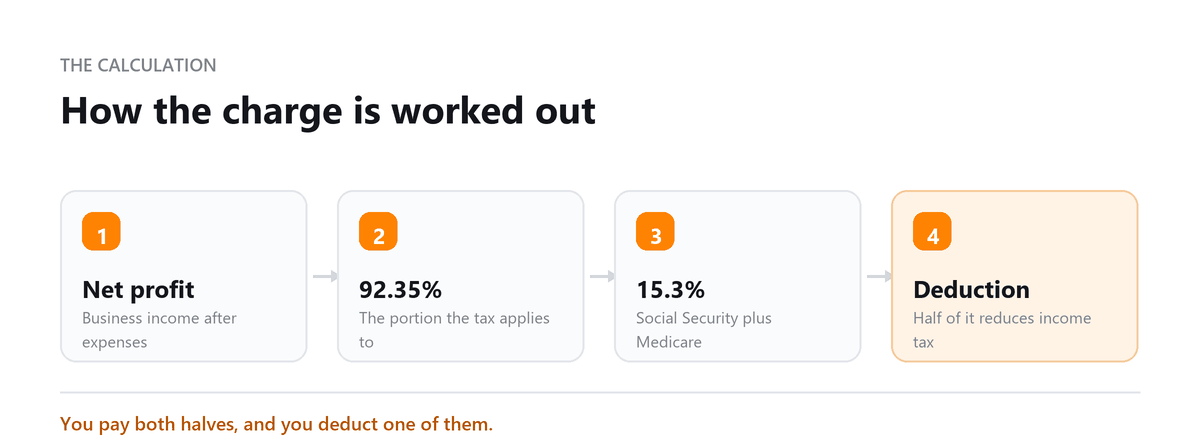
Step 1: Find Your Net Profit
Start with your business revenue and subtract ordinary and necessary business expenses. For sole proprietors, this is the net profit on Schedule C. You pay self-employment tax on profit, not on gross revenue.
Step 2: Multiply by 92.35 Percent
Multiply your net profit by 92.35 percent to get your net earnings from self-employment.
This adjustment exists because employees don't pay FICA on the employer's share of payroll tax. Reducing your profit by 7.65 percent, the employer's half, puts self-employed people on similar footing.
Step 3: Apply the Tax Rates
Apply 12.4 percent to net earnings up to the Social Security wage base, and 2.9 percent to all net earnings.
Example 1: $50,000 of Net Profit
| Step | Calculation | Amount |
|---|---|---|
| Net profit | $50,000 | |
| Net earnings from self-employment | $50,000 × 92.35% | $46,175 |
| Social Security tax | $46,175 × 12.4% | $5,725.70 |
| Medicare tax | $46,175 × 2.9% | $1,339.08 |
| Total self-employment tax | $7,064.78 |
Applying 15.3 percent directly to $50,000 would give $7,650, which overstates the tax by about $585.
Example 2: $250,000 of Net Profit, Single Filer, 2026
| Step | Calculation | Amount |
|---|---|---|
| Net earnings from self-employment | $250,000 × 92.35% | $230,875 |
| Social Security tax, capped at the wage base | $184,500 × 12.4% | $22,878.00 |
| Medicare tax, no cap | $230,875 × 2.9% | $6,695.38 |
| Self-employment tax | $29,573.38 | |
| Additional Medicare tax, reported separately | ($230,875 − $200,000) × 0.9% | $277.88 |
If You Also Have a W-2 Job
The Social Security wage base covers your wages and self-employment earnings together. If you earned W-2 wages during the year, those wages use up part of the wage base first, and Schedule SE reduces the Social Security portion on your self-employment earnings accordingly. You won't pay the 12.4 percent twice on the same dollars above the cap.
The Self-Employment Tax Deduction
You can deduct half of your self-employment tax as an adjustment to income on Schedule 1 of Form 1040. It reduces your adjusted gross income, and you don't need to itemize to claim it.
Using the $50,000 example, half of $7,064.78 is a $3,532.39 deduction.
Two points are worth being clear on. The deduction reduces your income tax, not your self-employment tax. And the additional 0.9 percent Medicare tax isn't included in the deduction.
Self-Employment Tax for LLCs and Partnerships
How an LLC's income is treated depends on how it's taxed.
| LLC Tax Treatment | How Self-Employment Tax Applies |
|---|---|
| Single-member LLC, default treatment | Taxed like a sole proprietorship, so all net profit is generally subject to self-employment tax |
| Multi-member LLC, default treatment | Taxed as a partnership, with members who actively participate generally owing self-employment tax on their share of business income and guaranteed payments |
| LLC electing S corporation treatment | Owners who work in the business receive a reasonable salary subject to payroll taxes, and remaining profit can be distributed without self-employment tax |
| LLC electing C corporation treatment | Owners who work in the business are paid wages subject to payroll taxes, and the corporation pays its own income tax |
The rules for multi-member LLC members who are more like passive investors aren't fully settled, so it's worth reviewing each member's role with a CPA.
How to Reduce Self-Employment Tax Legitimately
Claim All Your Business Expenses
Because self-employment tax is based on net profit, every legitimate business deduction on Schedule C lowers it. That includes home office costs, business vehicle use, equipment, software, supplies, and professional fees. For someone below the wage base, each $1,000 of deductible business expense saves about $141 in self-employment tax, on top of the income tax savings.
Consider an S Corporation Election When Profit Supports It
An S corporation lets you split business income between a reasonable salary, which is subject to payroll taxes, and distributions, which aren't.
Here's the effect for a business owner with $120,000 of net profit who pays herself a $60,000 salary:
| Sole Proprietor | S Corporation | |
|---|---|---|
| Earnings subject to Social Security and Medicare | $110,820 | $60,000 salary |
| Self-employment or payroll tax | About $16,955 | About $9,180 |
| Difference before added costs | About $7,775 |
That difference is reduced by the costs of running an S corporation, commonly $2,000 to $4,000 a year or more for payroll, a separate return, and added bookkeeping, and sometimes state fees. It can also reduce your qualified business income deduction. The salary must be reasonable for the work you do, and setting it too low is a common IRS audit issue.
As a general guide, the election is worth modeling once net profit consistently reaches the low six figures.
Hire Your Children in a Sole Proprietorship
A sole proprietor who employs their child under 18 doesn't owe Social Security or Medicare tax on the child's wages, as long as the work is real and the pay is reasonable. The same exemption applies to partnerships owned only by the child's parents, but not to corporations.
Know What Doesn't Reduce It
Some common tax strategies lower income tax but have no effect on self-employment tax for sole proprietors and partners:
Your own SEP-IRA or Solo 401(k) contributions, which are deducted on Form 1040, not against business profit.
The self-employed health insurance deduction, which is also an adjustment to income rather than a business expense.
The standard deduction and itemized deductions.
The qualified business income deduction.
These are still worth using for income tax, but they won't lower the self-employment tax figure on Schedule SE.
Paying Self-Employment Tax During the Year
Because no tax is withheld from self-employment income, most self-employed people need to make quarterly estimated tax payments that cover both income tax and self-employment tax. For the 2026 tax year, payments are due April 15, June 15, and September 15, 2026, and January 15, 2027.
You'll generally avoid an underpayment penalty if your payments cover at least 90 percent of your current-year tax, or 100 percent of last year's tax, rising to 110 percent if your prior-year adjusted gross income was above $150,000. Self-employment tax counts toward both figures.
If you also have a W-2 job, increasing withholding on that job through a new Form W-4 is another way to cover the tax, and withholding is treated as paid evenly throughout the year.
Common Self-Employment Tax Mistakes
| Mistake | What Happens | How to Avoid It |
|---|---|---|
| Setting aside money only for income tax | A large, unexpected balance due at filing | Budget for self-employment tax on top of income tax |
| Skipping estimated payments | Underpayment penalties, even if you pay in full when you file | Make quarterly payments or increase W-2 withholding |
| Applying 15.3% to full profit | Overestimating the tax and overpaying estimates | Multiply profit by 92.35% first |
| Forgetting the deduction for half the tax | Paying more income tax than necessary | Claim it on Schedule 1 |
| Assuming retirement contributions cut self-employment tax | Underestimating what you'll owe | Plan for self-employment tax separately |
| Electing S corporation status too early | Payroll and compliance costs outweigh the savings | Model the numbers with a CPA before electing |
Conclusion
Self-employment tax is the Social Security and Medicare contribution employees and employers normally share, paid entirely by you when you work for yourself. It's calculated on 92.35 percent of net profit, applies from $400 of earnings, and often exceeds income tax for small business owners. The deduction for half of it helps with income tax, but the most direct ways to lower self-employment tax itself are claiming every legitimate business expense and, once profit is high enough, considering an S corporation election.
Plan for it in your quarterly estimates, and it becomes a predictable cost instead of a surprise.
Book a free consultation and we will set the quarterly payments up.
Frequently Asked Questions
What is the self-employment tax rate for 2026?
The rate is 15.3 percent, made up of 12.4 percent for Social Security and 2.9 percent for Medicare. Social Security applies to net earnings up to the $184,500 wage base, and Medicare applies to all net earnings. An additional 0.9 percent Medicare tax applies to earnings above $200,000 for single filers or $250,000 for married couples filing jointly.
Do I pay self-employment tax on all my business income?
No. It's based on net profit, meaning revenue minus business expenses, and then only on 92.35 percent of that profit. Some types of income, such as most rental income, interest, dividends, and capital gains, generally aren't subject to it at all.
How can I reduce my self-employment tax?
The most direct ways are claiming every legitimate business expense, which lowers the profit the tax is based on, and electing S corporation status once your profit is high enough for the payroll tax savings to outweigh the added costs. Your own retirement contributions and health insurance premiums reduce income tax but not self-employment tax.
Do I owe self-employment tax if my business lost money?
No. If your net earnings from self-employment are less than $400, you generally don't owe self-employment tax for that year. A loss from one self-employment activity can also offset profit from another when calculating your total net earnings.
Does paying self-employment tax increase my Social Security benefits?
Yes. The earnings you pay self-employment tax on are credited to your Social Security record, which counts toward eligibility and the size of your future benefits. That's one reason to weigh the long-term effect when considering strategies that reduce taxable earnings, such as a very low S corporation salary.

Written by
Ankit Sarawagi, CPA, CA, MBA
Ankit leads the finance team at Profitjets, where he has worked with 500+ businesses across the US on bookkeeping, tax and CFO-level strategy. He writes about the habits that keep small business books accurate all year. Connect on LinkedIn
Free consultation
Self-Employed and Unsure?
Book a free consultation and we will set the quarterly payments up.