
The variable costs are the costs, which change depending on the level of production or sales volume. In other words, when the company produces more goods, the expenses associated with it increase, and when it decreases, the expenses are reduced too. Therefore, it is a cost that depends linearly on the number of products that are produced.
Examples, in this case, are raw materials, packaging, processing payment, shipping, and others. Thus, it is explained that variable costs are associated only with production or sales. However, calculating them correctly is essential for the company to maintain profitability. In fact, even if it is not explicit, all pricing decisions and break-even calculations are based on variable costs.
The most common mistake that companies make regarding variable costs is that they consider them as constant and do not monitor them. However, even the amount of variable costs per unit can change significantly due to various reasons.
One reason is the increase or decrease in tariffs. It is of utmost importance for the company to track changes in its variable costs per unit frequently and update the pricing strategy according to it. Otherwise, the company will begin to lose profits slowly and painfully without realizing it.
On the other hand, with analysis and timely changes to the prices, the company will be able to maintain an adequate level of profits.
What Is a Variable Cost?
A variable cost is directly tied to the level of activity: production volume, sales volume, or number of transactions. The key characteristic: if the business stops selling, variable costs stop accruing (unlike fixed costs like rent and salaries).
The variable cost owners consistently underestimate payment processing as they price around a 2.9% number they saw once and forget that chargebacks, currency conversion, and subscription retries push the real number meaningfully higher. On a thin-margin product, that gap alone can turn a profitable SKU into a break-even one.
Abhinav Gupta, CPA, CA, MBA · LinkedInVariable vs Fixed Costs: Quick Comparison
| Variable Costs | Fixed Costs | |
|---|---|---|
| Change with volume? | Yes, proportional to output | No, same regardless of output |
| Examples | Raw materials, delivery, packaging, payment processing | Rent, insurance, base salaries, loan repayments |
| Impact on break-even | Higher variable costs → higher break-even point | Higher fixed costs → higher break-even point |
| Scaling behaviour | Scale linearly (or can be reduced through bulk buying) | Leverage effect, once covered, more revenue goes to profit |
Examples of Variable Costs
| Business Type | Variable Cost Examples |
|---|---|
| E-commerce / Product seller | Cost of goods, outbound shipping, payment gateway fees (typically 1.5 to 3.5% per transaction), packaging materials |
| Restaurant | Food and beverage ingredients (typically 28 to 35% of revenue), disposable packaging, delivery platform fees |
| SaaS / Software | Cloud hosting per active user (AWS/GCP/Azure), payment processing per transaction, third-party API costs per call |
| Consulting / Professional Services | Billable staff hours, project-specific travel, freelancer/subcontractor fees |
| Manufacturing | Raw materials, direct labour (if hourly/piece-rate), energy consumption per unit, quality control per batch |
| Subscription box | Product cost per box, fulfilment cost per shipment, inserts and packaging per unit |
How to Calculate Variable Cost
Total Variable Cost = Variable Cost Per Unit × Number of Units Produced/Sold
Variable Cost Per Unit = Total Variable Costs / Total Units
Example from live page: 500 subscription boxes at $7 variable cost per box:
| Item | Value |
|---|---|
| Units produced | 500 boxes |
| Variable cost per unit | $7.00 (product cost + packaging + fulfilment) |
| Total Variable Cost | $3,500 |
Break-Even Analysis Using Variable Costs
Break-Even Point (units) = Fixed Costs / (Selling Price per Unit − Variable Cost per Unit)
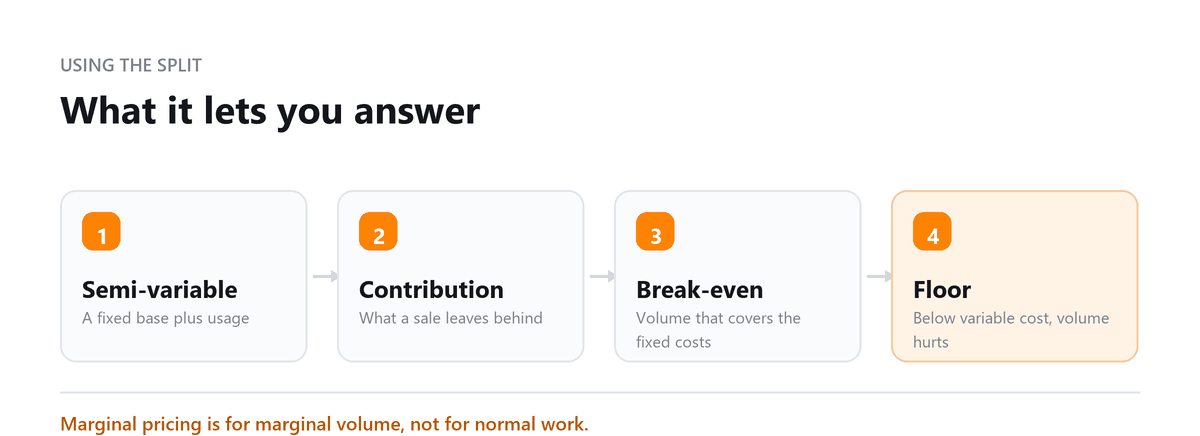
The denominator is the contribution margin per unit, how much each unit contributes to covering fixed costs and generating profit.
Example: Fixed costs $5,000/month; selling price $25/box; variable cost $7/box:
| Item | Value |
|---|---|
| Selling price per unit | $25.00 |
| Variable cost per unit | $7.00 |
| Contribution margin per unit | $18.00 |
| Fixed costs per month | $5,000 |
| Break-even point (units) | $5,000 / $18.00 = 278 boxes/month |
At 278 boxes, the business exactly covers all costs. Every box sold above 278 generates $18 of profit.
Variable Cost Strategy Tips for 2026
- Negotiate bulk purchasing discounts, as volume grows, renegotiate supplier contracts for volume pricing; even 5 to 10% reduction in COGS materially improves margins
- Track variable cost per unit every month, rising raw material costs or shipping rate increases often creep in unnoticed; catch them before they compress margins
- Review payment processing fees, switching from a flat-rate processor to interchange-plus pricing can reduce fees by 0.5 to 1.0% for high-volume businesses
- Model cost behaviour before scaling, if variable costs don't scale linearly (e.g., labour efficiency gains or volume discounts kick in), model the inflection points
- Separate true variable costs from semi-variable costs, some costs (like a manager's salary that scales with team size) are semi-variable; model them separately for accurate break-even analysis
CLIENT QUOTE:
Our shipping costs had been creeping up for months, but because sales were growing, we didn't notice how much they were affecting our margins. Profitjets broke down our variable costs and found that higher carrier rates were cutting our contribution margin by nearly 4 percentage points, so we renegotiated rates and adjusted our shipping strategy, bringing the margin back up.
Book a free consultation and we will work it out with you.
Frequently Asked Questions
Are employee salaries variable or fixed?
Depends on the pay structure. Fixed base salaries for permanent staff are fixed costs, they continue whether or not production happens. Hourly wages for production or temporary workers, piece-rate pay, and commissions are variables they move directly with output or sales.
Can variable costs be reduced without cutting production?
Yes. supplier renegotiation, reducing waste per unit, switching to cheaper equivalent inputs, or redesigning the product to use less or cheaper material. Reducing variable costs is one of the most direct levers for improving gross margin without touching volume at all.
Do variable costs ever go to zero?
In theory, at zero output but in practice, a few variable-feeling costs (minimum platform fees, a base cloud hosting tier) have a small fixed floor underneath them. True variable costs scale down close to zero; a handful of "mostly variable" costs don't quite get there.
How do variable costs affect pricing decisions?
Directly, your price has to clear the variable cost per unit before any dollar goes toward fixed costs or profit. Pricing below variable cost means losing money on every unit sold, regardless of volume; it's the first number to check before setting or discounting a price.
Should I recalculate variable costs every time I change a supplier?
Yes. a supplier switch is exactly the kind of event that changes your true variable cost per unit, and pricing or margin assumptions built on the old number will be wrong until you update it. Treat any input cost change as a trigger to recheck the whole calculation, not just the line item that changed.

Written by
Abhinav Gupta, CPA, CA, MBA
Abhinav works with business owners across the US on industry-specific bookkeeping, from dental practices and restaurants to construction and e-commerce. He writes about what each trade's books actually need. Connect on LinkedIn
Free consultation
Not Sure Where Break-Even Is?
Book a free consultation and we will work it out with you.