
Balance sheets are a thing for all businesses, even if no one looks at them. Accounting software can produce one automatically. The problem is, producing one and producing an accurate one are different things. The software will produce a balance sheet from unreconciled bank accounts, loans that are expensed, and equipment that was sold two years ago, and it will balance.
That's why so many owners distrust their balance sheet, or just avoid it. The report looks official, but the numbers don't match the bank statement, the loan balance is wrong, nobody knows what the opening balance equity is, and when a lender asks for it, the business doesn't have it ready.
A balance sheet shows what a business owns, what it owes, and what it has for the owners on a certain date. A balance sheet provides a snapshot of your company's financial position at a specific moment in time: what you own (assets), what you owe (liabilities), and what's left over for the owners (equity). The fundamental equation underpinning every balance sheet: Assets = Liabilities + Equity.
This guide covers what goes on one, how to prepare one accurately each month, what lenders are looking for, and the mistakes that make one inaccurate.
What Is a Balance Sheet?
Unlike the income statement (which covers a period) or the cash flow statement (which tracks movement of cash), the balance sheet is a point-in-time document. It is prepared as of a specific date, December 31, March 31, or the end of any financial period. The balance sheet answers: 'If we stopped trading today, what would the numbers look like?'
The one balance sheet check I'd ask every owner to do quarterly is compare the cash, loan, and credit card balances to the actual bank and lender statements. It takes ten minutes and tells you whether the rest of the balance sheet can be trusted.
If cash in the books doesn't match the bank, or the loan balance doesn't match the lender's statement, every ratio built on those numbers is wrong. Once those tie out, working capital is the ratio I look at first. It shows whether the business can handle a slow month without scrambling.
Abhinav Gupta, CPA, CA, MBA · LinkedInWhat Goes on a Balance Sheet?
Assets
Everything the business owns or controls that has economic value.
- Current Assets (convertible to cash within 12 months): Cash and bank balances, accounts receivable, inventory, prepaid expenses
- Non-Current Assets (long-term): Property, plant and equipment (PPE), intangible assets (goodwill, patents), long-term investments
Liabilities
Everything the business owes to outside parties.
- Current Liabilities (due within 12 months): Accounts payable, short-term loans, accrued expenses, tax payable, deferred revenue
- Non-Current Liabilities (due beyond 12 months): Long-term bank loans, lease obligations, deferred tax liabilities
Equity
The residual interest, what belongs to the owners after all liabilities are paid. Equity = Paid-in capital + Retained earnings (cumulative net profit minus dividends paid).
Sample Mini Balance Sheet
| Item | Amount ($) |
|---|---|
| ASSETS | |
| Cash & Bank | 45,000 |
| Accounts Receivable | 30,000 |
| Inventory | 20,000 |
| Total Current Assets | 95,000 |
| Equipment (net of depreciation) | 80,000 |
| Total Non-Current Assets | 80,000 |
| TOTAL ASSETS | 175,000 |
| LIABILITIES | |
| Accounts Payable | 18,000 |
| Short-Term Loan | 22,000 |
| Total Current Liabilities | 40,000 |
| Long-Term Loan | 55,000 |
| Total Liabilities | 95,000 |
| EQUITY | |
| Paid-in Capital | 50,000 |
| Retained Earnings | 30,000 |
| Total Equity | 80,000 |
| TOTAL LIABILITIES + EQUITY | 175,000 |
Key Balance Sheet Ratios for Small Businesses
| Ratio | Formula | Healthy Range (general) | What It Tells You |
|---|---|---|---|
| Current Ratio | Current Assets / Current Liabilities | 1.5 to 2.0x | Can you pay short-term debts? Below 1.0 = danger zone |
| Quick Ratio | (Current Assets, Inventory) / Current Liabilities | 1.0x or above | Same as current ratio but strips out inventory (less liquid) |
| Debt-to-Equity Ratio | Total Liabilities / Total Equity | Below 2.0x for most SMEs | How much debt per dollar of equity, higher = more leveraged |
| Working Capital | Current Assets, Current Liabilities | Positive | Day-to-day operational buffer |
Note: 'Healthy range' varies significantly by industry. Retailers may comfortably run higher debt ratios; professional services firms often have lower asset bases. Use industry benchmarks from your sector, not generic targets.
Why Is a Balance Sheet Important for Small Businesses?
- Lenders and investors review it before extending credit or capital, it is the first document requested in any due diligence
- It reveals whether working capital is adequate to fund operations through slow periods
- It tracks whether retained earnings are growing (business building wealth) or shrinking (owner drawings exceeding profits)
- It is required for accurate tax filing, depreciation schedules, loan amortisation, and deferred tax all begin on the balance sheet
How to Create a Balance Sheet for Your Small Business
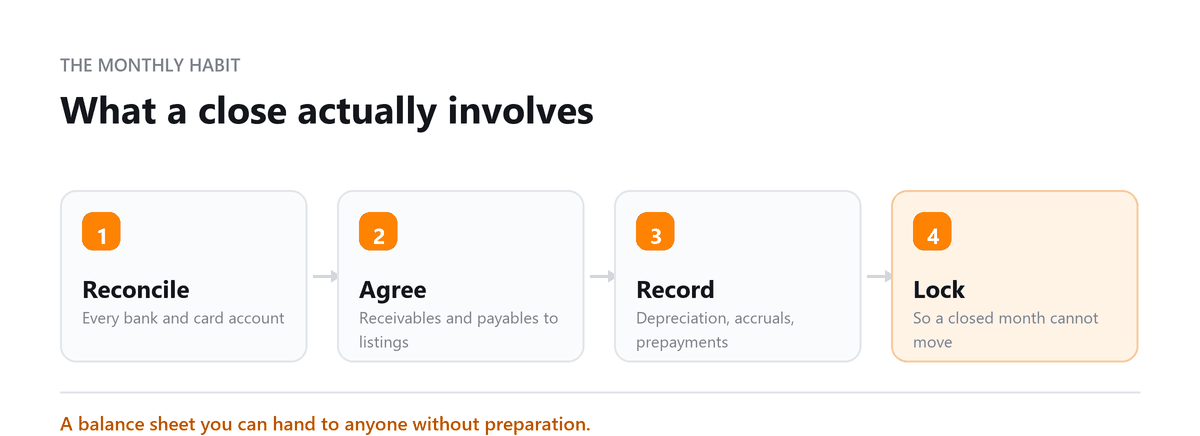
- Reconcile cash. Match every bank account balance in the books to the bank statement as of month-end.
- Reconcile credit cards and loans. Match credit card balances to statements, and loan balances to the lender's statement. Loan payments should be split between principal (reducing the liability) and interest (an expense).
- Review accounts receivable. Check the AR aging report against what customers actually owe, and deal with invoices that won't be collected.
- Review accounts payable. Confirm unpaid bills are real and current, and remove duplicates or bills already paid.
- Record accruals and deferred revenue. Add expenses incurred but not yet billed, such as wages or utilities, and move payments received for work not yet done into deferred revenue.
- Update fixed assets. Record new equipment purchases, depreciation for the month, and any assets sold or disposed of.
- Check payroll and sales tax liabilities. Confirm the balances match what's actually owed to tax agencies.
- Review equity accounts. Make sure owner contributions and draws are recorded correctly, and investigate any unexplained "opening balance equity."
- Compare with last month. Look at every balance that changed significantly and confirm there's a real reason.
What Lenders Look for on a Balance Sheet
A balance sheet that doesn't reconcile to bank and loan statements is one of the quickest ways to slow down or derail a loan application.
- Liquidity: enough current assets to cover short-term obligations.
- Leverage: how much debt the business already carries compared with owners' equity.
- Receivables quality: whether customer balances are current or mostly overdue.
- Existing loans: balances that match lender statements, with no undisclosed debt.
- Equity trend: whether retained earnings are growing, or being drained by losses or owner draws.
- Consistency: balances that line up with the P&L, tax returns, and bank statements.
Common Balance Sheet Mistakes
- Unreconciled accounts. Cash, credit card, or loan balances that don't match statements make the entire balance sheet unreliable.
- Loan payments recorded as expenses. Principal payments reduce the loan balance. Recording the full payment as an expense overstates the liability and understates profit.
- Mixing personal and business assets. Assets the owner holds personally, such as a family car or a home mortgage, don't belong on the business balance sheet. Assets the business actually owns do.
- Missing accruals. Wages, rent, or utilities owed for the month but not yet billed should be recorded as liabilities.
- Ignoring deferred revenue. Customer payments received before the work is done are a liability until the work is delivered.
- Stale fixed assets. Equipment sold or scrapped years ago still sitting on the books, along with its accumulated depreciation.
- Unexplained opening balance equity. Often left behind when accounts were set up incorrectly, it usually needs to be investigated and reclassified.
CLIENT QUOTE:
Our balance sheet looked fine at a glance, but several accounts hadn't been reconciled, one of our loan balances was incorrect, and we weren't seeing the working-capital gap clearly. Profitjets cleaned up the accounts and rebuilt the balance sheet, which showed us how much cash was tied up in working capital. That gave us enough visibility to plan our cash needs properly and avoid a shortfall while we were arranging additional financing.
Book a free consultation and we will get you a monthly one.
FAQs
How often should a small business prepare a balance sheet?
Monthly, as part of closing the books. A monthly balance sheet catches reconciliation errors early, shows working capital trends, and means you're always ready when a lender, investor, or buyer asks for one. At a minimum, prepare an accurate one every quarter and at year-end.
Do small businesses have to file a balance sheet with their tax return?
It depends on the entity. Sole proprietors report business income on Schedule C, which doesn't include a balance sheet. Partnerships and corporations generally report balance sheet information on their returns, though smaller businesses may be exempt below certain thresholds. Even when it isn't required for tax, lenders and buyers will expect one.
What is a healthy current ratio for a small business?
Many small businesses aim for a current ratio comfortably above 1.0, meaning current assets exceed current liabilities, though the right level varies by industry. Below 1.0 signals short-term liquidity risk. A very high ratio can mean cash, inventory, or receivables are sitting idle.
Why doesn't my balance sheet match my bank balance?
Common causes include unreconciled transactions, deposits or payments recorded in the wrong period, duplicate entries, or transactions that were never recorded. Reconciling each account to its statement at month-end finds the difference. The books should match the bank once outstanding checks and deposits in transit are accounted for.
What is "opening balance equity"?
It's an account accounting software creates when balances are entered without a matching entry, for example when a bank account or asset is set up with a starting balance. It should normally be zero once the books are set up correctly. A balance there usually means something needs to be reclassified to retained earnings, owner contributions, or another account.

Written by
Abhinav Gupta, CPA, CA, MBA
Abhinav works with business owners across the US on industry-specific bookkeeping, from dental practices and restaurants to construction and e-commerce. He writes about what each trade's books actually need. Connect on LinkedIn
Free consultation
Only See a Balance Sheet Once a Year?
Book a free consultation and we will get you a monthly one.