
<!doctype html>
Variable costs change in proportion to what your business produces or sells. Understanding them is critical for pricing, break-even analysis, and scaling confidently — whether you run an e-commerce store, a SaaS startup, or a subscription box company.
Key Takeaways
- Variable costs rise and fall with production volume. The more you produce or sell, the higher they go.
- The formula is simple: Variable Cost = Cost Per Unit x Number of Units Produced.
- Variable costs are essential for accurate break-even analysis and profit margin calculations.
- When times get tough, variable costs are easier to scale back than fixed costs, giving you financial agility.
As we move further into 2025, small business owners and startups must sharpen their understanding of cost structures to stay competitive. One of the most fundamental — yet often misunderstood — concepts is variable costs.
In this guide, we break down what variable costs are, how they impact your bottom line, and how to calculate them accurately. Whether you are a freelancer managing project-based expenses or an e-commerce owner handling fluctuating shipping rates, understanding your variable costs is critical for pricing, budgeting, and scaling operations.
What Is a Variable Cost?
A variable cost is an expense that changes in proportion to the level of goods or services a business produces. In simple terms: the more you produce or sell, the higher your variable costs — and vice versa.
Examples of Variable Costs
- Raw materials
- Packaging
- Direct labor (hourly or contract-based)
- Shipping fees
- Transaction fees (e.g., Stripe, PayPal)
- Sales commissions
Variable Costs vs. Fixed Costs
What is the difference between variable and fixed costs? Understanding this helps businesses plan for both short-term performance and long-term financial health.
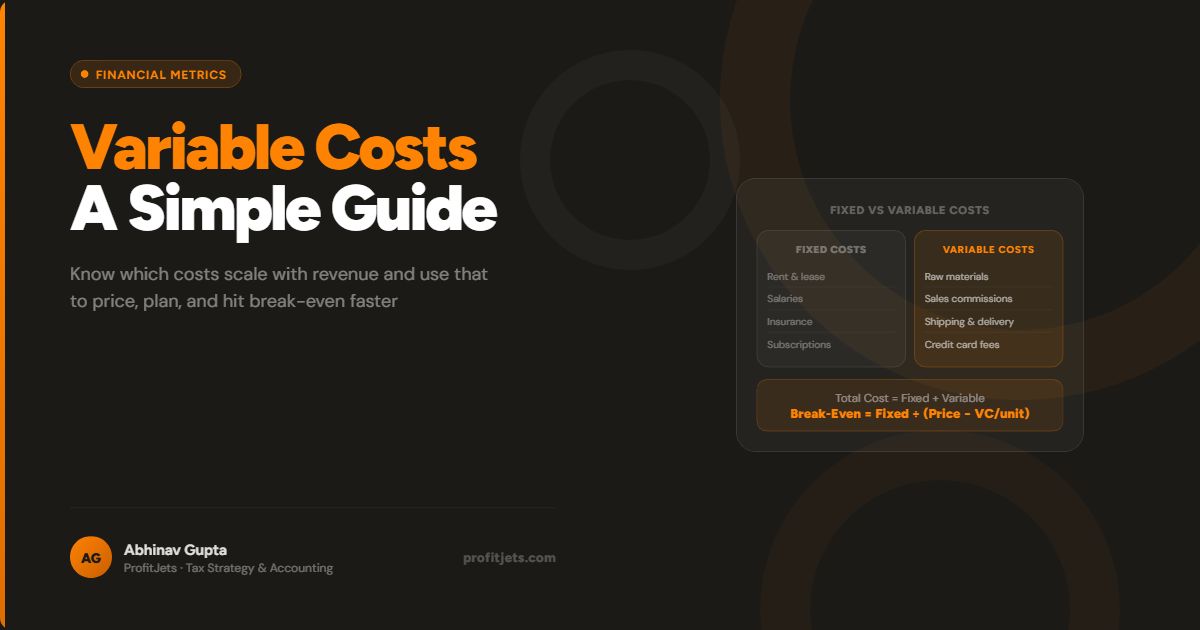
| Aspect | Variable Costs | Fixed Costs |
|---|---|---|
| Definition | Vary with production/sales volume | Remain constant regardless of output |
| Examples | Materials, shipping, labor | Rent, insurance, software subscriptions |
| Flexibility | Scalable up or down | Harder to change in the short term |
| Impact on Pricing | Directly influences unit economics | Indirectly affects long-term strategy |
Why Variable Costs Matter
1. Profitability Insights
Knowing your variable costs allows you to calculate profit margins on each unit sold — essential for smart pricing decisions.
2. Break-Even Analysis
Break-even = Fixed Costs divided by (Price per Unit minus Variable Cost per Unit). Without accurate variable cost data, this critical analysis will be flawed.
3. Cost Control
When times get tough, variable costs are easier to scale back than fixed costs. They offer greater agility in managing cash flow.
4. Budget Forecasting
An accurate forecast relies on anticipating how variable costs will grow or shrink as your business scales.
Break-Even Point = Fixed Costs / (Selling Price per Unit – Variable Cost per Unit). This is the number of units you need to sell before you start making a profit.
How to Calculate Variable Cost
The general formula is:
Variable Cost = Cost Per Unit x Number of Units Produced
Let’s say you run a subscription box business:
- You ship 500 boxes a month
- Each box costs $4 in materials and $3 in labor
- Variable Cost = (4 + 3) x 500 = $3,500
To get deeper insights, consider integrating this data with outsourced bookkeeping services to automate reports and track expenses in real time.
Some costs are semi-variable, like utility bills or cloud storage. Break them into their fixed and variable components to improve the accuracy of your financial models.
How to Find Variable Cost in Your Business
1. Review Your Expense Categories
Use your accounting software or an outsourced accounting firm to pull expense data. Group costs that fluctuate with production or sales.
2. Track Changes Over Time
Compare monthly costs as your output changes. Do your costs increase with sales? These are likely variable costs.
3. Categorize Mixed Costs
Some costs are semi-variable (e.g., utility bills, cloud storage). Break them into fixed and variable components if needed.
4. Use Accounting Tools
Apps like QuickBooks, Xero, or Wave help automate cost tracking and can be managed effectively with outsourced accounting services.
Want help categorizing and tracking your variable costs in real time?
Talk to a Bookkeeping ExpertReal-World Examples of Variable Costs by Business Type
Variable costs look different depending on your business model. Here is a breakdown by common business type.
| Business Type | Common Variable Costs |
|---|---|
| E-commerce | Product costs, shipping, returns, ads |
| SaaS Startup | Product development costs, hosting, support |
| Freelancer / Agency | Subcontractor payments, tools, licenses |
| Manufacturing | Raw materials, labor, energy |
| Subscription Boxes | Printing, packaging, fulfillment |
Variable Cost Strategy Tips for 2025
- Negotiate volume discounts on raw materials or shipping as you scale.
- Automate expense tracking to monitor variable costs monthly.
- Outsource bookkeeping to professionals who can flag anomalies or rising cost trends early.
- Benchmark your variable costs against industry peers to identify inefficiencies.
Utility bills and cloud storage are semi-variable. If you lump them entirely into fixed costs, your break-even analysis and pricing models will be inaccurate. Separate the fixed and variable components each month.
Variable Costs and Outsourced Financial Services
Working with an outsourced accounting firm for startups allows businesses to:
- Get real-time insights on variable cost fluctuations
- Build accurate break-even and margin models
- Forecast cash flow under different growth scenarios
- Maintain investor-ready financials
If you are focused on growth and do not want the hassle of managing cost data manually, consider outsourced bookkeeping services to maintain clean, categorized, and up-to-date records.
Frequently Asked Questions
What is the easiest way to track variable costs for a small business?
Are salaries considered variable costs?
Can I turn a fixed cost into a variable one?
How do variable costs impact pricing?
Do startups need to focus more on variable or fixed costs?
Ready to get clear on your variable costs and build smarter financial models?
Talk to a Profitjets ExpertProfitjets Editorial Team
The Profitjets team helps small businesses and startups build financial clarity through outsourced bookkeeping, accounting, and CFO services tailored to their growth stage.