
Trucking Accounting: Why Owner-Operators and Fleets Outsource Their Books
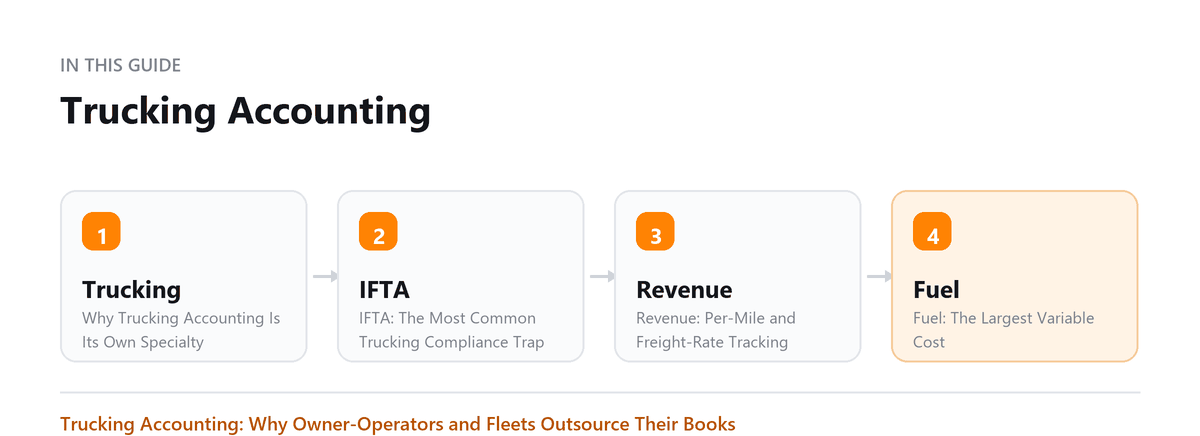
Why Trucking Accounting Is Its Own Specialty, IFTA: The Most Common Trucking Compliance Trap, and Revenue: Per-Mile
Trucking has accounting requirements that exist in almost no other industry, and a general bookkeeper will meet them late or not at all.
The fuel tax reporting is the clearest example. It is entirely a records problem: miles by state and fuel by state, captured as they happen. Reconstructed at the quarter end, it is neither accurate nor quick.
This covers what makes the sector distinct, the fuel tax filing and why it causes trouble, how revenue and fuel costs are tracked, the pay structures in use, the regulatory costs, and how the vehicles are depreciated.
Why Trucking Accounting Is Its Own Specialty
Trucking has accounting requirements found nowhere else: IFTA fuel tax reporting, per-mile revenue, driver pay structures with multiple classifications, and DOT-related compliance costs. A generalist bookkeeper will mishandle these routinely.
Fuel tax reporting across jurisdictions is where most operators get into trouble, and it is entirely a records problem. Miles by state and fuel by state, captured as they happen, and the filing becomes routine.
Abhinav Gupta, CPA, CA, MBA · LinkedInIFTA: The Most Common Trucking Compliance Trap
The International Fuel Tax Agreement (IFTA) requires carriers operating in multiple US states and Canadian provinces to file quarterly fuel tax returns. The calculation:
- Track total miles driven in each jurisdiction
- Track total gallons of fuel purchased in each jurisdiction
- Calculate fleet-wide average MPG
- Determine fuel consumed in each jurisdiction (miles / avg MPG)
- Compare fuel consumed vs. fuel purchased in each jurisdiction
- Pay net tax owed or claim net credit due in each jurisdiction
Missing an IFTA filing triggers penalties and audits. Errors in mileage records can result in assessments covering multiple quarters.
Revenue: Per-Mile and Freight-Rate Tracking
Trucking revenue is typically recognized per load at delivery. Owner-operators and small fleets track:
- Gross freight revenue per load
- Fuel surcharges (often separate from base rate)
- Detention charges (when shippers/receivers delay loading/unloading)
- Accessorial charges (lumper fees, oversize permits)
- Deadhead miles: miles driven empty between loads, a direct cost with no corresponding revenue
Fuel: The Largest Variable Cost
Fuel represents 25-40% of trucking revenue. Tracking fuel purchases by state is required for IFTA. An outsourced accounting team reconciles fuel card statements to IFTA mileage records monthly, a time-consuming process that many owner-operators skip until audit time.
Driver Pay Structures
| Driver Type | Accounting Treatment |
|---|---|
| Employee driver (W-2) | Payroll: withholding, 941 deposits, workers comp, FUTA/SUTA |
| Owner-operator (1099) | AP: 1099-NEC at year-end; no payroll tax obligation |
| Lease-operator | Complex: often a hybrid |
DOT Compliance Costs
- DOT registration and authority maintenance
- Commercial vehicle permit costs (oversize, overweight)
- IFTA and IRP (International Registration Plan) registration
- Drug and alcohol testing program
- Driver qualification file maintenance
Vehicle Depreciation
Trucks and trailers are depreciable assets. A $150,000 semi-truck can be fully expensed in year one under Section 179 or bonus depreciation (subject to limits and phase-outs). The depreciation election significantly impacts taxable income and cash flow planning.
Why Niche Expertise Matters
Trucking accountants who understand IFTA, per-diem deductions for drivers, fuel tax credits, and highway use tax (Form 2290) are not common. Local generalist accountants often miss deductions or misfile IFTA returns. The cost of errors typically exceeds the cost of specialized outsourced accounting.
Connecting the Systems That Hold the Data
Almost nothing a trucking business needs to know originates in its accounting system. Miles come from telematics, fuel from the card provider, loads from dispatch, hours from the logging device, and settlements from whatever pays the drivers. The accounting system is where these meet, and how well they meet decides whether the numbers are useful or merely accurate.
The question to ask a prospective provider is therefore not whether they know the industry but how they will get the data. A provider who expects monthly spreadsheets rekeyed by your staff has moved the work rather than removed it, and every rekeying is an opportunity for a discrepancy between what the systems say and what the accounts say.
Where a direct connection is not available, the fallback worth insisting on is a scheduled export in a fixed format, imported the same way every period. It is less elegant and it is still repeatable, which is the property that matters. What does not work is a different file each month assembled by whoever had time.
- List every system that holds operational data before you go to market, and ask each provider how they would take a feed from it
- Insist that fuel and mileage arrive by jurisdiction from the source rather than being apportioned afterwards
- Reconcile settlements to the accounts every period, since driver pay disputes are expensive in ways that go beyond the amount
- Agree who owns the connections if you change provider, so a move does not mean rebuilding every integration
Book a free consultation and we will put senior eyes on your numbers.
Frequently Asked Questions
What is Form 2290 and who must file it?
Form 2290 is the Heavy Highway Vehicle Use Tax return. Vehicles with a taxable gross weight of 55,000 pounds or more must file. The current tax is $100-$550 per vehicle annually. VERIFY current rate.
Can an outsourced firm handle IFTA and per-diem calculations?
Yes, trucking-specialist accounting firms handle IFTA quarterly filings, per-diem tracking for driver deductions, and fuel tax credit reconciliation as routine services.
How much does outsourced trucking accounting cost?
Typically $300-$800/month for a single owner-operator, $800-$3,000/month for small fleets of 5-20 trucks, depending on transaction volume and IFTA complexity.
What records does this business need that others do not?
The ones that connect a vehicle, a driver and a load to the money. Miles by jurisdiction, fuel purchased by jurisdiction, settlements per driver, maintenance by unit and revenue by load. Most of it originates outside the accounting system in telematics, fuel cards and dispatch software, so the practical question when choosing a provider is whether they can work from those sources rather than asking you to rekey them.
Why is profitability per truck so often unclear?
Because the costs are recorded in pools rather than by unit. Fuel, maintenance, insurance and driver pay all arrive as totals, and unless they are allocated to the vehicle that incurred them, every truck looks like the average. That hides the ones losing money. Allocating by unit is the single change that turns the accounts from a compliance record into something you can run the fleet with.

Written by
Abhinav Gupta, CPA, CA, MBA
Abhinav works with business owners across the US on industry-specific bookkeeping, from dental practices and restaurants to construction and e-commerce. He writes about what each trade's books actually need. Connect on LinkedIn
Free consultation
Want CFO-Level Clarity?
Book a free consultation and we will put senior eyes on your numbers.