
Outsourced Bookkeeping Services: Why It's the Best Decision for Small Businesses
When to outsource, what the service should include, how it compares to in-house, and what it costs in 2026
Opting the right bookkeeping practice is a main task for small business owners. As the practice jot down to two options whether to outsource bookkeeping services or maintain an in-house bookkeeping team to manage their financial workflows. Both of the above mentioned choices operate identical when it comes to financial records. They aren't the same when it comes to expertise, affordability, and operational activities.
Outsourcing bookkeeping services facilitates an entire team of expertise equipped with professionals capable of handling complex situations and provide insights to accelerate business scale. For small business owners, outsourcing provides a better return of investment compared to in-house teams.
You would have wondered how to choose the right bookkeeping service for your business. This guide explains that in detail, comparison and how to decide the best bookkeeping practice according to the volume and objective of your business. For majority of the small business owners, outsourcing bookkeeping services are the affordable option when it comes to quality and expertise.
In-house bookkeeping feels like control, but it often is not. One resignation, one sick leave, one holiday, and your financial records fall behind. Outsourcing builds resilience into your financial function.
Ankit Sarawagi, CPA, CA, MBA · LinkedInWhy Businesses Should Consider Outsourced Bookkeeping Services
Outsourced bookkeeping gives you access to experienced professionals who handle transaction recording, accounts payable and receivable, reconciliation, expense tracking, and payroll, freeing your team to focus on core business activities rather than financial administration.
When Should You Outsource Bookkeeping?
Most businesses can benefit from outsourcing some or all of their accounting functions. Key signals that it is time to consider outsourcing:
- Rapid growth: Scaling businesses face increasing financial complexity that overwhelms manual processes
- Time constraints: When bookkeeping is consuming hours that should be spent on growth
- Expertise gaps: Tax, payroll, and compliance all require specialist knowledge
- Cost pressure: Eliminating in-house hiring, training, and retention costs
Key Benefits of Outsourced Bookkeeping
- Cost Efficiency: No payroll, benefits, or overhead, pay for the service only
- Accuracy and Compliance: Professional expertise minimises errors and regulatory risk
- Scalability: Services adapt to your business needs without staffing decisions
- Focus on Core Business: Leadership time returned to strategy and growth
- Advanced Technology: Access to current accounting software included in the service
What Services Does an Outsourced Bookkeeping Company Provide?
A full-service outsourced bookkeeping provider covers:
- Accounts payable management, vendor bills, payment tracking, supplier relationships
- Accounts receivable management, customer invoicing, payment tracking, collections
- Bank and credit card reconciliation
- Payroll processing
- Expense tracking and categorisation
- General ledger maintenance
- Financial reporting, income statement, balance sheet, cash flow summary
- Inventory tracking (where applicable)
- Compliance support
Outsourced Bookkeeping vs. In-House: Direct Comparison
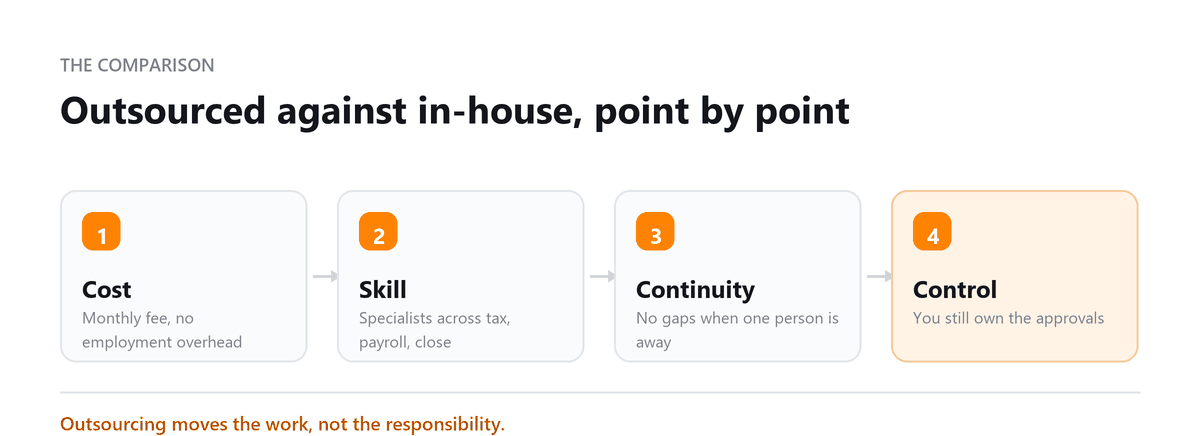
| Feature | Outsourced Bookkeeping | In-House Bookkeeping |
|---|---|---|
| Cost | Lower, no salary, benefits, or overhead | Higher, salary plus employment costs |
| Expertise | Access to specialist team | Limited to the skills of one hire |
| Scalability | Easily adjusts to business needs | Requires new hires or redundancies |
| Technology | Latest tools included in service | Requires additional software investment |
| Resilience | Team backup, no single point of failure | Dependent on one individual |
How to Choose the Right Outsourced Bookkeeping Service
- Define your needs: Identify the specific tasks you want to outsource before approaching providers
- Check industry experience: A provider with relevant sector knowledge will understand your specific challenges
- Verify technology compatibility: Ensure they work with your existing or preferred accounting software
- Assess pricing and scope: Compare packages carefully, identify what is and is not included
- Check references: Speak to current or past clients before committing
What Does Outsourced Bookkeeping Cost in 2026?
Pricing depends on transaction volume, service level, and reporting complexity:
- Basic bookkeeping (US): $300 to $800 per month
- Full-service solutions (including tax and CFO advisory): $2,500 to $20,000 per month
- International/offshore providers: Lower rates available, but verify quality and compliance standards carefully
At Profitjets, we mostly hear from clients that maintaining a team in-house gives them assurance of the process. But the reality is when small business owners are entrusting a single person to keep their complete financial system intact, dependence become the main criteria. When that employee is unfortunately resigning or having a change of mind, it reports an inefficiency in the system. Without any backups knowing what to do in the appropriate team, they end up with cash flow constraints.
There isn't a question about skill but there’s about dependency on one person for the most critical function.
Book a free consultation and we will cost both options for your business.
Frequently Asked Questions
Why should small businesses consider outsourced bookkeeping services?
Outsourcing provides professional-quality financial records at a lower cost than an in-house hire, frees business owner time for growth-focused work, improves compliance, and gives real-time visibility into cash flow. For most small businesses, the economics are compelling.
When is the right time to outsource bookkeeping?
When bookkeeping is consuming more than a few hours per week, when errors are appearing, when tax deadlines are stressful, or when the business is growing faster than your current process can keep up with. Earlier is almost always better.
What are the main benefits of outsourced vs. local bookkeeping?
Cost savings, access to specialist expertise, advanced software included in the service, better accuracy, and reduced compliance risk. Offshore or virtual outsourcing also substantially reduces expenses compared to local alternatives.
What is the average cost of outsourced bookkeeping services?
In the US, typically $300 to $2,500 per month for small businesses depending on transaction volume, service complexity, and provider. Fixed monthly packages are more predictable than hourly billing.
What types of outsourced bookkeeping solutions are available?
Basic bookkeeping (transactions, reconciliation, reports), virtual bookkeeping (cloud-based, real-time access), full-service bookkeeping (AP/AR, payroll, tax, budgeting), industry-specific solutions, and virtual CFO services for strategic financial guidance.
Conclusion
For small businesses, outsourced bookkeeping is not just a cost-cutting option, it is genuinely the better service. Access to a professional team, advanced technology, consistent accuracy, and built-in resilience are advantages that in-house bookkeeping at the small business level rarely matches. Choose your provider carefully, define the scope clearly, and your financial management will be in better shape than it has ever been.

Written by
Ankit Sarawagi, CPA, CA, MBA
Ankit leads the finance team at Profitjets, where he has worked with 500+ businesses across the US on bookkeeping, tax and CFO-level strategy. He writes about the habits that keep small business books accurate all year. Connect on LinkedIn
Free consultation
Want the Comparison on Your Numbers?
Book a free consultation and we will cost both options for your business.