
Online sellers learn about their misstatement of books in one of two ways: a sales tax letter arrives from an out-of-state nexus they didn’t think they had, or they consolidate their Shopify dashboard, Amazon seller reports, and bank statement and realize that the numbers don’t add up: sales look healthy, the P&L is profitable, but cash is always lower than it should be.
E-commerce is one of the most complex spaces in small business accounting. Sellers often generate revenue on Amazon, Shopify, Etsy, and their own websites, receive payments through Stripe, PayPal, and direct deposits, warehouse goods in multiple locations, and collect and remit sales tax in states where they don’t have a physical presence.
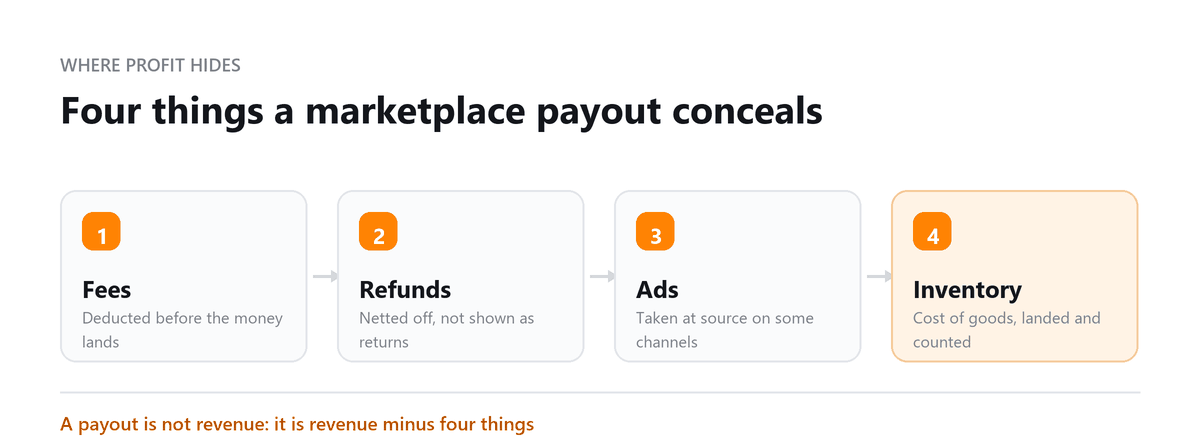
Every disbursement comes as a net amount, with fees, refunds, and reserves already taken out, so the number in their bank account doesn’t reflect the value of goods sold.
A general bookkeeper or a small business owner attempting to do their own books will see revenues recognized upon receipt of funds and inventory costs expensed out when they pay the supplier, obscuring the true margin of their e-commerce business.
Channel profits get aggregated into a single number, masking which platforms actually make money and which are a drain. The alternative is to outsource to a firm that specializes in e-commerce accounting and bookkeeping to set up the system to track the nuances of their business from the beginning.
Expert Perspective
The mistake that surprises e-commerce founders most is booking marketplace payouts as sales. It looks harmless because the money really did land in the bank. But that one deposit has fees, refunds, ad spend, and reserves already taken out, so you lose sight of your real revenue and your real costs at the same time. When we rebuild those numbers properly, founders often discover a channel or product they thought was carrying the business is barely breaking even.
Ankit Sarawagi, CPA, CA, MBA · LinkedInThis guide covers what e-commerce accounting involves, why outsourcing it makes sense, the most common mistakes sellers make, and how to get inventory and multi-channel reporting right.
What is an E-Commerce Accounting Service?
E-commerce accounting services are specialised bookkeeping and accounting functions tailored to the unique financial characteristics of online retail: multi-channel revenue reconciliation, inventory cost accounting (FIFO, LIFO, or weighted average), sales tax compliance across multiple jurisdictions, and payment processor fee accounting. A general bookkeeper who has not worked with e-commerce businesses will typically treat Amazon or Shopify payouts as revenue significantly understating costs, overstating profit, and creating tax compliance exposure.
Key Components of E-Commerce Accounting
| Component | What It Involves |
|---|---|
| Revenue reconciliation | Matching platform payouts (Amazon, Shopify, Etsy) to actual sales, payouts are net of fees, refunds, and reserves |
| Inventory accounting | Tracking the cost of inventory across multiple locations; choosing and consistently applying a cost method (FIFO is standard) |
| Sales tax compliance | Economic nexus rules (post-South Dakota v. Wayfair 2018) require sales tax collection once you pass a state's threshold. $100,000 in sales is the most common one, and thresholds vary by state: many have dropped the 200-transaction test that several set originally, so the sales figure alone decides it in those states |
| Payment processor reconciliation | Stripe, PayPal, and Amazon Payments each have their own fee structures, hold periods, and payout schedules, all must reconcile to the bank |
| COGS calculation | Matching inventory purchases to units sold to produce an accurate gross margin per product and per channel |
| Chargebacks and returns | Chargebacks reduce platform payouts; returns affect both revenue and inventory, both must be tracked separately |
Why Outsourcing E-Commerce Accounting Is Essential
- Transaction volume: a $500K/year e-commerce business can generate 5,000-20,000+ transactions annually, far more than most in-house bookkeepers can handle accurately while managing other responsibilities
- Multi-state sales tax: economic nexus rules now require sales tax compliance in most US states at relatively low volume thresholds. Getting this wrong exposes the business to back taxes, penalties, and interest across multiple states
- Platform-specific expertise: each platform (Amazon, Shopify, Etsy) has different payout structures, fee types, and reporting formats. Specialists know how to reconcile each
- Inventory accuracy: misstated inventory is one of the most common financial errors in e-commerce, overstated inventory overstates profit; understated inventory understates it. FIFO costing must be applied consistently
- Time: manual reconciliation of multi-channel e-commerce books can take 20-40 hours per month, an outsourced specialist team does this as part of their service
Common Mistakes in E-Commerce Accounting
| Mistake | Financial Impact |
|---|---|
| Treating platform payouts as revenue | COGS, fees, and returns embedded in the payout are hidden, gross margin is overstated |
| Not tracking inventory cost by batch | COGS is inaccurate; gross margin is unreliable; tax position is wrong |
| Ignoring sales tax nexus | Back taxes, penalties, and interest in multiple states when audited |
| Not reconciling chargebacks | Revenue is overstated; cash position is inaccurate |
| Mixing business and personal expenses | Tax deductions are inaccurate; audit exposure increased |
| No accruals at month-end | Revenue and profit swing between months based on payout timing, not sales timing |
Why Inventory Costs Are Often Miscalculated
E-commerce inventory cost is calculated differently from service business costs. Each unit sold has a specific cost that must be matched to revenue, the FIFO method (first-in, first-out) tracks this by treating the oldest inventory as sold first. When inventory is purchased at different prices over time (as it almost always is), FIFO produces an accurate per-unit cost that reflects actual historical purchase prices. Many e-commerce businesses start with an average cost method or no systematic cost method at all, resulting in inaccurate COGS and unreliable margins.
Managing Multi-Channel Sales
Each sales channel must be tracked separately in the accounting system: separate revenue accounts per channel, separate COGS, and separate fee expense accounts. This allows channel-level profitability analysis, identifying which channels generate the best margins after fees, advertising, and return rates are accounted for. Without channel-level tracking, the business is flying blind on where to invest its marketing budget.
Profitjets supports 35+ e-commerce businesses with marketplace reconciliation, inventory accounting, sales-tax reporting, and financial analysis. In initial channel reconciliations, approximately 30% of clients have identified meaningful differences between reported marketplace sales and accounting records, often caused by fees, refunds, chargebacks, or inventory costs being recorded incorrectly.
Book a free consultation and we will unpick the real numbers.
Frequently Asked Questions
Can a general bookkeeper handle e-commerce accounting, or do I need a specialist?
A general bookkeeper can usually manage a simple store on one platform with one warehouse. Once you're selling on multiple channels, carrying many SKUs bought at different costs, collecting sales tax in several states, or dealing with meaningful return and chargeback volume, a specialist is the safer choice. The cost of mistakes like sales tax penalties or misleading margins almost always outweighs the cost of getting it right.
How do I handle Amazon FBA accounting?
FBA is especially tricky because Amazon stores your inventory, fulfills orders, takes its fees, and holds reserves before paying you. Each settlement needs to be broken down into gross sales, referral and fulfillment fees, storage fees, refunds, advertising, and reserves. Tools like A2X or Finaloop, or a specialist accounting team, make that reconciliation far more reliable than doing it by hand.
Do marketplaces like Amazon and Etsy handle sales tax for me?
For sales made through their platforms, marketplaces generally collect and remit sales tax on your behalf in most states under marketplace facilitator laws. That doesn't usually cover sales through your own website, and you may still have registration or filing obligations in some states. It's worth reviewing your nexus position across all channels together, not just one.
Which inventory costing method should my e-commerce business use?
FIFO is the most common choice for online sellers because it reflects actual purchase costs as prices change over time. Weighted average can also work for some businesses. What matters most is picking a method that fits your inventory and applying it consistently, since switching methods has tax implications and makes your margins harder to compare.
What accounting software works best for e-commerce businesses?
QuickBooks Online and Xero are the most common accounting platforms for online sellers. They're usually paired with connector tools such as A2X that turn platform payouts into properly split journal entries, and with inventory management software for multi-warehouse or high-SKU businesses. The right combination depends on your channels, order volume, and how complex your inventory is.

Written by
Ankit Sarawagi, CPA, CA, MBA
Ankit leads the finance team at Profitjets, where he has worked with 500+ businesses across the US on bookkeeping, tax and CFO-level strategy. He writes about the habits that keep small business books accurate all year. Connect on LinkedIn
Free consultation
Payouts Booked as Revenue?
Book a free consultation and we will unpick the real numbers.