
Contractors find themselves unexpectedly in need of assistance despite having an apparently profitable business. It all adds up in the end of year reports, except there was this one job that ate up your profit from three others, your retainage from last jobs is still due to you and your bonding company is asking for a WIP schedule which no one has bothered to update since March. You did the work well, the accounting just seemed to miss a lot of the nuances
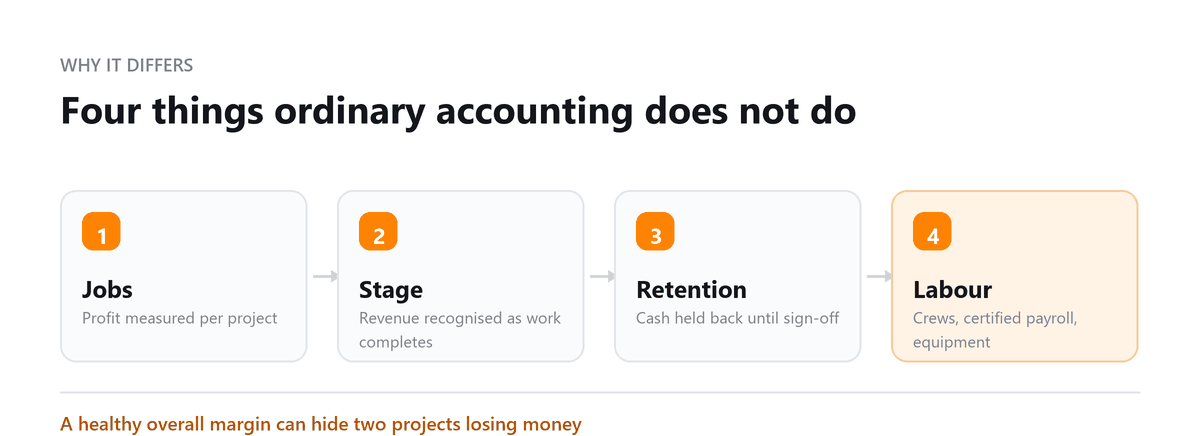
It misses a lot because construction accounting is significantly different from the usual accounting. Every dime should be tied to a particular job in construction accounting. Revenue is recognized as the work is done, not as invoices are paid.
Clients will always retain a percentage of the payment until the job is complete. There are many more wrinkles to deal with in construction accounting. Your accountant must know about retainage, billing, and invoicing.
They should also have a thorough understanding of why and when subcontractors and suppliers require lien waivers and insurance certificates prior to being paid. Additionally, you may have to provide certified payroll reports to government agencies if you do public works contracts.
Few small and mid-size contractors have qualified accounting personnel, and most don’t even realize the importance of these nuances. Contracting companies frequently outsource their accounting needs due to the complexity of their financial situation.
Expert Perspective
The most expensive mistake I see contractors make is not knowing a job is losing money until it's finished. Without proper job costing and a monthly WIP schedule, overruns hide inside company-wide numbers for months. By the time anyone notices, the budget is gone, the change orders weren't billed, and the bonding company is asking questions the owner can't answer.
Abhinav Gupta, CPA, CA, MBA · LinkedInYou can obtain precise job cost figures, WIP reporting, and other critical financial reports by outsourcing to a professional construction accountant, whereas a competent bookkeeper is not likely to fully understand these particulars.
This guide explains what makes construction accounting different, the benefits of outsourcing it, the services specialist firms provide, and how to pick the right partner.
What Is Construction Accounting?
Construction accounting differs from standard accounting in several important ways:
| Construction Accounting Feature | Why It Differs from Standard Accounting |
|---|---|
| Job costing | Every cost (labour, materials, equipment, subcontractors) must be tracked by project, not just by expense category. Profitability is measured job-by-job, not company-wide |
| Percentage-of-completion method | Revenue and profit are recognised as project milestones are reached, not when invoiced or when cash is collected (ASC 606 for US GAAP) |
| Retention / retainage | Clients often withhold 5-10% of each progress billing until project completion, this must be tracked as a separate receivable and managed carefully |
| Progress billing | Invoices are issued at project milestones, not on a fixed schedule, billing schedules must be tracked against contract values |
| Subcontractor management | Subcontractor costs, lien waivers, certificates of insurance, and 1099 reporting must be tracked by project |
| Prevailing wage compliance | Government contracts often require Davis-Bacon Act prevailing wages, payroll must track certified payroll reporting by project |
Why Is It Different from Regular Accounting?
Standard accounting records revenue when earned and expenses when incurred, with a single chart of accounts for the whole business. Construction accounting requires a secondary dimension, the job or project, for every transaction. Without job-level tracking, a contractor cannot know whether individual projects are profitable, which types of work generate the best margins, or whether a project is running over budget before it is too late to correct.
Benefits of Outsourcing Construction Accounting
- Specialist expertise: outsourced construction accountants understand job costing, WIP schedules, AIA billing, retention management, and prevailing wage, skills that are rare in general accounting firms
- Accurate WIP reporting: work-in-progress (WIP) schedules are the key financial report for construction companies, showing overbillings, underbillings, and project completion percentages. Outsourced specialists produce these accurately every month
- Cash flow visibility: construction cash flow is notoriously unpredictable due to milestone billing and retention. An outsourced accounting team tracks these receivables precisely and forecasts cash by project
- Compliance: lien law compliance, prevailing wage reporting, subcontractor lien waiver tracking, and 1099 filing are all handled by the outsourced team, reducing compliance risk
- Cost reduction: an outsourced construction accounting team typically costs 40-60% less than an equivalent in-house function when all-in employment costs (salary, benefits, training, software, space) are compared
- Scalability: workload scales with project volume, busy seasons and project ramp-ups are absorbed by the outsourced team without emergency hiring
Profitjets supports 20+ construction businesses with project accounting, WIP reporting, job-cost tracking, and financial reporting. In initial WIP reviews, approximately 1 in 4 clients have identified a project with materially lower margins than expected, allowing management to address cost overruns, billing gaps, or pricing issues before the project is completed.
What Services Do Outsourced Construction Accountants Offer?
- Job costing and profitability reporting by project
- WIP (work-in-progress) schedule preparation monthly
- AIA G702/G703 progress billing preparation
- Retention/retainage tracking and aging
- Subcontractor payment tracking, lien waiver management, and 1099 filing
- Prevailing wage / certified payroll reporting
- Month-end close, reconciliation, and financial statement preparation
- Cash flow forecasting by project and company-wide
- Integration with construction-specific software (Sage 300 CRE, Procore, Buildertrend, QuickBooks Contractor)
How to Choose the Right Outsourced Construction Accounting Partner
- Construction industry experience: ask specifically about their construction clients, job costing, WIP reporting, AIA billing, and retention management are non-negotiable competencies
- Software familiarity: confirm they can work with your existing project management and accounting software
- Reporting cadence: you should receive a WIP schedule and job-level P&L monthly, within 7 business days of month-end
- References: ask for references from construction companies of similar size and type, residential vs commercial vs specialty trade
- Clear scope and pricing: understand exactly what is included (bookkeeping only? payroll? WIP? tax prep?) and what is not
Book a free consultation and we will set up job-level costing.
Frequently Asked Questions
What is a WIP schedule, and why does it matter?
A work-in-progress schedule shows, for every active job, the contract value, costs to date, percentage complete, amount billed, and whether the job is overbilled or underbilled. It's the most important management report in construction. Lenders and surety companies expect it, and without it a contractor often can't tell a job is losing money until it's too late to recover.
What accounting software is best for small contractors?
QuickBooks is the most common starting point for smaller contractors thanks to its project and job costing features. QuickBooks Desktop Enterprise with the Contractor edition is widely used by larger contractors, and Sage 300 CRE, formerly Timberline, is a long-standing standard for bigger commercial firms. Project management tools like Procore and Buildertrend connect to accounting platforms to keep job data in sync.
What is retainage, and how should it be tracked?
Retainage is a portion of each progress payment, often 5 to 10%, that the client holds back until the project is finished. It should be tracked as a separate receivable by job, with its own aging, so it doesn't get lost after the project closes and so you can plan for when that cash will actually come in.
What's the difference between overbilling and underbilling?
Overbilling means you've invoiced more than the work completed so far, which shows up as a liability. Underbilling means you've completed more work than you've invoiced, which is an asset but often signals billing delays or unapproved change orders. Both appear on the WIP schedule, and large swings in either direction are worth investigating.
Do I still need a CPA if I outsource construction accounting?
Often, yes. Your outsourced team handles the monthly bookkeeping, job costing, WIP, and reporting. You may still need a CPA for tax returns, and many bonded contractors need reviewed or audited financial statements that a CPA firm has to provide. Some outsourced firms offer both, so it's worth asking.

Written by
Abhinav Gupta, CPA, CA, MBA
Abhinav works with business owners across the US on industry-specific bookkeeping, from dental practices and restaurants to construction and e-commerce. He writes about what each trade's books actually need. Connect on LinkedIn
Free consultation
Not Sure Which Jobs Make Money?
Book a free consultation and we will set up job-level costing.