
Restaurant accounting is a more challenging endeavor than most industries, and the margins leave significantly less room for error. Hundreds of transactions per day across numerous channels, food costs fluctuating weekly, payroll consisting of tips and split shifts, and a net margin, for most independents, that sits just shy of single digits.
Therefore, the question of who handles the books becomes non-administrative. At a 5% net margin, an unaccounted for percentage point of food cost represents a 20th of your profit.
A disclosure, as an aside: we offer outsourced accounting. Which means the point of this page is to be completely honest about the places in which in-house restaurant accounting actually proves superior, and it does so in specific sizes and configurations.
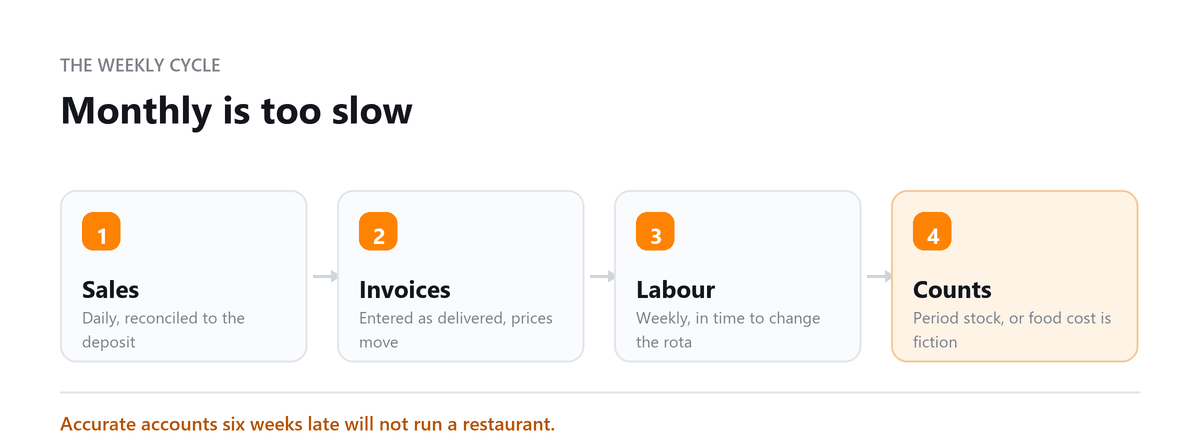
Prime cost is the number, and it has to be weekly. Food and labour together, as a percentage of sales, looked at every Monday for the week just gone. Monthly is too late by the time a monthly report lands, a food cost problem has been running for four or five weeks and the money is gone. What matters isn't whether your bookkeeper sits in your office or somewhere else. It's whether that number arrives every week without you chasing it.
Anu Gupta, CA, EA, B.Tech · LinkedInWhat makes restaurant accounting different
Transaction volume. Hundreds daily across cash, card, and multiple delivery platforms. Reconciliation is a real job rather than a monthly task.
Delivery platform accounting, which almost everyone gets wrong. UberEats, DoorDash and the rest remit net of commission. If you book the deposit as revenue, you've understated sales by 20 to 30% and hidden the commission entirely. Done correctly you record gross revenue and commission as a separate expense, which is the only way to see what delivery is actually costing you. Most independents we see are recording the net.
Tips and payroll. Tip pooling, tip credit where your state permits it, the distinction between service charges and tips (they're treated differently for payroll tax), and the FICA tip credit, a credit for employer payroll tax paid on reported tips that a great many independent restaurants never claim.
Inventory that moves daily. Food cost isn't a monthly figure. It moves with supplier prices, portioning, waste and theft, and it needs weekly counting to mean anything.
Sales tax complexity. Varies by state, and the food versus non-food distinction produces genuine mistakes. Delivery platforms also handle tax differently depending on marketplace facilitator rules.
Thin margins. Independent net margins typically run in the low single digits to high single digits.
In-House vs Outsourced: Comparison
| Dimension | In-House Accounting | Outsourced Accounting |
|---|---|---|
| Cost | $35,000 to $65,000+/year for dedicated bookkeeper; more for controller | $500 to $3,000+/month depending on scope; typically lower all-in cost for small restaurants |
| Expertise | Depends on hire quality; may not have restaurant-specific expertise | Specialised firms have restaurant-specific knowledge: food cost, POS integration, tip accounting |
| Availability | On-site, daily access | Remote; may have response-time SLAs |
| Scalability | Need to rehire/restructure as you grow | Scales with your needs, add more scope without hiring |
| Technology | You select and manage systems | Typically provides or recommends integrated POS-accounting stack |
| Data Entry Speed | Immediate, transactions entered daily | Dependent on data feeds and scheduled processing |
| Financial Reporting | Available if staff are capable | Regular reports typically included in scope |
| Tax Compliance | Requires separate CPA for tax filing | Often bundled, bookkeeping + tax in one engagement |
Where outsourcing wins
Single location under a couple of million in revenue. The work doesn't fill a full-time role, and you're paying for idle capacity if you hire.
You want restaurant-specific knowledge without hiring for it. Delivery platform accounting, tip handling, food cost reporting and POS integration are things a restaurant specialist has done a hundred times and a generalist hire learns on your books.
Your bookkeeper just left. The most common trigger, and the point where owners discover how much institutional knowledge was in one head.
The books are always behind. In-house bookkeeping in restaurants slips constantly, because the person doing it is also covering shifts and dealing with the day.
You want bookkeeping and tax in one place. Fewer handoffs, and nobody billing you to fix what someone else recorded.
Key Metrics to Track (Regardless of Model)
| Metric | Target Range | Why It Matters |
|---|---|---|
| Food Cost Percentage | 28 to 35% of revenue | Core profitability driver, track weekly, not monthly |
| Labour Cost Percentage | 25 to 35% of revenue | Largest controllable expense after food |
| Prime Cost (Food + Labour) | 55 to 65% of revenue | Industry benchmark, above 70% typically signals a profitability problem |
| Net Profit Margin | 3 to 9% (independent restaurant) | Thin industry, even 1% improvement = material cash change |
| Beverage Cost Percentage | 20 to 35% (beer/wine) | 18 to 24% (spirits) | High-margin revenue, track separately from food |
| Table Turn Rate | Depends on format | Revenue per square foot indicator |
Which Model Is Right for Your Restaurant?
| Choose In-House if… | Choose Outsourced if… |
|---|---|
| You have a high-volume operation where daily on-site accounting oversight is critical | You are a single-location restaurant under $2M revenue |
| You already have an office manager who can handle bookkeeping with training | You want restaurant-specific accounting expertise without a full-time hire |
| You are a multi-location chain needing a dedicated accounting department | You want bookkeeping and tax bundled in one cost-effective engagement |
| You have specific technology or POS systems requiring dedicated staff integration | You are owner-operated and want to stay focused on the kitchen and front-of-house |
Prime cost benchmarks vary by format: a bar, a quick-service counter and a full-service kitchen sit in genuinely different ranges, so compare against your own trend and your own format rather than against a general figure.
The delivery channel needs watching separately too. A dish that's profitable at the table can lose money after platform commission, and you can only see that if commission is recorded as an expense rather than netted out of revenue.
About 40% of Profitjets restaurant clients need a bookkeeping cleanup or reporting restructure when they first come on board. Restaurants that implement weekly food-cost tracking have seen food costs fall by an average of 2 to 4 percentage points after identifying purchasing, waste, and portion-control issues.
Our bookkeeper left, and by the time we brought in Profitjets, our books were almost three months behind. We were watching sales every day but had no clear idea why our margins were getting tighter. Profitjets caught that our food cost had climbed to about 36% of sales and set up weekly tracking for food purchases, waste, and inventory.
Within a few months, we brought food cost down to roughly 32%, while the books were kept current enough for us to see the problem before it showed up at tax time.
Book a free consultation and we will get you weekly figures.
Frequently Asked Questions
What accounting software do restaurants use?
The common independent setup is a POS: Square, Toast or Clover feeding into QuickBooks Online or Xero. Larger operations and small chains often move to a restaurant-specific platform like Restaurant365 that combines accounting and operations. What matters more than the choice is how the integration is configured: whether delivery revenue comes through gross, whether sales tax maps correctly, and whether tips flow into payroll properly.
How often should I review food cost?
Weekly. Food cost swings within a week on supplier prices, portioning, waste and theft, and a monthly review finds the problem four weeks after it started. At restaurant margins, a few points of overrun sustained for a month is serious money. Whoever does your books should be producing a weekly prime cost figure without being asked.
Is outsourcing cheaper than hiring?
For a single location, usually because the work doesn't fill a full-time role and the fully loaded cost of an employee is considerably more than the salary. The gap narrows as you grow, and at multiple locations a dedicated function often wins. Compare the fee against total employment cost including payroll taxes, benefits, software and your own supervision time, not against salary alone.
What's the most common restaurant bookkeeping mistake?
Recording delivery platform deposits as revenue. The platform pays you net of commission, so booking the deposit understates sales and hides the commission cost completely. You end up unable to tell whether delivery is making you money which for a lot of restaurants it isn't, at least on some items.
Do I still need a CPA if I outsource bookkeeping?
Depends on the arrangement. Some outsourced engagements include tax filing; others cover bookkeeping only and you engage a CPA separately. Ask what's included, because assuming tax is covered when it isn't is discovered at the worst time of year.

Written by
Anu Gupta, CA, EA, B.Tech
Anu works with US businesses on tax and entity questions at Profitjets, from choosing a structure to the filings that follow it. She writes about the decisions owners make once and then live with for years. Connect on LinkedIn
Free consultation
Running a Restaurant on Late Numbers?
Book a free consultation and we will get you weekly figures.