
The range runs from a spreadsheet to a full outsourced function, and most businesses end up on whichever one they started with.
That is the real cost here. Changing systems is disruptive enough that companies stay on something they outgrew, and the price of that is paid in hours rather than in a bill anybody sees.
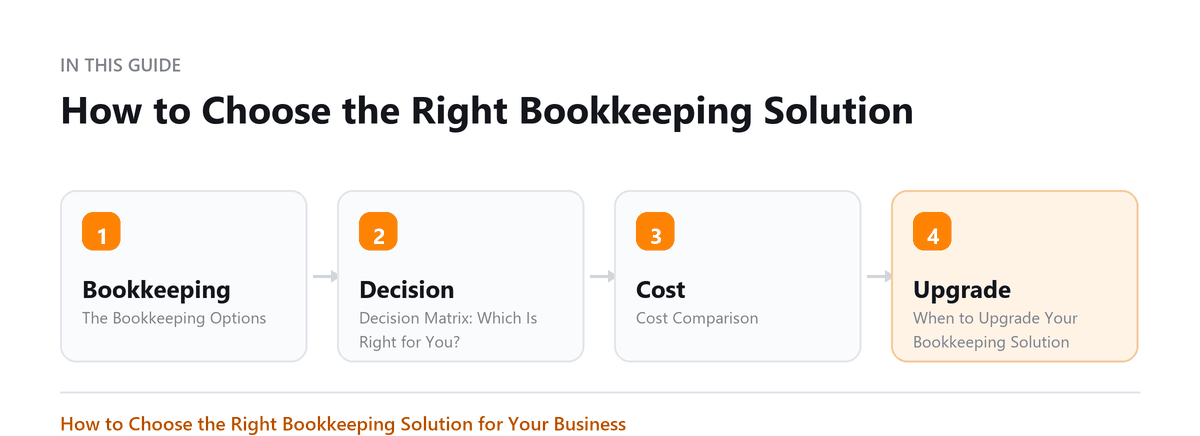
This covers the options available, a way of matching them to your situation, what each costs, and the signals that it is time to move up.
Bookkeeping is non-negotiable. But how you handle it, DIY, software, outsourced, or full-service, should match your business size, complexity, and how much of your time you want to spend on it.
The Bookkeeping Options
Option 1: Do It Yourself
You record transactions, reconcile accounts, and generate reports yourself, typically using accounting software.
- Cost: $0 in labor, $25-$80/month for software
- Time: 5-15 hours/month depending on transaction volume
- Works for: freelancers, sole proprietors, businesses under $250K revenue with low transaction volume
- Risk: errors go undetected; tax deductions get missed; books go stale during busy periods
Option 2: Accounting Software (Cloud-Based)
QuickBooks Online, Xero, and FreshBooks handle a lot of the data entry through bank feeds and automation. You or a non-accountant staff member manages it.
- Cost: $30-$200/month
- Time: 2-6 hours/month for review and reconciliation
- Works for: businesses that want control but with automation reducing manual work
- Risk: still requires a knowledgeable user to categorize correctly
Option 3: Outsourced Bookkeeper (Freelance)
A part-time freelance bookkeeper handles your data entry, categorization, and reconciliation on a monthly or weekly basis.
- Cost: $300-$1,500/month depending on scope
- Time: minimal for you, review reports, answer questions
- Works for: growing businesses that are past the DIY stage but not ready for full-service
- Risk: quality varies; find someone with CPA oversight or references
Option 4: Virtual Bookkeeping Services
Firms like Bench, Pilot, or Profitjets provide dedicated bookkeepers who work remotely, using your accounting software.
- Cost: $300-$2,000+/month depending on transaction volume and service level
- Time: 30-60 minutes/month for your review
- Works for: businesses that want professional bookkeeping without hiring in-house
- Advantage: consistent quality, backup coverage, integration with tax prep
Option 5: Full Accounting Firm
Your CPA firm handles bookkeeping, tax prep, and planning all in one.
- Cost: $500-$5,000+/month
- Time: minimal for you
- Works for: complex businesses needing a one-stop-shop
- Risk: higher cost; may be over-engineered for simple businesses
Pick for the volume you will have in a year, not the volume you have now. Changing systems is disruptive enough that most businesses stay on something they outgrew, and the cost of that shows up as hours rather than as a bill.
Ankit Sagatani, MBA, B.Com · LinkedInDecision Matrix: Which Is Right for You?
| Your Situation | Recommended Option |
|---|---|
| Freelancer, under $100K revenue, simple transactions | DIY + accounting software |
| Small business, $100K-$500K, owner has no time | Outsourced bookkeeper |
| Growing business, $500K-$2M, needs clean monthly reports | Virtual bookkeeping service |
| Multi-entity, complex transactions, needs CPA oversight | Full accounting firm |
| Early-stage startup, investor reporting needed | Virtual service + fractional CFO |
Cost Comparison
| Option | Monthly Cost Range |
|---|---|
| DIY + software | $25-$80 |
| Software only (with staff) | $30-$200 + staff time |
| Freelance bookkeeper | $300-$1,500 |
| Virtual bookkeeping service | $300-$2,000+ |
| Full accounting firm | $500-$5,000+ |
When to Upgrade Your Bookkeeping Solution
- You're spending more than 5 hours/month on bookkeeping, hire someone
- Your books are more than a month behind, get help now
- You have employees, you need payroll expertise
- You're applying for a loan, lenders want CPA-prepared financials
- You have inventory, complexity requires professional handling
- Tax season surprises you, switch to someone who plans proactively
Book a free consultation and we will bring them current.
Frequently Asked Questions
What is the best bookkeeping software for small businesses?
QuickBooks Online is the most widely used and has the broadest CPA ecosystem. Xero is excellent for tech-forward businesses and international operations. FreshBooks is ideal for service-based businesses that prioritize invoicing.
How much does a virtual bookkeeping service cost?
Most services charge $300-$2,000/month depending on transaction volume, payroll, and reporting needs. Most include bank reconciliation, categorization, and monthly financial statements. Tax prep is usually separate.
Can my bookkeeper also do my taxes?
A bookkeeper maintains your records; only a licensed CPA or EA can prepare and sign tax returns. Many virtual bookkeeping firms offer tax prep as an add-on service, or partner with a CPA for this.
Is outsourced bookkeeping safe?
Yes, when done through a reputable firm. Look for data encryption, NDA agreements, and U.S.-based oversight even if the work is done offshore. Never give a bookkeeper direct access to move money.
How do we know we have outgrown the option we chose?
The signals are consistent whichever option you are on. The close takes longer each month rather than shorter. Questions you used to answer from memory now need somebody to go and look. Errors are found by other people, such as a supplier or a customer, rather than by your own checks. And the person doing the work has become a single point of failure nobody else can cover. Any two of those together is the signal to move.

Written by
Ankit Sagatani, MBA, B.Com
Ankit works with business owners across the US on industry-specific bookkeeping, from real estate to construction and retail. He writes about what each trade's books actually need. Connect on LinkedIn Connect on LinkedIn
Free consultation
Books Behind?
Book a free consultation and we will bring them current.