
Most often, learning the terms of accounting is not a systematic process for small business owners. They learn about "equity" when a new partner invests money into the company, liabilities when the bank calls to charge their loan, and assets when the accountant asks if the laptop they bought should be depreciated. Information gathered together that allows explaining these terms to someone else may take some time.
The balance sheet equation is the key to understanding the relationships between items on the balance sheet, and all entries on the balance sheet must follow it. Assets are resources owned by the company, liabilities are its obligations, and equity is the amount of assets that belong to the owners of the company.
Next, every transaction that requires recording changes at least two accounts in the balance sheet, thus keeping the balance. Any business activity in the life of the company starts with assets, liabilities, equity, revenues, expenses, gains, and losses.
Therefore, the balance sheet can be seen as a report that summarizes where and how the company's funds came from and where and how they were spent.
The misconception about equity I hear most often is that it's the cash the owner could take out of the business. It isn't. Equity is an accounting figure: assets minus liabilities. Much of it can be tied up in equipment, receivables, or inventory.
A business can show $300,000 in equity and still not have enough cash to cover next month's payroll. Owners who treat equity as spendable money end up taking distributions that the business's cash can't actually support. Before taking money out, look at cash and upcoming obligations, not the equity line.
Abhinav Gupta, CPA, CA, MBA · LinkedInThe Accounting Equation
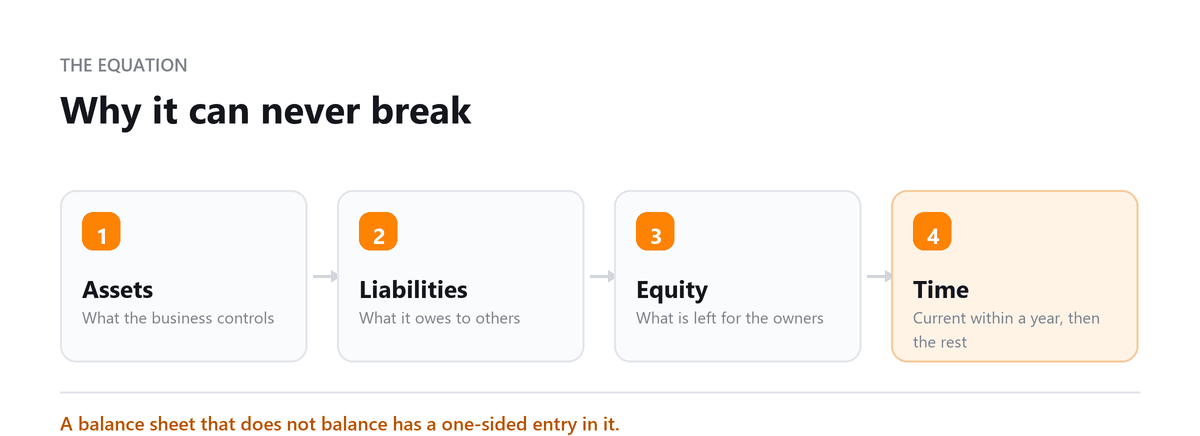
Every financial statement in accounting rests on three concepts: assets (what the business owns), liabilities (what it owes), and equity (what belongs to the owners). Understanding these three and how they relate through the accounting equation is the starting point for reading any financial report.
Assets = Liabilities + Equity
This equation always balances, by definition. Every transaction a business records affects at least two of these three elements simultaneously and keeps the equation in equilibrium.
What Are Assets?
Assets are resources controlled by the business that have economic value and are expected to provide future benefit. They are classified by how quickly they can be converted to cash:
| Asset Type | Description | Examples |
|---|---|---|
| Current Assets | Convertible to cash within 12 months | Cash, accounts receivable, inventory, prepaid expenses |
| Non-Current Assets | Long-term; used over multiple years | Equipment, property, vehicles, intangibles, long-term investments |
What Are Liabilities?
Liabilities are obligations, amounts the business owes to outside parties. Like assets, they are split by time horizon:
| Liability Type | Description | Examples |
|---|---|---|
| Current Liabilities | Due within 12 months | Accounts payable, accrued wages, short-term loans, GST/VAT payable, deferred revenue |
| Non-Current Liabilities | Due beyond 12 months | Long-term bank loans, equipment finance, deferred tax liabilities |
What Is Equity?
Equity is the residual interest in the business after subtracting all liabilities from assets. It belongs to the owners. Equity = Assets − Liabilities.
- Paid-in capital / share capital: cash invested by owners or shareholders
- Retained earnings: cumulative net profits kept in the business after distributions
- Owner drawings: amounts withdrawn by owners (reduces equity)
- Revaluation reserves: increases in asset values recorded directly in equity (not through the P&L)
How Transactions Affect All Three
| Transaction | Asset Effect | Liability Effect | Equity Effect |
|---|---|---|---|
| Owner invests $50,000 cash | Cash +$50,000 | None | Paid-in capital +$50,000 |
| Buy equipment for $20,000 cash | Equipment +$20,000; Cash −$20,000 | None | None (asset swap) |
| Take a $30,000 bank loan | Cash +$30,000 | Loan payable +$30,000 | None |
| Earn $10,000 revenue (cash) | Cash +$10,000 | None | Retained earnings +$10,000 |
| Pay $4,000 rent expense | Cash −$4,000 | None | Retained earnings −$4,000 |
| Owner withdraws $5,000 | Cash −$5,000 | None | Drawings −$5,000 |
Assets vs Liabilities: Key Differences
| Assets | Liabilities | |
|---|---|---|
| What it is | Resources owned or controlled | Obligations owed to others |
| Effect on equity | Higher assets → higher equity (all else equal) | Higher liabilities → lower equity |
| Balance sheet side | Left side (or top) | Right side (or middle, above equity) |
| Goal | Maximise productive assets | Minimise unnecessary debt; manage repayment timing |
CLIENT QUOTE: When Profitjets cleaned up our balance sheet, we found that some equipment purchases had been recorded as expenses, several owner transactions were mixed into business expenses, and one of our loans had been recorded incorrectly. Once those items were corrected, our financial position looked very different, and we had a much clearer picture of our actual assets, liabilities, and profitability.
Book a free consultation and we will find what is on one side only.
FAQs
Is cash an asset or equity?
Cash is an asset, something the business owns. Equity is the owners' claim on the business after liabilities. When an owner puts cash into the business, both cash (an asset) and owner contributions (equity) go up by the same amount, and the equation stays balanced.
Can equity be negative?
Yes. Negative equity means total liabilities are larger than total assets, usually because losses or owner distributions have exceeded what the owners put in. It's a serious warning sign, especially for lenders. It isn't the same as being unable to pay bills, though. A business with negative equity can still meet its obligations if it has enough cash flow, and many young businesses go through a period of it.
Is a loan an asset or a liability?
For the business that borrows the money, a loan is a liability. The cash it receives is an asset. If your business lends money to someone else, such as a loan to an owner or another company, that loan is an asset, because someone owes it to you.
Are owner draws an expense?
No. Owner draws and distributions reduce equity, not profit. They don't appear on the income statement. That's why a business can report a profit while the owner's equity still falls, if the owner took out more than the business earned.
How is this different from reading a balance sheet?
This page covers what the three elements are and how transactions move through them. Reading a balance sheet means applying those ideas to a full statement: checking working capital, liquidity, and debt levels. The balance sheet guide walks through that step by step.

Written by
Abhinav Gupta, CPA, CA, MBA
Abhinav works with business owners across the US on industry-specific bookkeeping, from dental practices and restaurants to construction and e-commerce. He writes about what each trade's books actually need. Connect on LinkedIn
Free consultation
Books Not Balancing?
Book a free consultation and we will find what is on one side only.