
Schools are operating in a landscape that is broader and modern with increasing focus on efficiency. The need is crucial is streamlining financial architecture to support the modern practices. Contrary to the other organizations financial documentation is more complex with maintaining ongoing payroll, reimbursements, ESOPS and student welfare benefits. It applies for both public and private schools regardless of the ownership status.
Beyond ensuring compliance, clean books are significant to regulate financial health. Good bookkeeping extends from being an administrative requirement to the main factor that accelerates and strategizes overall growth. Contrary to the conventional approaches that requires documenting expense and profitability, schools have an intensive protocol when recording multiple income sources across different timezones.
Accurate bookkeeping ensures the leaders to strategize effective schemes and focus on streamlining expansion. Whereas improper classifications, unresolved books and missed documentation often incur additional costs. Over time bad bookkeeping practices compound to influence the structural decisions that impact growth and financial activity. Investing in the critical functions can ensure good ROI along with equipping leaders to make proper decisions involving hiring, facility expansion and welfare programs.
This blog provides insights on bookkeeping practices, when schools should opt a bookkeeper and how they can neglect errors in tracking income sources
School finance is more regulated than most business owners realise. Between government reporting requirements, grant restrictions, and payroll complexity, a school that uses consumer accounting software instead of education-specific tools is creating unnecessary risk.
Abhinav Gupta, CPA, CA, MBA · LinkedInWhat is Bookkeeping for Schools?
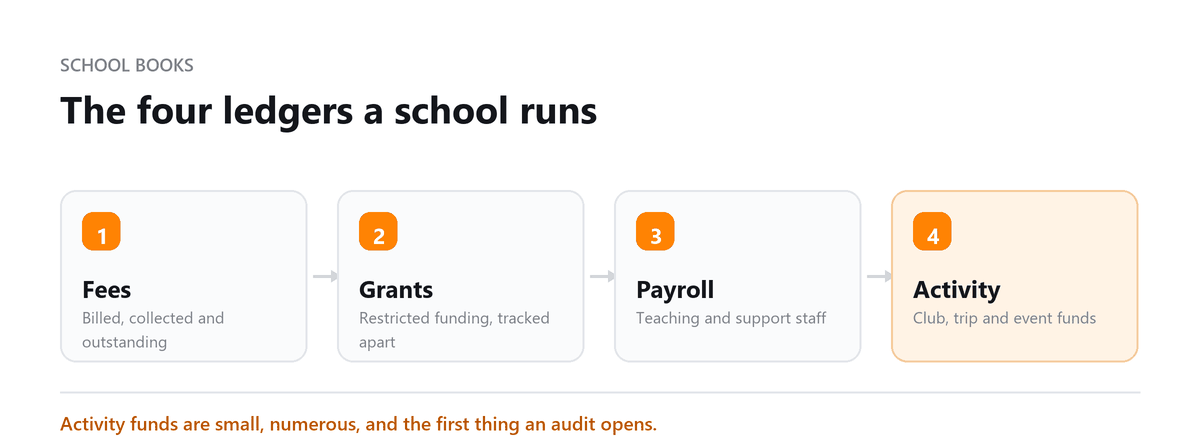
Bookkeeping for schools involves recording, categorising, and managing every financial transaction of an educational institution. Income sources include tuition fees, government funding allocations, grants, donations, and fundraising proceeds. Expenses cover teacher and staff salaries, educational supplies, technology, facility maintenance, utilities, and insurance. School bookkeeping must also handle multi-fund tracking, separately recording government-restricted funds, grants, and general operating funds, to meet reporting obligations to oversight bodies, accreditors, and boards of trustees.
Why Bookkeeping Matters for Schools
- Financial stability: Accurate records allow school leadership to monitor spending against budget and act before deficits develop
- Legal compliance: Government-funded schools must meet strict financial reporting requirements, inaccurate books risk funding clawback
- Reporting to government and accreditation bodies: Annual financial statements and grant reports must be accurate and timely
5 Bookkeeping Tips for Schools
- 1. Stay organised: Use a detailed chart of accounts that separates all income sources (tuition, government funding, grants, donations) and all major expense categories
- 2. Update records regularly: Transactions should be recorded within 24 to 48 hours, weekly at the very latest. Backlogs are the root cause of most bookkeeping errors
- 3. Separate accounts by fund: Track government-restricted funds, grant funds, and general operating funds in separate accounts or sub-ledgers
- 4. Use accounting software designed for education: Generic consumer tools lack the fund accounting and grant tracking features that schools require
- 5. Consider professional help: A bookkeeper or outsourced service with education sector experience understands payroll complexity, grant compliance, and government reporting requirements
The Role of a School Bookkeeper
A school bookkeeper performs several critical functions. They maintain accurate records of all income and expenditure, reconcile bank accounts and petty cash regularly, process payroll for teaching and administrative staff, prepare financial reports for the board of governors or trustees, and liaise with external auditors at year-end. In larger schools, these duties are shared between a finance officer and an external accountant.
Tracking Income and Creating Financial Reports
Schools should track income by source, tuition, government grants, fundraising, and donations each in a dedicated income category. Monthly income reports should be compared against the annual budget to identify variances early. Financial reports for the board should include a P&L (or income and expenditure statement), a balance sheet, and a cash flow forecast. Grant-funded activities require separate income and expenditure reporting to meet grant conditions.
Best Bookkeeping Software for Schools
| Software | Best For |
|---|---|
| Skyward School Management | Public and private schools, comprehensive HR, payroll, and finance in one platform |
| K-12 Online | Private, public, and charter schools, purpose-built for K-12 financial management |
| Multiview ERP | Schools needing scalable, integrated financial suite with strong reporting |
| Blackbaud Tuition Management | Schools focused on tuition collection, billing, and payment plan management |
Common Bookkeeping Mistakes in Schools
- Poor record-keeping: Incomplete or inconsistent records make annual audits and grant reporting extremely difficult
- Not reconciling accounts: Monthly bank and petty cash reconciliation must be a fixed part of the finance calendar
- Not tracking all expenses: Small purchases, supplies, refreshments, incidentals, add up and must be recorded
- Mixing funds: Government-restricted grants must never be co-mingled with general operating funds
- Procrastinating on record updates: Allowing transactions to accumulate without recording them is the most common cause of year-end audit complications
At Profitjets, we have worked with school administrators and educational organizations that were managing complex budgets, grant allocations, and reporting requirements through spreadsheets and disconnected systems. While these approaches may work temporarily, they often become difficult to maintain as institutions grow. We have seen schools significantly improve financial visibility and reduce administrative workload after implementing structured bookkeeping processes and fund-tracking systems designed for educational environments.
One common challenge we encounter is restricted fund management. Schools frequently receive grants and program-specific funding that must be tracked separately from general operating funds. Without proper accounting controls, it becomes difficult to demonstrate compliance with funding requirements or prepare accurate reports for government agencies, donors, and governing boards. Establishing clear fund accounting procedures helps ensure resources are used appropriately and reporting obligations are met efficiently.
Book a free consultation and we will get every fund reporting cleanly.
Frequently Asked Questions
Do schools need specialist accounting software?
Yes, in most cases. Generic consumer accounting software lacks the fund accounting, payroll, and grant management features that schools require. Education-specific platforms like Skyward, K-12 Online, or Blackbaud are built for the reporting requirements and financial complexity of educational institutions. Smaller independent schools may use QuickBooks with specialist configuration, but dedicated tools are preferable.
How often should a school reconcile its accounts?
Monthly, at a minimum. Bank account reconciliation, petty cash reconciliation, and comparison of actual spending against budget should all happen every month. Payroll reconciliation should happen every pay period. Annual audits go much more smoothly when monthly reconciliation has been consistent throughout the year.
What is fund accounting and why do schools need it?
Fund accounting tracks money by its designated purpose rather than as a single pool. A school might have a general education fund, a capital improvements fund, a Title I grant fund, and a parent association fund, all managed separately. This ensures that restricted government and grant funding is used only for its designated purpose, which is a legal requirement for most public funding.
Who is responsible for bookkeeping in a school?
Responsibility varies by institution size. In small independent schools, the headteacher or business manager may handle bookkeeping with support from an external accountant. Larger schools have a dedicated finance officer or bursar. Public school districts typically have a centrally managed finance function. All schools benefit from having at least one person with formal bookkeeping or accounting training responsible for financial records.
How are school grants tracked in the books?
Each grant should have its own income category and corresponding expense categories in the chart of accounts. A grant tracking schedule should record the grant amount, expenditures to date, remaining balance, eligible expense categories, and reporting deadlines. Grant funds must be kept separate from general operating funds at all times.
Conclusion
School bookkeeping is one of the most regulated and complex forms of financial management in any sector. With the right software, the right internal processes, and specialist professional support, schools can meet their reporting obligations efficiently, and spend more of their time and resources on education.
Profitjets works with educational institutions to deliver accurate, compliant bookkeeping and financial reporting, handling the financial complexity so school leaders can focus on what matters most.

Written by
Abhinav Gupta, CPA, CA, MBA
Abhinav works with business owners across the US on industry-specific bookkeeping, from dental practices and restaurants to construction and e-commerce. He writes about what each trade's books actually need. Connect on LinkedIn
Related articles
Free consultation
Want the School's Books in Order?
Book a free consultation and we will get every fund reporting cleanly.