
Debt financing implies raising money through a loan, meaning that the debtor will have to pay interest and eventually repay the principal sum. At the same time, the company will retain full ownership of the product. Equity financing, conversely, involves selling a share in the company, meaning that the owner will be unable to withhold total control and ownership of the company and its subsequent revenues.
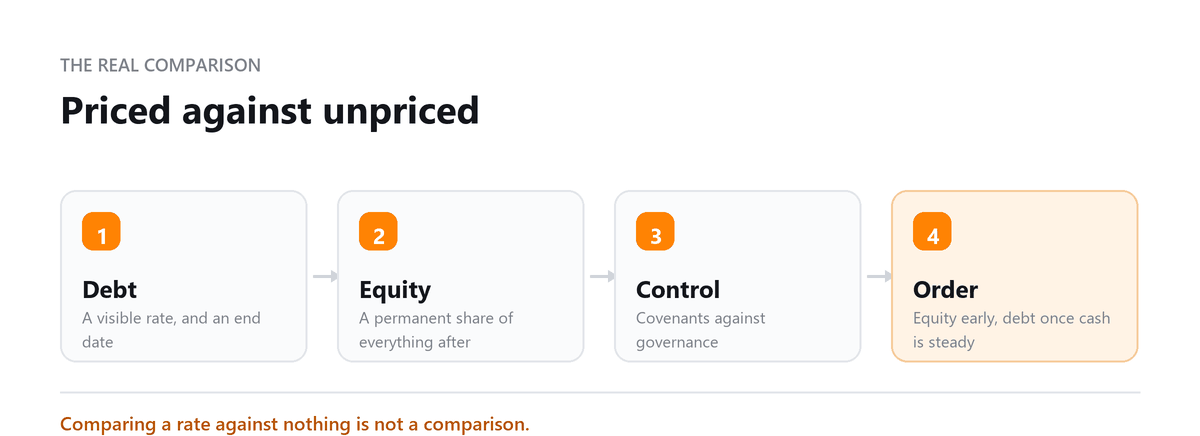
One is typically presented with the idea of debt being effectively cheap, while equity is considered safe. The truth is that debt is not necessarily cheap, and equity is not necessarily safe, so both sides of the argument should be carefully considered.
Debt is not cheap, as there is a high risk of personal guarantees for small business loans. In other words, the point that one will keep full control of the product is valid, but the assumption that they will not risk their own money is not. At the same time, one should understand that several instruments designed as debt financing may actually feature significantly higher rates due to the complexity of the design.
Meanwhile, equity does not involve any repayment, but it is the most expensive way of financing when one considers a successful exit. Ten percent of a company sold at a $2M valuation costs you $2M valuation would require the seller to assign an additional $2M for the buyer to reach the $20M exit.
This text is designed to discuss both options fully, including the information omitted in the comparison tables.
The metric that should drive it is whether your cash flow can service the debt through a bad quarter, not an average one. Founders model repayments against their forecast and the forecast assumes things go roughly to plan. Debt doesn't care about your plan, the payment is due whether the quarter was good or not. If you can't service it through a genuinely poor period, you're not choosing debt over equity, you're choosing debt over solvency.
Anu Gupta, CA, EA, B.Tech · LinkedInCore Definitions
- Debt Financing: Borrowing money that must be repaid with interest over a defined period. The lender has no ownership stake in your business. Interest payments are tax-deductible. Examples: bank term loans, SBA loans, revenue-based financing, bonds, lines of credit.
- Equity Financing: Selling ownership (shares) in your business in exchange for capital. The investor receives a percentage of the company and shares in future profits and proceeds on exit. You do not repay equity, but you permanently dilute your ownership. Examples: angel investment, venture capital, private equity.
Debt vs Equity: Head-to-Head Comparison
| Dimension | Debt Financing | Equity Financing |
|---|---|---|
| Repayment | Yes, fixed schedule of principal + interest | No, no repayment obligation |
| Cost | Interest rate (typically 5 to 25% depending on type and lender) | Cost of equity = expected return investors demand (typically 20 to 40%+ for VCs) |
| Ownership Dilution | None, you retain 100% ownership | Yes, you give up a percentage of the business |
| Control | Retained, lenders impose covenants but not operational control | Shared, investors may require board seats or veto rights |
| Tax Treatment | Interest is tax-deductible | Dividends are not tax-deductible |
| Cash Flow Impact | Mandatory monthly/quarterly payments, reduces operating cash flow | No mandatory cash outflow until exit or dividend |
| Risk | Default risk if cash flow deteriorates, lender may accelerate repayment | Lower short-term cash risk, no repayment; higher long-term cost (you share upside forever |
Types of Debt Financing
| Type | Typical Cost | Best For |
|---|---|---|
| SBA 7(a) Loan | Prime + 2.25 to 4.75% (approx., varies) | Small businesses with 2+ years of history; up to $5M |
| Bank Term Loan | 6 to 12% (varies by creditworthiness) | Established businesses with strong financials |
| Line of Credit | Prime + 1 to 5% (revolving) | Working capital, seasonal cash flow needs |
| Revenue-Based Financing | 1.2x, 1.5x of advance amount (factor rate) | SaaS or subscription businesses with predictable revenue |
| Equipment Financing | 5 to 15% | Businesses buying machinery, vehicles, or equipment |
| Invoice Financing | 1 to 3% per month on outstanding invoice value | B2B businesses with long payment terms (30 to 90 days) |
Two of those are priced differently from the rest and the table can't show it.
Revenue-based financing quotes a factor: repay 1.3x what you took, say. That isn't 30%. If you repay over twelve months as a share of revenue, the effective annualised cost is considerably higher, because you're repaying continuously rather than at the end. Ask for the effective APR before comparing it to a bank rate.
Invoice financing quotes monthly. Two percent a month is roughly 24% a year, which sits very differently next to a single-digit term loan rate. We cover it in invoice financing vs factoring.
Always convert everything to an annual effective rate before comparing. Products are priced in the units that make them look cheapest.
Types of Equity Financing
| Type | Typical Check Size | Best For |
|---|---|---|
| Friends & Family | $10,000 to $250,000 | Pre-revenue or very early stage; informal terms |
| Angel Investment | $25,000 to $500,000 | Early-stage startups; angels often provide mentorship too |
| Seed VC | $500,000 to $3M | Startups with product-market fit signals |
| Series A VC | $3M to $15M | Post-revenue startups showing growth metrics |
| Private Equity | $10M+ | Established profitable businesses; often takes majority control |
| Crowdfunding (Reg CF) | Up to $5M per year | Consumer-facing brands with strong community |
Equity has a structural requirement worth knowing before you start: institutional investors generally require a C-Corporation, usually in Delaware, because they invest through preferred stock that doesn't exist in an LLC. If you're an LLC and raising, expect to convert. We cover that in LLC vs C-Corporation.
On friends and family specifically: document it as either a loan or an equity investment, in writing, with terms. Undocumented money from people you know is the most common cause of both cap table problems at the first institutional round and permanently damaged relationships.
What each actually costs
Debt costs the interest, minus the tax benefit, interest is generally deductible, so the after-tax cost is lower than the headline rate, though deductibility is subject to limitation rules for larger businesses. Add origination fees, and factor in the covenant restrictions, which can cost you optionality even when they cost no money.
Equity costs a percentage of everything, forever. That's the calculation founders consistently underweight: 15% sold at a $3M valuation raises $450,000 and costs $3M if you exit at $20M. Investors price for that outcome, the returns they need reflect how many of their investments fail.
Which Should You Choose?
Use the following framework:
- If you have predictable cash flow and can service debt comfortably: debt financing preserves equity and is cheaper in the long run
- If you need capital to grow before you have cash flow to service debt: equity financing removes repayment risk during the growth phase
- If your business has assets (equipment, inventory, receivables): these can serve as collateral for debt, making debt cheaper and more accessible
- If you need more than just capital (networks, expertise, credibility): equity investors bring these; lenders do not
- If you are building to an exit: consider the dilution carefully, equity given up early at low valuation is expensive capital in hindsight
How to decide
Can your cash flow service the payments through a bad quarter? Not an average one. If yes, debt preserves your ownership and is usually cheaper. If no, debt is a risk you're taking with personal assets behind it.
Do you have collateral? Equipment, inventory, receivables and property make debt cheaper and more available. Without them you're borrowing on cash flow and a personal guarantee, at worse terms.
Are you pre-revenue or growing faster than cash allows? Equity removes the repayment risk during the phase where you can least afford it. This is the situation equity genuinely exists for.
Do you need more than money? Investors bring networks, credibility and experience. Lenders bring money. If the introductions matter more than the dilution, that changes the calculation.
What's your exit horizon? Equity given up early at a low valuation is the most expensive capital you'll ever raise, measured at exit. If you can wait and raise later at a higher valuation, or fund from cash flow in the meantime, that's frequently worth doing.
And the one nobody asks: do you need the capital at all? Plenty of businesses raise to accelerate something that would have happened anyway, and pay for it permanently.
Profitjets has supported clients across venture debt, bank financing, revenue-based financing, and equity raises, with clients using financial modelling to evaluate more than $50 million in combined funding decisions. In roughly 1 in 4 cases, modelling showed that debt could cover the near-term requirement without giving up additional equity.
We needed about $500,000 to expand our sales team and launch in two new markets. We had investors willing to participate in another equity round, but that would have diluted the founders at a point when the business was already generating predictable revenue. Profitjets modelled both options and showed us that a 12-month term loan would cost us roughly $45,000 in interest and fees, while the equity route would have required giving up a meaningful ownership stake.
We went with debt, used it to fund the expansion, and kept the equity round available for a later stage when we needed significantly more capital.
Book a free consultation and we will get your numbers ready for either.
Frequently Asked Questions
What's the cheapest form of business financing?
Retained earnings, which nobody counts. After that, secured bank debt or an SBA loan is usually the cheapest external capital, because interest rates sit well below the returns equity investors need. "Cheapest" assumes you can service it though, debt that forces a distressed sale isn't cheap at any rate.
Can I use both debt and equity financing?
Yes, and most growing businesses do. The mix is your capital structure, and the aim is balancing the lower cost of debt against the risk that fixed payments create. There's no universal right ratio,it depends on how predictable your cash flow is and how much personal exposure you're willing to carry.
Will I have to personally guarantee a business loan?
Almost certainly, at small business scale. SBA loans require it from significant owners, and most bank lending does. Ask what the guarantee covers, whether it's capped, and whether it can be released after a period or on hitting a covenant, these are occasionally negotiable and rarely raised by borrowers.
How much equity should I give up in an early round?
Less than you think you need to, and the amount depends on the round rather than on a rule. What matters more is the valuation and the terms: liquidation preferences, participation rights and anti-dilution provisions can affect your outcome more than the headline percentage. Have someone model what you actually receive in various exit scenarios before signing.
What's revenue-based financing and is it debt?
It's debt, repaid as a percentage of revenue rather than a fixed monthly amount, priced as a factor rather than an interest rate. The flexibility suits businesses with variable revenue. Convert the factor to an effective annual rate before comparing it to anything, it's usually considerably more expensive than it looks.

Written by
Anu Gupta, CA, EA, B.Tech
Anu works with US businesses on tax and entity questions at Profitjets, from choosing a structure to the filings that follow it. She writes about the decisions owners make once and then live with for years. Connect on LinkedIn
Free consultation
Raising Capital This Year?
Book a free consultation and we will get your numbers ready for either.