
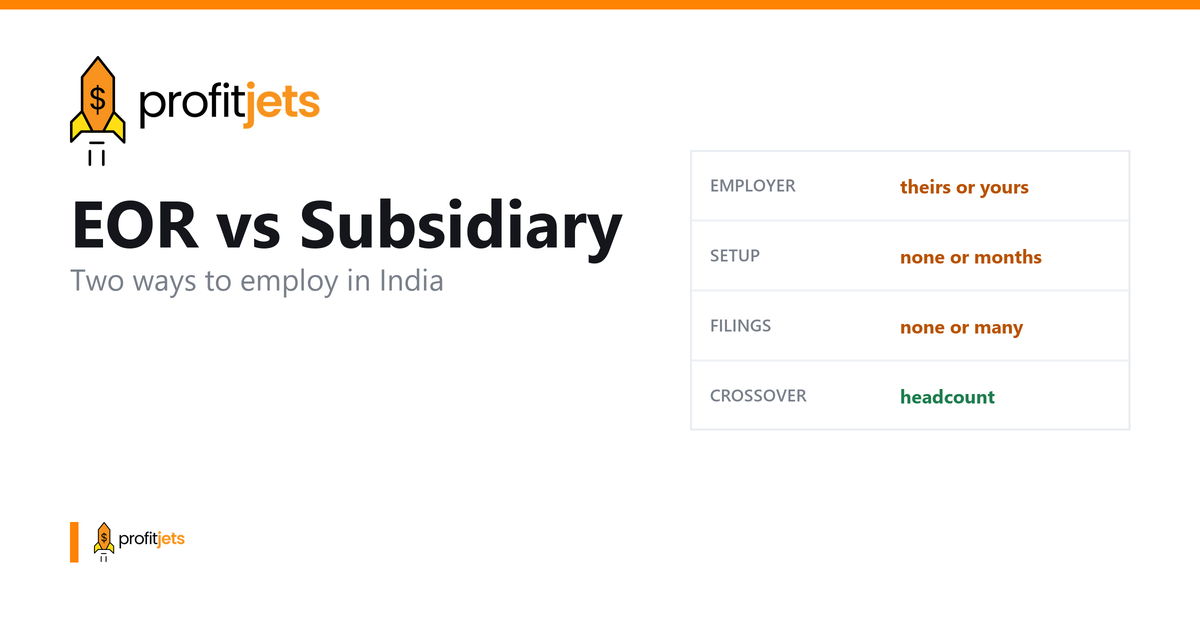
A subsidiary is your own entity, but it takes a while to get up and running (incorporation, resident director, office setup, tax registrations) before you can hire anyone.
It’s something you should think about if you know you want to scale up your India operations.
The EOR is Employer of Record, which is a legal entity who will take on your hire as an employee in India to make it possible for you to be able to start hiring without having to go through the hassle of setting up an entity.
An EOR lets you start small and fast, with less per-employee cost.
Founders that get in touch with us asking about hiring in India have read that there are two options, a subsidiary and an employer of record, and wonder which is better. It depends on how much you want to put on the expansion.
In short, whether EOR or subsidiary depends on how serious you are about building a bigger team in India, and how soon you want to get people on board. Here’s a detailed breakdown of how the two options compare.
What the two routes actually are
The difference is not administrative. It is the question of who, in Indian law, is the employer.
With an employer of record, usually shortened to EOR, a company that already exists in India employs your people on your behalf. Its name is on the employment contract. It runs the payroll, deducts and deposits the statutory contributions, and carries the obligations of an Indian employer. You direct the work, set priorities and manage performance, exactly as you would with anyone else on your team.
With a subsidiary, you incorporate an Indian company that you own, and it employs them. You hold the employment relationship directly, and with it every obligation that attaches to being an Indian company.
An employer of record is not the same as a PEO. A PEO works alongside an entity you already have, as a co-employer. If you have no Indian entity at all, a PEO is not an option, which is a distinction that trips up a lot of first-time buyers.
What a subsidiary commits you to
This is the part that tends to be underestimated, because the incorporation itself is the easy bit. The obligations start at incorporation and do not stop.
Before anyone can be paid
- Incorporation itself, then PAN and TAN for the company
- GST registration, where your activity requires it
- EPFO and ESIC registration, so provident fund and state insurance can actually be deducted and deposited
- An Indian bank account, which is routinely the slowest step of the lot and is not something you can rush from abroad
Because the shareholder is foreign
- Form FC-GPR, filed on the RBI's FIRMS portal within 30 days of allotting the shares. Not within 30 days of the money landing. That distinction is the single most commonly missed deadline in the whole process
- The FLA return to the RBI, every year, reporting foreign liabilities and assets
- Form FC-1 within 30 days of incorporation, carrying the foreign parent's details
Because the subsidiary and the parent are related
This is the one that surprises people most. Everything your Indian company charges the parent, or is charged by it, is a transaction between associated enterprises. That brings India's transfer pricing regime into play.
- A transfer pricing study, maintained and refreshed annually, justifying the basis on which the Indian entity is remunerated
- Form 3CEB, certified by a practising Chartered Accountant, filed every year
- An arm's length position you can defend, typically cost plus a markup for a captive services entity, which is what most of these companies are in substance
Every year, regardless of size
- Statutory audit, whatever the headcount and whatever the revenue
- ROC annual filings
- Board meetings and minutes, kept properly
- TDS returns, GST returns where applicable, and the payroll filings
None of that scales down because you only have two employees. A subsidiary with two people on the payroll carries most of the same annual calendar as one with fifty.
The mistake I see is treating incorporation as the finish line. It is the start of a compliance calendar that runs every year whether you have two employees or twenty, and the transfer pricing piece catches people completely off guard, because they never thought of paying their own subsidiary as a transaction that needs defending.
Anu Gupta, CA, EA, B.Tech · LinkedInWhere the money actually differs
Three things make up the cost of employing someone in India, and only one of them changes between the two routes.
| Employer of record | Your own subsidiary | |
|---|---|---|
| Salary | At cost | At cost |
| Statutory employer contributions | At cost, set by Indian law | At cost, set by Indian law |
| Provider fee | A monthly fee per employee | None |
| Incorporation and registrations | None | One off, and it is real work |
| Annual audit, ROC, 3CEB, FLA | None for this purpose | Every year, fixed, regardless of headcount |
| Your own time | Low | The cost nobody budgets for |
The salary and the statutory layer are identical either way, because provident fund, ESI, gratuity and professional tax are set by Indian law and do not care who signs the cheque. So the comparison is genuinely just this: the monthly fee per employee, against the fixed annual cost of running a company plus the time it takes you.
That is why the answer flips on headcount. A monthly per-employee fee grows in a straight line with the team. The cost of running an entity is close to flat. Somewhere those two lines cross.
Where the crossover sits
You will find confident numbers for this online. Fifteen employees. Twenty five. Fifty. They disagree with each other because the honest answer is that it depends on your salaries, the fee you are paying and what your own time is worth.
The calculation itself is not complicated. Take the annual provider fee for the headcount you expect in two years. Set it against the annual cost of an Indian entity at that same size: audit, ROC filings, the transfer pricing study and 3CEB, payroll compliance, and someone's attention every month. Where the first number passes the second, the entity starts to win.
A subsidiary is harder to close than it is to open. If the India plan is a bet rather than a commitment, that asymmetry belongs in the decision. An employer of record arrangement ends with notice and a final settlement.
When a subsidiary is simply the right answer
There is one situation where the headcount maths does not matter at all, and it is worth being blunt about it.
An employer of record employs people. It cannot trade for you. It cannot sign contracts with Indian customers in your name, raise Indian invoices, or collect Indian revenue. If your India plan involves selling into India rather than only building there, you need your own entity, and no fee comparison changes that.
The same applies if you need to hold assets in India, take on Indian regulatory licences, or if a large customer or investor requires a local legal counterparty.
When an employer of record is the better route
- You want a small team, and you want them working this quarter rather than after a registration queue
- India is a talent decision, not a market-entry decision
- You are testing whether an India team works before committing to one
- You do not want transfer pricing documentation and an annual audit attached to a two-person team
- You would rather your finance time went somewhere other than an RBI portal
If that is you, our employer of record in India service employs your team through our own Indian entity at a flat fee per employee, with the salary and statutory contributions billed at cost.
A practical way to decide
Ask what India is for
Talent, or market? If you will be selling into India, you need an entity and the rest of this is academic.
Write down the two year headcount, honestly
Not the ambition, the plan. Two people who might become four is a very different answer from four becoming forty.
Price both at that headcount
Provider fee against entity running cost. Include the transfer pricing work and the audit, because they are not optional.
Weigh how reversible each is
If the plan might change, the route that ends with a notice period is worth paying something for.
Then choose, and revisit it annually
Starting with an employer of record and moving to an entity later is a normal path, not a failure. The reverse is much more painful.
The short version
If you want a team in India, an employer of record is usually the faster and cheaper way in, and it stays the cheaper way for longer than most people expect. If you want a business in India, you need an entity, and the sooner you accept that the better.
Most companies we see should start with the first and keep the second under review. The mistake is incorporating on day one because it feels more serious, and then discovering that two employees have brought an annual audit, a transfer pricing study and an RBI filing calendar with them.
Incorporation, banking, registrations, and ongoing compliance often add administrative work, when a company is starting with just one or two employees.
One of the first questions they ask is how much an EOR provider charges per employee and what that fee actually covers. Published monthly fees are ranging from $199 to $699 among the EOR providers.
At Profitjets, our EOR service starts at $75 per employee per month. We help foreign companies with local employment, payroll, and compliance without paying a global platform fee.
Frequently Asked Questions
What is the difference between an EOR and a subsidiary in India?
An employer of record is an existing Indian company that employs your people on your behalf, so its name is on the employment contract and it carries the Indian employer obligations. A subsidiary is your own Indian company, which employs them directly and carries those obligations itself, along with incorporation, annual audit, ROC filings, FDI reporting and transfer pricing documentation.
Is an EOR cheaper than a subsidiary in India?
For a small team, usually yes, because the salary and the statutory employer contributions are identical either way and the only difference is a monthly fee against the fixed annual cost of running a company. As headcount grows the per-employee fee rises in a straight line while the entity cost stays roughly flat, so at some point the entity wins. Where that point sits depends on your salaries and the fee you pay.
Can an employer of record sign contracts with customers in India?
No. An employer of record employs people. It cannot sign customer contracts in your name, raise Indian invoices or collect Indian revenue. If your plan involves selling into India rather than only hiring there, you need your own entity.
What is Form 3CEB and would I have to file it?
Form 3CEB is an annual report on international transactions with associated enterprises, certified by a practising Chartered Accountant. If you set up an Indian subsidiary, the dealings between it and the parent are exactly those transactions, so it applies and a transfer pricing study sits behind it. Hiring through an employer of record does not create that obligation for the India hire.
How long does it take to start hiring under each route?
With an employer of record the entity and the registrations already exist, so the timeline is the onboarding paperwork. With a subsidiary you cannot pay anyone until incorporation, PAN, TAN, EPFO and ESIC registration and an Indian bank account are all in place, and the bank account is usually the step that sets the pace.
Can I start with an EOR and move to my own entity later?
Yes, and it is a common path. Employees are transferred from the employer of record onto your own payroll once the entity is ready. It needs planning around continuity of service, benefits and timing, so it is worth mapping before you start rather than after.

Written by
Anu Gupta, CA, EA, B.Tech
Anu works with US businesses on tax and entity questions at Profitjets, from choosing a structure to the filings that follow it. She writes about the decisions owners make once and then live with for years. Connect on LinkedIn
Free consultation
Not Sure Which Route Fits You?
Tell us how many people you want in India and what they will be doing, and we will tell you honestly which of the two makes sense.