
Many growing businesses cross an important line without noticing. When the headcount of full-time employees exceeds 50, when part-time hours are included, and the company is an applicable large employer under the Affordable Care Act. In the next year, it must offer affordable health coverage to all full-time employees or face penalties and report to the IRS and all its full-time employees what it offered.
This report takes the form of two documents. Form 1095-C is sent to each full-time employee and indicates for each month if coverage was offered, the self-only cost of the least expensive coverage and which safe harbor or exception applied. Form 1094-C is the transmittal to the IRS with these statements.
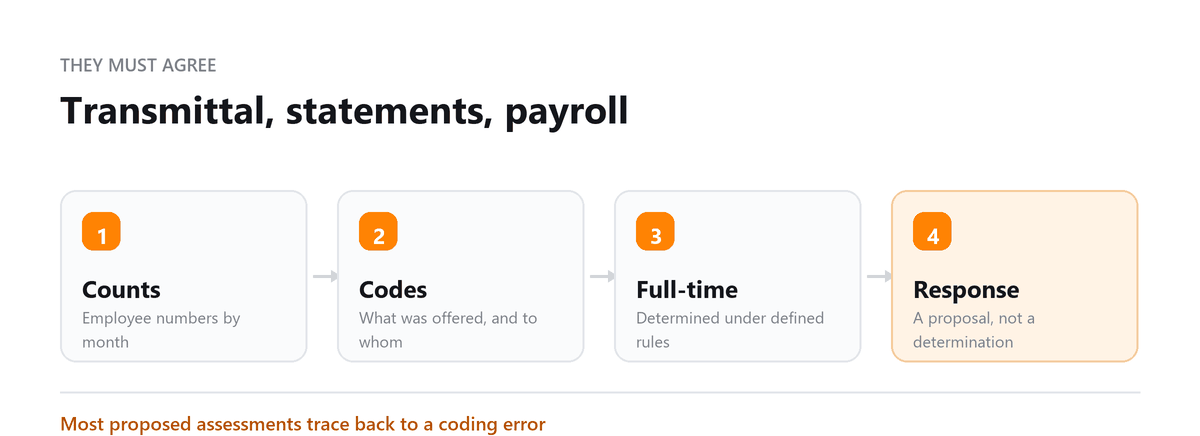
They summarize the employer information, affirm if coverage was offered to a sufficient number of full-time employees each month, indicate the number of employees per month and identify other entities in the aggregated group.
The IRS uses this information to determine if an employer may be liable for an Employer Shared Responsibility payment.
When a full-time employee claims a premium tax credit via the Marketplace, the codes on the 1094-C and 1095-C indicate if the employer offered affordable minimum value coverage. Incorrect codes, failure to establish a safe harbor or late filing can transform a compliant employer into one at risk of a penalty letter.
This guide explains who has to file Form 1094-C, how applicable large employer status is determined, how affordability and the safe harbors work, filing and furnishing deadlines, penalties, and what Form 1094-C reports.
Who Must File Form 1094-C?
Applicable Large Employers
An employer is an applicable large employer, or ALE, for a calendar year if it had on average at least 50 full-time employees, including full-time equivalent employees, during the prior calendar year.
Full-time employees are those who averaged at least 30 hours of service per week, or 130 hours per month.
Full-time equivalents are calculated by adding the hours of non-full-time employees for each month, up to 120 hours per employee, and dividing by 120.
Because ALE status is based on the prior year, an employer that grows past 50 full-time employees during 2025 generally becomes an ALE for 2026, with its first Forms 1094-C and 1095-C due in early 2027.
Aggregated Groups
Companies under common ownership are combined when determining ALE status. Each company in the group that's part of an ALE is an ALE member and generally files its own Form 1094-C and Forms 1095-C for its employees, even if that company alone has fewer than 50 employees.
Filing Isn't Optional
ALEs must file Forms 1094-C and 1095-C whether or not they offered health coverage, and whether or not they expect to owe an Employer Shared Responsibility payment.
Self-Insured Employers
Self-insured employers that are ALEs report coverage information on Form 1095-C, completing the section for covered individuals. Employers with self-insured plans that aren't ALEs generally report coverage on Forms 1094-B and 1095-B instead.
TY2025 ACA Affordability Threshold
| Year | ACA Affordability Percentage |
|---|---|
| 2022 | 9.61% |
| 2023 | 9.12% |
| 2024 | 8.39% |
| 2025 | 9.02% |
For TY2025: employer-sponsored health coverage is considered 'affordable' if the employee's share of the self-only premium does not exceed 9.02% of the employee's household income. Since household income is not directly known, employers use one of three safe harbors: W-2 wages safe harbor, rate of pay safe harbor, or federal poverty level safe harbor.
The affordability error I see most often is testing the employee's contribution against the wrong number. Employers can't see household income, so they have to use one of the IRS safe harbors, and many don't pick one deliberately.
They set the contribution at a flat dollar amount, then discover that for lower-paid or part-year employees it exceeded the affordability percentage of W-2 wages. The rate of pay or federal poverty line safe harbors usually prevent that, as long as the contribution is set with the safe harbor in mind before the plan year starts.
Ankit Sarawagi, CPA, CA, MBA · LinkedInFiling Deadlines for TY2025 (Filed in 2026)
| Filing Method | Deadline |
|---|---|
| Paper filing (mail to IRS) | February 28, 2026 |
| Electronic filing (IRS AIR system, mandatory for 10+ forms) | March 31, 2026 |
| Furnish Form 1095-C to employees | January 31, 2026 |
Mandatory e-filing threshold: as of 2024, employers filing 10 or more information returns in aggregate must e-file. Most ALEs filing 50+ employee returns must e-file via the IRS Affordable Care Act Information Returns (AIR) system.
Penalties for Late or Incorrect Filing
- Filed within 30 days: $60 per form
- Filed 31 days to August 1: $130 per form
- Filed after August 1 or not filed: $330 per form
- Intentional disregard: $660 per form, no cap
What Form 1094-C Transmits
Form 1094-C is a cover sheet, it does NOT contain individual employee data. It tells the IRS:
- Employer identifying information (EIN, name, address)
- Total number of Forms 1095-C enclosed
- Whether the employer was an ALE member (in an aggregated ALE group)
- Whether minimum essential coverage was offered to at least 95% of full-time employees
- Each month the employer was an ALE member and the total number of full-time employees per month.
Profitjets manages ACA reporting for more than 30 Applicable Large Employer (ALE) clients, processing approximately 4,000 Forms 1095-C annually and coordinating related Form 1094-C filings.
We grew from 45 to 52 full-time employees during the year and realized we now needed to address ACA reporting requirements. Profitjets implemented the 1094-C and 1095-C process, reviewed our employee data, and helped us apply the appropriate affordability safe harbor so our reporting was handled consistently.
Book a free consultation and we will reconcile it to payroll.
FAQs
What is the ACA affordability percentage for 2025 and 2026?
It's 9.02 percent for 2025 and 9.96 percent for 2026. Employer coverage is affordable if the employee's required contribution for the lowest-cost self-only plan providing minimum value doesn't exceed that percentage of household income, which employers measure using the W-2, rate of pay, or federal poverty line safe harbor.
When are Forms 1094-C and 1095-C due?
For 2025 coverage, Forms 1095-C had to be furnished to employees by March 2, 2026. Paper filings with the IRS were due March 2, 2026, because February 28 fell on a Saturday, and electronic filings were due March 31, 2026. Most ALEs must file electronically.
Who counts as an applicable large employer?
An employer that had on average at least 50 full-time employees, including full-time equivalents, during the prior calendar year. Companies under common ownership are combined to determine ALE status. Full-time generally means averaging 30 or more hours of service per week.
Do small self-insured employers file Form 1094-C?
No. Self-insured employers that aren't ALEs generally report coverage on Forms 1094-B and 1095-B. Self-insured employers that are ALEs report both offers and coverage on Forms 1094-C and 1095-C.
What is Letter 226-J?
It's the IRS letter proposing an Employer Shared Responsibility payment, based on the information reported on Forms 1094-C and 1095-C and on employees who received premium tax credits. Employers generally have 90 days to respond, and many proposed payments are reduced or eliminated when the employer corrects coding errors or shows coverage was affordable.

Written by
Ankit Sarawagi, CPA, CA, MBA
Ankit leads the finance team at Profitjets, where he has worked with 500+ businesses across the US on bookkeeping, tax and CFO-level strategy. He writes about the habits that keep small business books accurate all year. Connect on LinkedIn
Free consultation
ACA Reporting Due?
Book a free consultation and we will reconcile it to payroll.