
A US citizen moves to Dubai for a job, or a freelancer relocates to Portugal and keeps working with clients back home. Many assume that once they live and pay tax abroad, the IRS is no longer part of the picture. It is. The United States taxes its citizens on worldwide income wherever they live, so moving overseas doesn't end the need to file a US return.
What it can end, for many people, is the US tax bill. The foreign earned income exclusion lets qualifying taxpayers exclude a large amount of wages or self-employment income earned abroad from US income tax, and the foreign housing exclusion or deduction can add more on top. Form 2555 is how both are claimed.
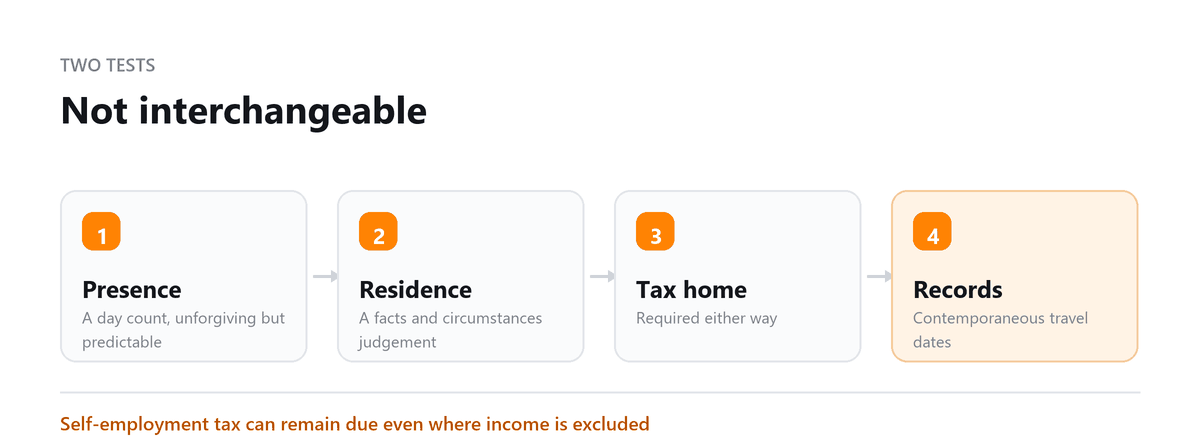
The exclusion comes with conditions that trip people up. You need a foreign tax home and must pass either the bona fide residence test or the physical presence test. It only covers earned income, not investments. It doesn't remove self-employment tax. And for people in high-tax countries, the foreign tax credit is often the better choice. Picking the wrong approach, or counting days carelessly, can cost more than it saves.
This guide explains who qualifies for the foreign earned income exclusion, the two qualifying tests, what counts as foreign earned income, the housing exclusion and deduction, how the exclusion compares with the foreign tax credit, and the filing deadlines and extensions for taxpayers abroad.
TY2025 Foreign Earned Income Exclusion Limit
| Tax Year | FEIE Maximum Exclusion |
|---|---|
| 2022 | $112,000 |
| 2023 | $120,000 |
| 2024 | $126,500 |
| 2025 | $130,000 |
The foreign tax credit usually beats the exclusion for people living in countries with higher income tax than the US, such as the UK, Germany, or France. Their foreign tax already covers the US tax, and the credit lets them carry unused foreign tax forward for up to ten years. The exclusion can also cost families with children the refundable child tax credit, and it blocks IRA contributions based on excluded income. For expats in low-tax or no-tax countries like the UAE, the exclusion is usually the stronger option.
Ankit Sarawagi, CPA, CA, MBA · LinkedInWho Qualifies for Form 2555?
You must meet ALL of the following:
- Have foreign earned income (wages, salaries, professional fees, or self-employment income from services performed abroad)
- Have a tax home in a foreign country (your principal place of business or employment is abroad)
- Meet EITHER the Bona Fide Residence Test OR the Physical Presence Test (see below)
Bona Fide Residence Test vs Physical Presence Test
| Test | Requirement | Typical User |
|---|---|---|
| Bona Fide Residence Test | Bona fide resident of a foreign country for an uninterrupted period that includes an entire calendar year | Long-term expats with established foreign residency |
| Physical Presence Test | Present in a foreign country for at least 330 full days in any consecutive 12-month period | Contractors, shorter-term assignees, those still establishing residency |
What Is 'Foreign Earned Income'?
- YES, foreign earned income: wages, salaries, bonuses, self-employment income, professional fees, all from services performed outside the U.S.
- NO, not foreign earned income: dividends, interest, capital gains, Social Security benefits, pension distributions, deferred compensation, corporate dividends, alimony
Key distinction: earned income = active compensation for services. Investment income from foreign accounts is NOT eligible for the FEIE, it is reported and may be eligible for the foreign tax credit instead.
Foreign Housing Exclusion/Deduction
In addition to the FEIE, qualifying expats may exclude or deduct housing expenses paid with employer-provided funds (housing exclusion) or self-employment income (housing deduction). The base amount is 16% of the FEIE, for TY2025: $20,800 base. Allowable housing costs above this base (up to a city-specific limit) are excluded or deducted.
FEIE vs Foreign Tax Credit: Key Trade-Off
The FEIE excludes income from U.S. tax, you pay no U.S. tax on excluded income. The Foreign Tax Credit (Form 1116) offsets U.S. tax dollar-for-dollar with foreign taxes paid. For expats in high-tax countries (UK, Germany, France), the foreign tax credit often eliminates the U.S. tax liability more efficiently because it allows you to use the entire foreign tax paid as a credit. If you claim the FEIE and live in a high-tax country, you may waste some of your foreign tax credit capacity.
Filing Deadline
Form 2555 is attached to Form 1040 by April 15, 2026 for TY2025, with automatic extension to June 16, 2026 for U.S. persons living abroad, plus Form 4868 for an additional 4-month extension to October 15, 2026.
Conclusion
The foreign earned income exclusion can remove most or all US income tax on wages and self-employment income earned abroad, but only for taxpayers who meet the foreign tax home requirement and pass either the bona fide residence or physical presence test.
It covers earned income only, doesn't remove self-employment tax, and can affect credits and retirement contributions. For expats in high-tax countries, the foreign tax credit is often the better tool. File Form 2555 every year you rely on it, keep careful records of where you lived and worked, and compare it against the foreign tax credit before making an election you'll have to live with.
Profitjets supports more than 50 US expatriate clients with foreign-earned income reporting and FEIE planning, helping eligible taxpayers document their overseas workdays, calculate the Foreign Earned Income Exclusion, and evaluate related housing benefits.
“I’m a US citizen working in Dubai and spent more than 330 full days outside the US during the qualifying 12-month period, allowing me to meet the physical presence test for the FEIE. Profitjets helped me claim approximately $130,000 of qualifying foreign earned income under the exclusion and also reviewed whether I qualified for the foreign housing exclusion based on my eligible housing expenses.”
Book a free consultation and we will compare exclusion against credit.
Frequently Asked Questions
What is the foreign earned income exclusion for 2025 and 2026?
The maximum exclusion is $130,000 per person for 2025 and $132,900 for 2026. If both spouses qualify and earn foreign income, each can claim their own exclusion, so a couple could exclude up to $260,000 for 2025.
Can I claim both the foreign earned income exclusion and the foreign tax credit?
Yes, but not on the same income. You can exclude foreign earned income up to the limit and claim the foreign tax credit on income above the limit or on other foreign income, such as investment income. Foreign taxes allocable to excluded income can't be used as a credit.
Does the foreign earned income exclusion eliminate self-employment tax?
No. It only applies to income tax. Self-employed taxpayers abroad generally still owe US self-employment tax, unless a totalization agreement between the United States and their country of residence exempts them.
How do I count days for the physical presence test?
You need at least 330 full days in a foreign country or countries during any 12 consecutive months. A full day runs from midnight to midnight. Days spent partly in the United States or traveling over international waters don't count. You can choose the 12-month period that works best, even if it overlaps two tax years.
When is Form 2555 due?
It's filed with your Form 1040, which is due April 15. If you live and work outside the United States on that date, you get an automatic two-month extension to June 15 to file, and you can extend further to October 15 with Form 4868. Interest on tax owed still runs from April 15.

Written by
Ankit Sarawagi, CPA, CA, MBA
Ankit leads the finance team at Profitjets, where he has worked with 500+ businesses across the US on bookkeeping, tax and CFO-level strategy. He writes about the habits that keep small business books accurate all year. Connect on LinkedIn
Free consultation
Working Abroad?
Book a free consultation and we will compare exclusion against credit.