
Form 8621 must be filed by any U.S. person who is a direct or indirect shareholder of a Passive Foreign Investment Company (PFIC). PFICs are foreign corporations that earn primarily passive income or hold mostly passive assets, including many foreign mutual funds, ETFs, and holding companies. The PFIC regime imposes punitive tax treatment unless the shareholder makes a specific election.
Many people who move to the United States keep their investments from home. A mutual fund in India, an ETF bought through a UK brokerage, a savings fund linked to an employer abroad.
Nothing about that seems unusual until tax time, when those holdings turn out to be passive foreign investment companies, or PFICs, and fall under some of the harshest rules in the tax code.
A PFIC is generally any foreign corporation where at least 75 percent of gross income is passive or at least 50 percent of assets produce passive income. Most foreign mutual funds and ETFs meet that test.
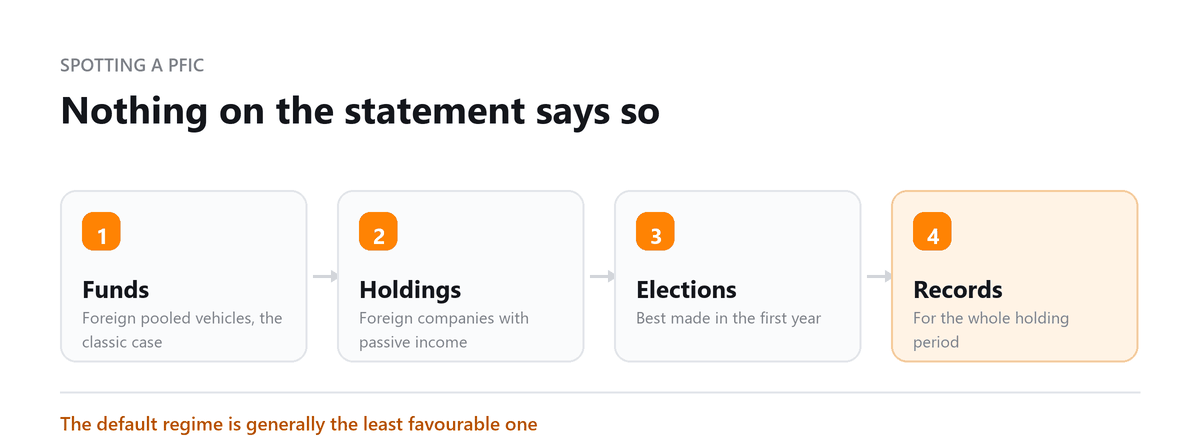
Under the default rules, gains and larger distributions can be taxed at the highest ordinary income rate with an interest charge added, as if the income had been earned over every year you owned the fund. Elections like a qualified electing fund or mark-to-market election can change that outcome, but only if they're made correctly and on time.
Expert Perspective
The clients most surprised by PFIC rules are usually new US residents who kept their mutual funds back home, often in India. They expect a sale to be taxed like a US fund at capital gains rates.
Under the default rules, it can be taxed at the highest ordinary rate with an interest charge on top, and years of missed Form 8621 filings can leave old returns open. Reviewing foreign holdings in the first year of US tax residency is far cheaper than cleaning it up at the point of sale.
Ankit Sarawagi, CPA, CA, MBA · LinkedInThis guide explains what counts as a PFIC, who has to file Form 8621, the filing exceptions, how the default tax rules and elections work, and what to do about missed filings.
What Is a PFIC?
A foreign corporation is a PFIC if it meets either of two tests:
- Income test: 75% or more of gross income is passive income (dividends, interest, rents, royalties, capital gains)
- Asset test: 50% or more of assets produce or could produce passive income
Common PFIC examples for U.S. taxpayers: foreign mutual funds, foreign ETFs, foreign insurance products with investment components, and some foreign holding companies.
Who Must File Form 8621?
Form 8621 reports each PFIC investment, the income from it, and any elections. The filing requirement stands apart from the tax itself, and failing to file can leave the statute of limitations open on your entire return. Many holders only discover the issue years later, when they sell and a preparer asks how the fund was reported in prior years.
- Any U.S. person who is a direct or indirect shareholder of a PFIC during any part of the tax year
- Must file for each PFIC separately, one Form 8621 per PFIC investment
- Required even if no income was received, ownership alone triggers the filing requirement
The Three PFIC Taxation Regimes
| Regime | How It Works | Election Required? |
|---|---|---|
| Default (Excess Distribution) | Tax and interest charges applied to excess distributions and gains from sale, calculated as if income earned ratably over holding period. Most punitive. | No election, default |
| QEF Election (Qualified Electing Fund) | Taxpayer includes pro-rata share of PFIC ordinary income and capital gains each year, even if not distributed. Requires PFIC to provide Annual Information Statement. | Yes, Form 8621, Section B |
| Mark-to-Market (MTM) | Taxpayer marks PFIC shares to fair market value each year; gains are ordinary income; losses deductible up to prior MTM gains. Requires publicly traded PFIC shares. | Yes, Form 8621, Part IV |
Penalties for Failing to File Form 8621
There's no specific dollar penalty for failing to file Form 8621 itself. That doesn't make missing it harmless. The consequences come from how an unfiled form affects the rest of your return.
The Statute of Limitations Stays Open
Normally, the IRS has three years from the date you file a return to assess additional tax. When a required Form 8621 isn't filed, that period doesn't start running for the return. It stays open until the required information is provided.
The extended period generally covers the entire return, not just the PFIC income. If the failure was due to reasonable cause and not willful neglect, the extension is limited to the items related to the missing form. Either way, a year with an unfiled Form 8621 can remain open to examination long after the usual three-year window would have closed.
Tax and Interest Still Apply
Not filing doesn't change how the income is taxed. Under the default PFIC rules, excess distributions and gains on sale are allocated across your holding period, taxed at the highest ordinary income rate for each prior year, and subject to an interest charge. The longer a PFIC has been held without proper reporting, the larger that interest charge can grow.
Missing Form 8621 in the first year can also cost you the chance to make a timely qualified electing fund or mark-to-market election, which often produce a lower tax result.
Accuracy-Related Penalties
If unreported PFIC income leads to an underpayment of tax, accuracy-related penalties can apply to that underpayment, generally 20 percent. If the PFIC is also a foreign asset that should have been reported on Form 8938 and wasn't, a 40 percent penalty can apply to the related underpayment, along with the separate Form 8938 failure-to-file penalty.
Catching Up on Missed Filings
If you've held PFICs without filing Form 8621, filing the missing forms with amended returns restarts the clock on the statute of limitations. Depending on your circumstances, the IRS Streamlined Filing Compliance Procedures or another compliance option may be appropriate. Review the situation with a tax professional before filing, since the right approach depends on how many years are involved, whether any elections are still available, and how the income was reported originally.
Filing Deadline
Form 8621 is attached to the annual tax return (Form 1040, 1065, or 1120 depending on filer type) and is due by the same deadline, including extensions. For calendar-year individual filers (TY2025): April 15, 2026 (or October 15, 2026 with extension).
Profitjets manages approximately 40 PFIC-related Form 8621 filings each year, including catch-up filings for clients who discover previously unreported foreign mutual funds or other PFIC investments during a tax review. In roughly 1 in 5 cases, the PFIC reporting requirement is identified for the first time during the client's initial review.
I had held several foreign mutual funds for years without realizing they could trigger separate US reporting requirements, and I had never filed Form 8621. Profitjets reviewed my investment history, identified the unfiled forms, calculated the required PFIC information, and developed a catch-up filing strategy for the prior years so we could bring the reporting up to date and address the associated IRS exposure.
Book a free consultation and we will check what you actually hold.
Frequently Asked Questions
What is a PFIC?
A passive foreign investment company is a foreign corporation that meets either an income test, where 75 percent or more of its gross income is passive, or an asset test, where 50 percent or more of its assets produce passive income or are held to produce it. Foreign mutual funds and ETFs almost always qualify. Some foreign holding companies and cash-rich startups can qualify too.
Who has to file Form 8621?
US persons who own PFIC shares directly or, in many cases, indirectly generally must file a separate Form 8621 for each PFIC. Filing is required when you receive distributions, sell or dispose of shares, make or report an election, or otherwise meet the annual reporting requirement. The form is attached to your federal income tax return.
Is there an exception for small PFIC holdings?
Generally, yes. You typically don't need to file for the annual reporting requirement if the total value of all your PFIC stock is $25,000 or less at year-end, or $50,000 or less for married couples filing jointly, and you had no excess distributions or gains and aren't reporting income under an election. A lower threshold applies to certain indirect holdings. If you sell shares or receive a reportable distribution, you must file regardless of value.
What are the QEF and mark-to-market elections?
Both are alternatives to the default excess distribution rules. A qualified electing fund election requires you to include your share of the fund's ordinary earnings and capital gains in income each year, but the fund must provide a PFIC annual information statement, which many foreign funds don't. A mark-to-market election, available for marketable stock, taxes the annual increase in value as ordinary income each year. Both work best when made in the first year you own the fund.
What happens if I never filed Form 8621?
There's generally no separate penalty just for not filing, but the consequences can still be significant. The statute of limitations can stay open for your entire return until the required information is filed, and any excess distributions or gains remain subject to tax and interest charges. Depending on the situation, amended returns or an IRS compliance program may be the right way to catch up.

Written by
Ankit Sarawagi, CPA, CA, MBA
Ankit leads the finance team at Profitjets, where he has worked with 500+ businesses across the US on bookkeeping, tax and CFO-level strategy. He writes about the habits that keep small business books accurate all year. Connect on LinkedIn
Free consultation
Holding Foreign Investments?
Book a free consultation and we will check what you actually hold.