
A real estate investor sells a rental property, buys a larger one a few months later, and assumes there's no tax because "it was a 1031 exchange." Then the preparer asks for the exchange agreement, the written identification of the replacement property, and closing statements from both deals.
One closing statement shows the sale proceeds were wired to the seller's own bank account for a week before being sent on. That single detail can be enough to disqualify the exchange.
A Section 1031 exchange lets you defer tax on the gain from selling business or investment real estate when you reinvest in other qualifying real estate. The tax isn't eliminated.
It's carried into the replacement property through a lower basis, and it comes due when that property is eventually sold without another exchange. Form 8824 is where the exchange is reported, the deferred and taxable gain is calculated, and the basis of the new property is set.
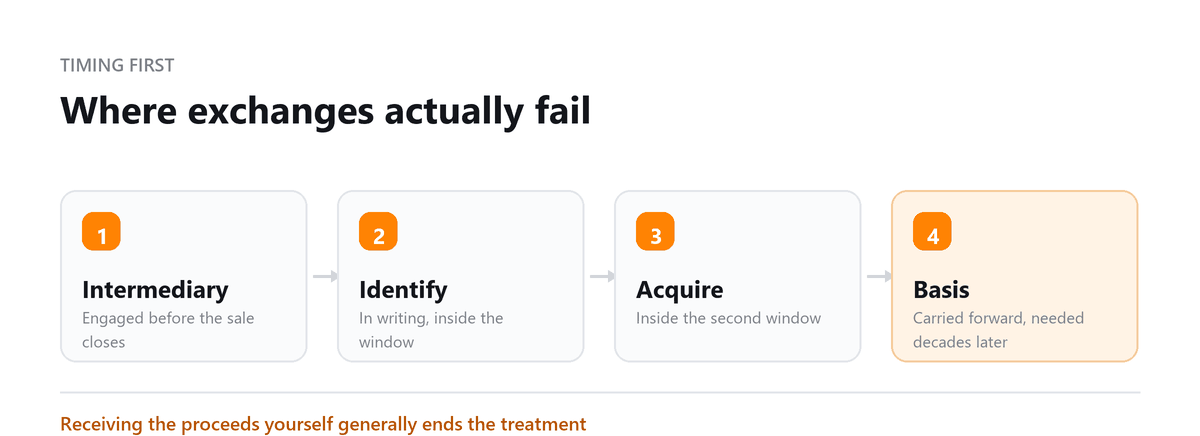
The rules leave very little room for error. You have 45 days to identify replacement property and 180 days to acquire it, with no extensions for weekends or holidays.
You can't take control of the sale proceeds. Cash or debt reduction you receive along the way can be taxable, and related party exchanges carry their own holding requirements. Getting these details right when the deal is structured is far easier than explaining them when the return is filed.
This guide explains how a like-kind exchange works, which property qualifies, the key deadlines and identification rules, how boot and replacement basis are calculated, how to complete Form 8824, and how related party exchanges and state rules affect reporting.
What is a Like-Kind Exchange?
A like-kind exchange under Section 1031 lets you defer recognizing gain when you exchange real property held for business or investment for other like-kind real property held for the same purposes.
The property you give up is the relinquished property. The property you receive is the replacement property. Instead of paying tax on the gain from the sale, you carry that gain into the replacement property by giving it a basis based on the old property's basis. The deferred gain is taxed later, when the replacement property is sold in a taxable transaction.
Most exchanges today are deferred exchanges, where you sell the relinquished property first and buy the replacement property later. To keep the sale proceeds out of your hands in the meantime, most taxpayers use a qualified intermediary, who holds the funds and handles the exchange documents.
What Property Qualifies?
Real Property Only
For exchanges completed after 2017, only real property qualifies. Equipment, vehicles, artwork, collectibles, and other personal property no longer qualify for like-kind treatment, so exchanges of those assets are generally taxable.
Held for Business or Investment
Both properties must be held for productive use in a trade or business or for investment. That includes rental properties, commercial buildings, industrial properties, farmland, and land held for investment.
What Doesn't Qualify
Your primary residence, although part of a home used as a rental or business may qualify.
Property held mainly for sale, such as houses bought to fix and flip, or lots held by a developer as inventory.
Interests in partnerships or LLCs, even if the entity owns real estate.
Stocks, bonds, notes, and other securities.
What "Like-Kind" Means for Real Estate
The like-kind test for real estate is broad. It looks at the nature of the property, not its quality or use. An apartment building can be exchanged for vacant land, a warehouse for a retail building, or a rental condo for a commercial office. However, US real property and foreign real property are not like-kind to each other.
Key 1031 Exchange Deadlines
| Deadline | Requirement |
|---|---|
| Day 0: Transfer of relinquished property | The clock starts on the date you transfer the relinquished property. Proceeds should go to a qualified intermediary, not to you. |
| Day 45: Identification period | Replacement property must be identified in writing, signed by you, and delivered to the intermediary or another party to the exchange who isn't disqualified. |
| Day 180: Exchange period | You must receive the replacement property by the earlier of 180 days after the transfer or the due date of your tax return for that year, including extensions. |
Both periods run at the same time, so the 45 days are part of the 180 days. Deadlines aren't extended for weekends or holidays. The IRS may postpone them for taxpayers affected by a federally declared disaster.
If the relinquished property is sold late in the year, the tax return due date can arrive before day 180. Filing an extension for that return preserves the full 180 days.
Identification Rules
You can generally identify replacement property under any one of these rules:
The three-property rule. Identify up to three properties of any value.
The 200 percent rule. Identify any number of properties, as long as their total fair market value doesn't exceed 200 percent of the value of the relinquished property.
The 95 percent exception. If you identify more than allowed under the first two rules, the identification can still be valid if you acquire properties worth at least 95 percent of the total value of everything you identified.
Deferred Gain vs Recognized Gain
A like-kind exchange doesn't make the entire transaction tax-free. It defers gain only to the extent you receive like-kind property.
Realized gain is the total economic gain from the exchange: the value of everything you received, minus the adjusted basis of the property you gave up and your exchange expenses.
Recognized gain is the portion you pay tax on now. It's generally equal to the boot you received, but never more than your realized gain.
Deferred gain is the realized gain that isn't recognized. It's carried into the replacement property through its basis.
What is Boot, and When is It Taxable?
Boot is anything you receive in an exchange that isn't like-kind property. It's taxable up to the amount of your realized gain.
Cash Boot
Cash you receive at closing, sale proceeds that aren't reinvested, and funds left with the intermediary that are returned to you after the exchange are all cash boot.
Mortgage Boot
When the debt on your replacement property is lower than the debt paid off on your relinquished property, the net reduction is treated as boot. For example, if your old property had a $500,000 mortgage and your new property has a $300,000 mortgage, you have $200,000 of mortgage boot unless you add $200,000 of your own cash to the purchase.
The netting rules aren't symmetrical. Adding cash to the replacement purchase can offset mortgage boot you receive, but taking on more debt doesn't offset cash boot you receive.
Other Boot
Non-like-kind property received in the exchange, such as furniture, equipment, or a promissory note from the buyer, is also boot.
How to Avoid Boot
To defer all of the gain, you generally need to buy replacement property of equal or greater value, reinvest all of the net proceeds, and replace any debt paid off with new debt or additional cash.
Basis of the Replacement Property
Your basis in the replacement property generally starts with the adjusted basis of the relinquished property, then:
Increases by any additional cash you paid, any gain you recognized, and any extra debt you took on.
Decreases by any cash boot you received and any debt relief.
The result is that the deferred gain stays built into the new property. When you sell the replacement property later without another exchange, that deferred gain becomes taxable, along with any gain that built up afterward.
Depreciation also carries over. The portion of the replacement property's basis that came from the relinquished property generally continues to be depreciated over its remaining recovery period, while any additional basis is depreciated as newly acquired property. Accurate basis and depreciation records are essential for the eventual sale.
How to Complete Form 8824
Form 8824 is organized in four parts.
Part I: Information on the Like-Kind Exchange
Describe the relinquished and replacement properties, and enter the dates you acquired the relinquished property, transferred it, identified the replacement property, and received it. You'll also indicate whether the exchange involved a related party.
Part II: Related Party Exchange Information
Complete this part if the exchange was with a related person, such as a family member or an entity you control. Related party exchanges are covered in more detail below.
Part III: Realized Gain or Loss, Recognized Gain, and Basis of Like-Kind Property Received
This is where the calculation happens. You enter the fair market value and adjusted basis of the properties, exchange expenses, cash and other boot received or paid, and liabilities assumed or relieved. The form then calculates realized gain, recognized gain, deferred gain, and the basis of the replacement property.
Any recognized gain flows to Schedule D, Form 4797, or both, depending on the type of property and whether depreciation recapture applies.
Part IV: Deferral of Gain From Section 1043 Conflict-of-Interest Sales
This part is only for certain government officials who sell property to comply with conflict-of-interest requirements. Most taxpayers won't use it.
If you complete more than one exchange during the year, file a separate Form 8824 for each. A summary Form 8824 with attached statements can be used when there are many exchanges.
When to File Form 8824
File Form 8824 with your federal income tax return for the tax year in which you transferred the relinquished property. That's true even if the replacement property is received in the following year.
If you sold the relinquished property in December 2025 and closed on the replacement property in March 2026, the exchange is reported on your 2025 return. In many cases, that means extending the 2025 return so the exchange can be completed and reported accurately.
Individuals attach Form 8824 to Form 1040. Partnerships, S corporations, and corporations attach it to their own business returns.
Related Party Exchanges
A like-kind exchange with a related person can still qualify, but both parties generally must hold the properties they received for at least two years after the last transfer in the exchange. If either party disposes of the property within that period, the deferred gain generally becomes taxable in the year of the disposition.
Exceptions exist for dispositions due to death, involuntary conversions, and transactions where tax avoidance wasn't a principal purpose.
If you exchange property with a related party, you generally must file Form 8824 for the year of the exchange and for each of the two following years.
State Considerations
Most states with an income tax follow the federal like-kind exchange rules, but some add their own requirements.
California is the most common example. When California property is exchanged for property located outside California, the state generally requires an annual information return so it can track the deferred gain and tax it when the replacement property is eventually sold.
If you're exchanging property across state lines, check the rules in both the state where the relinquished property is located and the state where the replacement property is located.
Common 1031 Exchange Mistakes
| Mistake | What Happens | How to Avoid It |
|---|---|---|
| Receiving the sale proceeds | The proceeds become taxable, and the exchange can fail | Engage a qualified intermediary before the sale closes |
| Missing the 45-day identification deadline | The exchange fails, and the gain is taxable in the year of sale | Identify properties in writing well before day 45 |
| Buying with less debt and no additional cash | Mortgage boot creates taxable gain | Replace debt paid off with new debt or added cash |
| Exchanging personal property | The exchange doesn't qualify | Remember only real property qualifies after 2017 |
| Reporting the exchange in the wrong year | Incorrect return and possible notices | Report in the year the relinquished property was transferred |
| Selling a related party's property too soon | Deferred gain becomes taxable | Track the two-year holding period for both parties |
| Losing track of carryover basis | Gain and depreciation recapture are wrong when the replacement property is sold | Keep basis and depreciation records from every exchange |
Conclusion
A Section 1031 exchange can defer a large tax bill on the sale of business or investment real estate, but only when the rules are followed precisely. Qualifying properties must be real estate held for business or investment, replacement property must be identified within 45 days and acquired within 180 days, and sale proceeds can't pass through your hands.
Boot received is taxable, and the deferred gain carries into the replacement property through its basis. Plan the exchange before the sale closes, report it on Form 8824 in the year you transfer the relinquished property, and keep careful basis records for the day the replacement property is eventually sold.
Profitjets has coordinated more than 30 Section 1031 exchanges, helping clients plan replacement-property purchases, track identification deadlines, and structure transactions to support capital gains deferral.
We were close to missing the 45-day identification deadline on a 1031 exchange because we hadn't finalized our replacement-property options. Profitjets helped us review the available properties and complete the identification process in time, and afterward we put a deadline-tracking process in place so future exchanges would be planned well before the identification window closed.
The biggest mistake first-time exchange clients make is touching the money. They close on the sale, receive the proceeds, and plan to send them to the intermediary later, or they pull out some cash at closing to cover other expenses.
Once you have actual or constructive receipt of the funds, that portion of the gain is taxable, and in some cases the whole exchange fails. The second most common mistake is buying a replacement property with less debt than the old one without adding cash to make up the difference. That debt reduction is boot, and it's taxable too.
Ankit Sarawagi, CPA, CA, MBA · LinkedInBook a free consultation and we will map the timeline with you.
Frequently Asked Questions
What qualifies for a 1031 exchange?
Only real property held for use in a trade or business or for investment, such as rental properties, commercial buildings, and investment land. Your primary residence, property held mainly for resale, partnership interests, securities, and personal property like equipment and vehicles don't qualify. Most US real estate is like-kind to other US real estate, but US and foreign real property aren't like-kind to each other.
What happens if I miss the 45-day or 180-day deadline?
The exchange generally fails, and gain on the sale of the relinquished property is taxable in the year of sale. The deadlines aren't extended for weekends, holidays, or financing delays. The main exception is when the IRS postpones deadlines for taxpayers affected by a federally declared disaster.
When is Form 8824 due?
Form 8824 is filed with your federal income tax return for the year in which you transferred the relinquished property, including extensions. If the exchange started in one year and finished in the next, it's still reported in the year the relinquished property was given up. Related party exchanges also require Form 8824 for the two following years.
What is boot in a 1031 exchange?
Boot is anything you receive that isn't like-kind property, including cash, sale proceeds that aren't reinvested, a reduction in mortgage debt that isn't offset, and other property such as notes or furniture. Boot is taxable up to the amount of your realized gain.
Can I do a 1031 exchange with a family member?
Yes, but related party exchanges have extra rules. Both parties generally must keep the properties they received for at least two years, or the deferred gain can become taxable. You must also file Form 8824 for the year of the exchange and the two years that follow.

Written by
Ankit Sarawagi, CPA, CA, MBA
Ankit leads the finance team at Profitjets, where he has worked with 500+ businesses across the US on bookkeeping, tax and CFO-level strategy. He writes about the habits that keep small business books accurate all year. Connect on LinkedIn
Free consultation
Planning an Exchange?
Book a free consultation and we will map the timeline with you.