
Form 8867 is the Paid Preparer's Due Diligence Checklist, required whenever a paid tax preparer completes a return or amended return claiming the Earned Income Tax Credit (EITC), Child Tax Credit (CTC) / Additional Child Tax Credit (ACTC), American Opportunity Tax Credit (AOTC), or Head of Household filing status. It certifies that the preparer performed the required diligence checks.
Most paid preparers think of Form 8867 as one more page to finish before e-filing. The software prompts for it, a few boxes get checked, and the return goes out. It feels like a formality right up until the IRS opens a due diligence audit, asks for the notes behind a head of household claim from two filing seasons ago, and there's nothing in the file except the form itself.
That's the core problem with Form 8867. The checklist isn't really the requirement. It's a summary of work the IRS expects you to have done: asking the right questions when a client's story doesn't add up, confirming that a child actually lived with the taxpayer, keeping the worksheets that show how each credit was calculated, and documenting who told you what and when. Checking a box without the records to back it up doesn't protect you.
The stakes are real on both sides of the desk. A preparer can be penalized for each missed requirement on each return, and the firm that employs them can be penalized too. Clients whose credits are disallowed can face repayment, penalties, and in some cases a ban on claiming those credits for years. Getting the process right means building due diligence into the interview, not tacking it onto the end of the return.
Expert Perspective
When a firm gets into trouble over Form 8867, it's rarely because the form was left blank. It's because the answers on the form weren't supported by anything in the file. The IRS doesn't just ask whether you checked 'yes.' It asks what the client told you, what questions you asked when something looked inconsistent, and where that's written down. Firms that treat the checklist as part of the client interview, with notes saved alongside the return, are the ones that come through a due diligence review without penalties.
Ankit Sarawagi, CPA, CA, MBA · LinkedInThis guide explains who has to file Form 8867, which credits and filing statuses it covers, the four due diligence requirements behind it, how to complete and submit the form, the records you need to keep, and the penalties for getting it wrong.
Who Must File Form 8867?
- Any paid preparer who prepares or assists in preparing a return or amended return that claims EITC, CTC/ACTC, AOTC, or Head of Household status
- Self-employed preparers: attach to client's return and retain a copy for 3 years
- Firm employees: the firm is also subject to the penalty if it knew or should have known of the failure
- NOT required for self-prepared returns, only for paid preparers
What Form 8867 Requires the Preparer to Certify
- That they completed the relevant due diligence worksheets (see Publication 596 for EITC worksheet)
- That they asked all required questions and recorded client responses
- That they did not ignore any information that appeared incorrect, inconsistent, or incomplete
- That no part of the compensation was contingent on the refund amount
What are the due diligence requirements behind Form 8867?
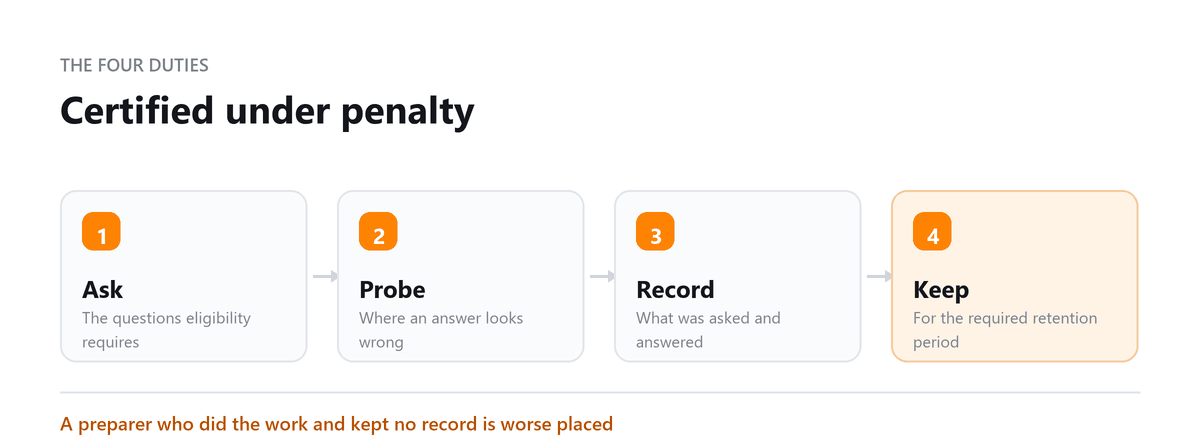
There are four.
You must complete and submit Form 8867 based on information provided by the taxpayer or otherwise reasonably obtained.
You must complete the computation worksheets for each credit claimed, or keep your own record of the calculation.
You must meet the knowledge requirement, which means not relying on information you know or have reason to know is incorrect, inconsistent, or incomplete, and making reasonable follow-up inquiries when something doesn't add up.
And you must keep the required records.
Credits Covered by Form 8867
| Credit / Status | Key Diligence Requirement |
|---|---|
| EITC | Verify income, filing status, qualifying child residency, SSN, and self-employment income |
| CTC / ACTC | Verify qualifying child age, relationship, SSN, and dependency |
| AOTC | Verify student enrollment at least half-time, first 4 years of higher education, no prior AOTC disallowance |
| Head of Household | Verify that client maintained a home and qualifying person lived there for more than half the year |
Penalty for Failure
Step-by-Step: Completing Form 8867
- Part I: Identify the tax return and preparer; check boxes for which credits/status are claimed
- Part II: EITC due diligence questions (income, filing status, qualifying children)
- Part III: CTC/ACTC due diligence questions
- Part IV: AOTC due diligence questions
- Part V: Head of Household due diligence questions
- Part VI: Records retention, preparer must keep all due diligence documentation for 3 years
- Sign the form; attach to the filed return
For returns involving refundable or education credits, we use a client questionnaire to collect the information needed to establish eligibility and request supporting records such as income documents, dependent information, school records, and other relevant documentation. We retain the required records with the return file and use a review checklist to confirm that Form 8867 is complete and the credit claims are supported before the return is finalized.
Book a free consultation and we will review your due diligence file.
FAQs
What is IRS Form 8867?
Form 8867, Paid Preparer's Due Diligence Checklist, is a form paid tax return preparers must complete and submit for returns that claim certain tax benefits. It documents that the preparer met the IRS due diligence requirements when determining a client's eligibility for those benefits and the amount claimed.
Who has to file Form 8867?
Paid tax return preparers do, not taxpayers. If you prepare your own return, you don't file Form 8867. A preparer must complete it for each client return that claims any of the covered benefits, whether the return is e-filed or filed on paper.
Which credits and filing statuses require Form 8867?
Four tax benefits trigger the due diligence requirements: the Earned Income Tax Credit, the Child Tax Credit and its related credits, including the Additional Child Tax Credit and the Credit for Other Dependents, the American Opportunity Tax Credit, and head of household filing status. A single return claiming more than one of these needs one Form 8867 covering all of them.
What are the penalties for not meeting Form 8867 due diligence requirements?
The IRS can assess a separate penalty for each failure to meet the requirements, for each covered credit or filing status claimed on each return. The penalty amount is adjusted for inflation every year. A single return claiming several covered benefits can therefore carry multiple penalties. A firm employing a preparer can also be penalized in some circumstances, and preparers face other possible consequences, such as suspension from IRS e-file.
Does using tax software satisfy the due diligence requirements?
No. Software can generate Form 8867 and the computation worksheets, but it can't meet the knowledge requirement for you. The preparer is still responsible for asking follow-up questions, evaluating whether the information makes sense, and documenting the conversation. Software prompts are a starting point, not proof of due diligence.

Written by
Ankit Sarawagi, CPA, CA, MBA
Ankit leads the finance team at Profitjets, where he has worked with 500+ businesses across the US on bookkeeping, tax and CFO-level strategy. He writes about the habits that keep small business books accurate all year. Connect on LinkedIn
Free consultation
Running a Tax Practice?
Book a free consultation and we will review your due diligence file.