
Form 8915-F is used to report qualified disaster retirement plan distributions, special withdrawals from IRAs, 401(k)s, and other retirement accounts following a federally declared disaster. It allows the tax on these distributions to be spread over 3 years and waives the 10% early withdrawal penalty.
After a hurricane, wildfire, or flood, money is needed fast. Insurance claims take weeks, temporary housing has to be paid for now, and a retirement account may be the largest pool of cash a family can reach.
The worry that usually follows is the tax bill: an early withdrawal is normally taxed as income in full, with a 10 percent additional tax on top if you're under 59.
For people affected by a federally declared major disaster, the rules can be much gentler. A qualified disaster distribution isn't subject to the 10 percent additional tax, the income can be spread evenly over three years instead of landing in one, and the money can be put back into a retirement plan within three years and treated as if it had never been taken out. Form 8915-F is where all of that is reported.
The relief isn't automatic, though. You have to meet the location and economic loss tests, take the distribution within the allowed window, stay under the dollar limit, and then keep reporting on Form 8915-F in the following years if you spread the income or make repayments. People who claim the relief in year one and forget about it in years two and three are the ones who end up with IRS notices.
What Is a Qualified Disaster Distribution?
A qualified disaster distribution is a distribution from an eligible retirement plan to a qualified individual that's made within a set window around a qualified disaster.
Eligible retirement plans include 401(k) plans, 403(b) plans, governmental 457(b) plans, other qualified employer plans, and traditional, SEP, SIMPLE, and Roth IRAs.
Qualified disasters are generally federally declared major disasters. For disasters declared after December 27, 2022, SECURE 2.0 made the relief permanent, so it no longer depends on Congress passing new legislation for each event.
The Distribution Window
To qualify, a distribution generally must be made on or after the first day of the disaster's incident period and no later than 180 days after the later of that date or the date of the disaster declaration.
Who Counts as a Qualified Individual
You're generally a qualified individual if:
Your principal residence was in the qualified disaster area at any time during the disaster's incident period.
You sustained an economic loss because of the disaster. Examples include damage to or destruction of your home or property, displacement from your home, or loss of income from job loss or reduced work hours caused by the disaster.
Key Limits and Tax Treatment
| Feature | Rule |
|---|---|
| Maximum eligible distribution | $100,000 per disaster event per taxpayer |
| Early withdrawal penalty (10%) | Waived, not applicable to qualified disaster distributions |
| Income tax treatment | Included in gross income ratably over 3 years (1/3 per year) unless taxpayer elects to include all in year of distribution |
| Repayment option | May repay to a retirement plan within 3 years of the distribution date; repaid amounts are not taxable income |
| If repaid after already taxed | Amend prior year returns to claim refund for tax already paid on repaid amount |
Whether to repay a disaster distribution or just pay tax on it over three years comes down to cash flow and long-term retirement savings. If the money was a short-term bridge until insurance or FEMA assistance arrived, repaying within three years usually makes sense, because it restores the retirement account and recovers the tax already paid on the repaid amount.
If the family genuinely needs the money to rebuild and won't have it back, spreading the income over three years keeps the tax manageable. The mistake is making no decision and letting the three-year window close without planning.
Ankit Sarawagi, CPA, CA, MBA · LinkedInHow Form 8915-F Works Across Tax Years
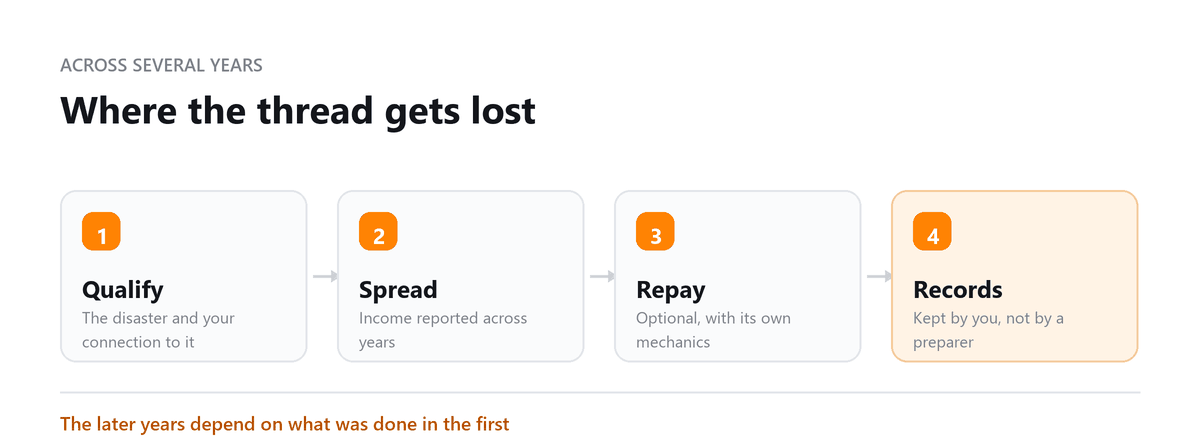
Because income is spread over 3 years, Form 8915-F is filed in up to 3 separate tax years for each disaster distribution:
- Year 1 (year of distribution): report 1/3 of the distribution on Form 8915-F, attached to Form 1040
- Year 2 and Year 3: file Form 8915-F again in each subsequent year to report the remaining thirds
- If the full amount is repaid before any given year's return is filed, no income is recognised for that year
Step-by-Step: Completing Form 8915-F
- Part I: Identify the disaster event and distribution amounts from each plan type (IRA, defined contribution, defined benefit)
- Part II: Calculate repayments made during or before the current tax year
- Part III: Calculate the taxable amount for the current year (after spreading and repayment offsets)
- The result flows to Schedule 1, Line 8 of Form 1040
Profitjets has supported more than 15 disaster-related retirement distribution engagements, helping clients review eligibility, coordinate the tax treatment, and evaluate repayment or three-year income-spreading options to avoid unnecessary tax consequences.
Our home and finances were affected by a major wildfire, so we took a disaster distribution from our retirement account to cover recovery costs. Profitjets helped us set up the three-year income spread and later reviewed our finances to determine whether repaying part of the distribution made sense before we finalized the tax treatment.
Book a free consultation and we will keep the reporting consistent.
Frequently Asked Questions
What is the maximum qualified disaster distribution?
For disasters occurring on or after January 26, 2021, the limit is $22,000 per disaster, combined across all your retirement plans and IRAs. Distributions above that amount follow normal distribution rules. Earlier 2020 and early 2021 disasters, and coronavirus-related distributions, had a $100,000 limit.
Do I have to pay the 10 percent early withdrawal penalty on a qualified disaster distribution?
No. The 10 percent additional tax on early distributions doesn't apply to the qualified amount. The distribution is still subject to regular income tax, which can be spread over three years or included all in the first year.
Can I repay a qualified disaster distribution?
Yes. You can repay all or part of it to an eligible retirement plan within three years, starting the day after you received it. Repayments are treated as rollovers. If you already paid tax on the repaid amount, you can generally recover it by amending the return for the year the income was reported.
Do I have to file Form 8915-F in more than one year?
Usually, yes. If you spread the income over three years, you file Form 8915-F in the year of the distribution and in each of the next two years. You also file it in any year you make a repayment. A separate form is generally filed for each disaster year.
Who qualifies for disaster retirement relief?
Generally, anyone whose principal residence was in a federally declared major disaster area during the incident period and who suffered an economic loss because of the disaster, such as property damage, displacement, or lost income. The distribution must also be taken within the allowed window after the disaster.

Written by
Ankit Sarawagi, CPA, CA, MBA
Ankit leads the finance team at Profitjets, where he has worked with 500+ businesses across the US on bookkeeping, tax and CFO-level strategy. He writes about the habits that keep small business books accurate all year. Connect on LinkedIn
Free consultation
Took a Disaster Distribution?
Book a free consultation and we will keep the reporting consistent.