
Form 8938 is required under FATCA (Foreign Account Tax Compliance Act) for U.S. taxpayers who hold specified foreign financial assets above certain thresholds. It reports foreign bank accounts, foreign stocks, foreign mutual funds, interests in foreign entities, and other overseas financial instruments to the IRS.
People with money abroad usually know they have to report it somewhere. A bank account kept from before moving to the US, investments with a brokerage overseas, an inheritance from family in another country.
Most have heard of the FBAR. Far fewer know about Form 8938, a separate requirement filed with a different agency, with different thresholds, covering a different set of assets. Filing one doesn't satisfy the other.
The consequences of missing it are significant. The penalty for failing to file starts at $10,000 and can grow by up to $50,000 after an IRS notice, a 40 percent penalty can apply to tax underpayments linked to undisclosed assets, and the statute of limitations can stay open.
Because foreign financial institutions report account information to the IRS under FATCA, mismatches are more likely to be noticed than many people assume.
Expert Perspective
Most people with overseas accounts have heard of the FBAR, so they file it and assume they're done. Form 8938 is a separate requirement with its own thresholds, and it goes with the tax return, not to FinCEN. It also covers things the FBAR doesn't, like foreign shares held outside a bank account or an interest in a foreign partnership. Anyone with significant assets abroad should check both every year, especially in the year they first become a US tax resident.
Ankit Sarawagi, CPA, CA, MBA · LinkedInWho Must File Form 8938?
Any U.S. taxpayer (citizen, resident alien, or certain nonresident aliens) who holds specified foreign financial assets above the applicable threshold must attach Form 8938 to their annual tax return.
Under the Foreign Account Tax Compliance Act, specified individuals, and certain domestic entities, must report specified foreign financial assets on Form 8938 when their total value exceeds certain thresholds.
The thresholds depend on filing status and whether you live in the US or abroad. The assets covered go beyond bank accounts to include foreign stock held directly, interests in foreign partnerships and companies, foreign pension plans, and foreign insurance policies with cash value.
Filing Thresholds, Domestic vs Abroad
| Filing Status | Living in U.S., File if Value Exceeds | Living Abroad, File if Value Exceeds |
|---|---|---|
| Single / MFS / HoH | $50,000 at year-end OR $75,000 at any point during year | $200,000 at year-end OR $300,000 at any point during year |
| Married Filing Jointly (both abroad) | $100,000 at year-end OR $150,000 at any point during year | $400,000 at year-end OR $600,000 at any point during year |
What Are Specified Foreign Financial Assets?
- Foreign bank and financial accounts (also reported on FBAR/FinCEN 114, see overlap note below)
- Stocks or securities issued by foreign companies
- Interests in foreign entities (partnerships, trusts, estates)
- Foreign financial contracts and instruments (swaps, options, forward contracts with foreign counterparties)
- Foreign pension plans and deferred compensation plans
NOT reportable on 8938: real estate held directly (not through a foreign entity), precious metals held directly, social security-type benefits from foreign governments.
FBAR vs Form 8938: Key Differences
| Factor | FBAR (FinCEN 114) | Form 8938 (FATCA) |
|---|---|---|
| Filed with | FinCEN (Treasury) electronically via BSA E-Filing System | IRS, attached to annual tax return |
| Threshold (domestic) | $10,000 aggregate at any time during year | $50,000 year-end OR $75,000 anytime (single) |
| What it covers | Foreign bank and financial accounts only | Broader: accounts + foreign stocks, entities, contracts, pensions |
| Deadline | April 15 (auto extension to October 15) | April 15 (or extension deadline of tax return) |
| Penalty for failure | Up to $10,000 civil non-willful; up to $100,000 or 50% of account balance for willful | $10,000 per year (Form 8938) + up to $50,000 if continued 90+ days after notice |
Penalty for Failure to File
Profitjets has supported more than 40 FATCA and Form 8938 compliance engagements, helping US taxpayers with overseas bank accounts, investments, pensions, and other foreign financial assets identify reporting requirements and complete catch-up filings.
I had returned to the US after several years abroad and realized I had unreported foreign accounts and investments that should have been disclosed on Form 8938. Profitjets reviewed my previous returns, assessed the potential filing and penalty exposure, and developed a catch-up filing strategy that brought the reporting up to date while addressing the applicable compliance requirements.
This Sits Alongside Other Reporting, Not Instead of It
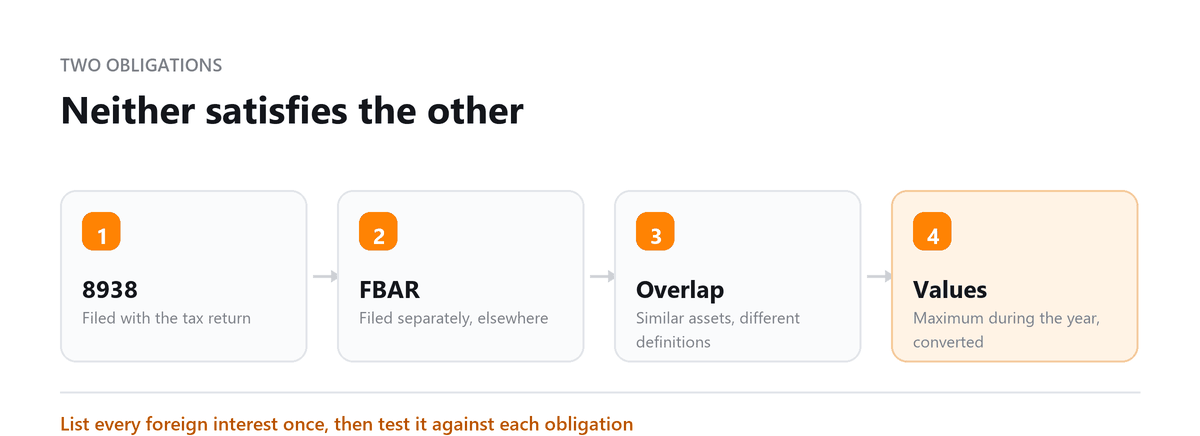
The most consequential misunderstanding here is treating this as the single foreign asset filing. It is one of several, with different thresholds, different definitions of what is reportable, different filing routes and different deadlines.
- One obligation is filed with the tax return, another is filed separately with a different agency
- The asset definitions overlap substantially without being identical, so the same account can appear on both or on only one
- The thresholds differ, so meeting one obligation says nothing about the other
- Filing one does not satisfy the other, and the penalties are separate
The practical approach is to list every foreign financial interest once, then test the list against each obligation separately. Working from one obligation and assuming the other follows is how filings get missed.
Assembling the Information
The reporting requires maximum values during the year rather than year-end balances, which is information many foreign institutions do not provide in a usable form.
That makes this a records problem as much as a filing one. Statements have to be collected through the year rather than requested afterwards, and for accounts that report only periodically, the highest balance has to be identified from what is available.
Currency conversion adds another layer, since values have to be translated on a defined basis rather than at whatever rate seems reasonable. Keeping the rate used and its source with the working papers is what makes the figure defensible later, and the IRS publishes guidance on the conversion basis expected.
If You Should Have Been Filing and Were Not
This is one of the more commonly discovered historic omissions, usually by someone who moved to the US, or who inherited or retained accounts abroad, and had no reason to think a filing was required.
Doing nothing is the worst option, because the failure to file a required international information form can keep the statute open on the whole return indefinitely, and the exposure grows with each year that passes.
The IRS maintains defined procedures for taxpayers coming forward, with different routes depending on whether the failure was non-wilful and on other circumstances. Which route applies matters a great deal to the outcome, the procedures change, and this is firmly an area for advice before making any filing rather than after.
Assets People Forget They Hold
The definition reaches further than a bank account abroad, and the items most often missed are the ones that never felt like investments.
- Foreign pension arrangements and employer savings schemes from a previous country of residence
- An interest in a foreign company, including a small holding in a family business
- Foreign life insurance or annuity contracts with a cash value
- Accounts held jointly with a family member abroad
- Accounts where you are a signatory for someone else, which may be reportable under a different obligation
Anyone who has lived outside the US, or who has family abroad, is worth taking through that list specifically. The pattern in practice is not concealment, it is an account opened years ago in another life that nobody thought to mention.
Book a free consultation and we will map both obligations.
FAQs
Who has to file Form 8938?
US citizens, resident aliens, and certain nonresident aliens may need to file if their specified foreign financial assets exceed the applicable threshold. Certain domestic corporations, partnerships, and trusts may also qualify as specified domestic entities. You generally don't need to file Form 8938 if you aren't required to file a federal income tax return.
What are the Form 8938 reporting thresholds?
For single taxpayers living in the US, the thresholds are generally $50,000 at year-end or $75,000 at any time during the year. For married couples filing jointly, they are $100,000 and $150,000.Higher thresholds apply to taxpayers living abroad: $200,000/$300,000 for single filers and $400,000/$600,000 for joint filers.
How is Form 8938 different from the FBAR?
Form 8938 is filed with your federal income tax return, while the FBAR is filed separately with FinCEN.The FBAR generally applies when foreign financial accounts exceed $10,000 at any time during the year. Form 8938 covers a broader range of foreign assets, so some taxpayers may need to file both.
What assets count as specified foreign financial assets?
These can include foreign financial accounts, stocks, securities, interests in foreign entities, pensions, and certain insurance or annuity contracts. Some foreign retirement and deferred-compensation arrangements may also qualify. Directly owned foreign real estate and foreign currency generally aren't reported on Form 8938.
What are the penalties for not filing Form 8938?
The initial penalty for failing to file is generally $10,000.Additional penalties may apply if you don't respond to an IRS notice, subject to statutory limits.A 40% accuracy-related penalty can also apply to certain tax underpayments connected with undisclosed foreign financial assets.

Written by
Ankit Sarawagi, CPA, CA, MBA
Ankit leads the finance team at Profitjets, where he has worked with 500+ businesses across the US on bookkeeping, tax and CFO-level strategy. He writes about the habits that keep small business books accurate all year. Connect on LinkedIn
Free consultation
Holding Assets Abroad?
Book a free consultation and we will map both obligations.