
Many taxpayers first notice the net investment income tax in a year that felt like a win. A rental property sold at a healthy gain, a large dividend payout arrived, or a stock portfolio was rebalanced after a strong run. Then the return shows an extra charge on Schedule 2 that wasn't there the year before, on top of the capital gains tax they had already planned for.
The net investment income tax is a 3.8 percent tax on investment income for individuals, estates, and trusts with income above certain thresholds. It sits on top of regular income tax and doesn't appear in the standard bracket tables, which is why it's easy to miss
. Its thresholds for individuals have never been adjusted for inflation since the tax began in 2013, so each year more households cross them without any real change in their circumstances.
For business owners and real estate investors, the rate is the simple part. The harder question is what counts as net investment income. Rental income is usually included. Income from a business you actively run is usually excluded.
Gain on selling a partnership or S corporation interest can land partly on each side. How you participate in an activity, and how well you document it, can decide whether the tax applies at all.
This guide explains who owes the net investment income tax, the thresholds for each filing status, what does and doesn't count as net investment income, how rental and business income are treated, how to complete Form 8960, and practical ways to reduce the tax.
What is the Net Investment Income Tax?
The net investment income tax, or NIIT, is a 3.8 percent tax under Section 1411 of the Internal Revenue Code. It applies to individuals, estates, and trusts that have net investment income and income above certain thresholds.
It's calculated on Form 8960 and reported on Schedule 2 of Form 1040 as an additional tax. Estates and trusts attach Form 8960 to Form 1041.
The NIIT is separate from the 0.9 percent additional Medicare tax, which applies to wages and self-employment income. A taxpayer can owe both in the same year, but no single dollar of income is subject to both.
Who Pays the NIIT?
| Filing Status | MAGI Threshold (These Are NOT Indexed for Inflation) |
|---|---|
| Single / Head of Household / MFS | $200,000 |
| Married Filing Jointly | $250,000 |
| Married Filing Separately | $125,000 |
| Estates and Trusts | $14,450 (TY2024; indexed annually) |
The NIIT applies to the LESSER of your net investment income OR the amount by which your MAGI exceeds the threshold. Example: single filer with $220,000 MAGI and $30,000 of net investment income, NIIT applies to the lesser of $30,000 (NII) or $20,000 (excess above threshold) = NIIT on $20,000 = $760.
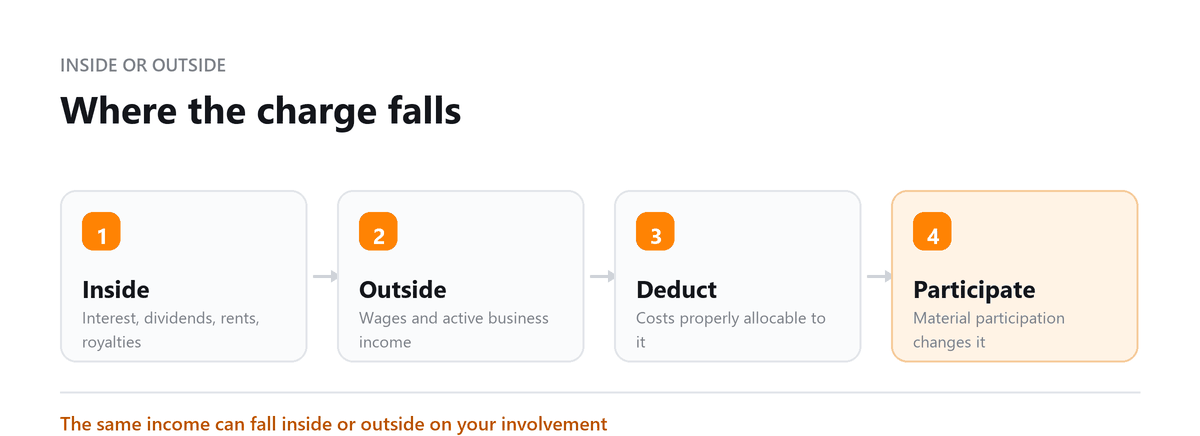
For clients approaching the thresholds, the most effective strategy is usually about classification rather than timing. Income from a business or rental you don't materially participate in is net investment income. The same income from an activity you do materially participate in generally isn't. Owners who move from being passive investors to being genuinely involved, and who keep contemporaneous records of their hours, can take that income out of the tax entirely. Timing sales and harvesting losses help, but they tend to defer the tax rather than remove it.
Ankit Sarawagi, CPA, CA, MBA · LinkedInWhat Is Net Investment Income?
- Interest, dividends, annuities, royalties (from non-business sources)
- Net rental and royalty income (passive)
- Net capital gains from property sales
- Passive activity income (income from activities you don't materially participate in)
- Net gain from disposition of a passive activity trade or business
NOT included in NII:
- Wages, salary, tips
- Self-employment income from active business activities
- Social Security benefits, pension distributions, IRA distributions
- Alimony (pre-2019 divorce agreements)
- Gain from sale of an active interest in a partnership or S corp where you materially participate
Step-by-Step: Completing Form 8960
Part I: Net Investment Income
- Lines 1-7: Enter each category of gross investment income (interest, dividends, rental/royalty, other)
- Lines 8-9b: Subtract deductions allocable to investment income (investment expenses, state taxes, broker fees)
- Line 12: Net investment income (NII)
Part II: MAGI Calculation
- Line 13: MAGI from Form 1040, Line 11 (MAGI for this purpose generally equals AGI + certain exclusions)
- Line 14: Applicable threshold for your filing status
- Line 15: Excess MAGI above threshold
Part III: Tax Calculation
- Line 17: Smaller of Line 12 (NII) or Line 15 (excess MAGI)
- Line 19: NIIT = Line 17 x 3.8%; transfers to Schedule 2, Line 12
Strategies to Reduce NIIT Exposure
- Increase material participation in passive rental or business activities to reclassify income as non-passive
- Use tax-loss harvesting to offset capital gains that push income above the threshold
- Invest in municipal bonds, exempt from both NIIT and federal income tax
- Consider qualified opportunity zone (QOZ) investments to defer and potentially reduce capital gains subject to NIIT
- Charitable remainder trusts can shift investment income away from the taxpayer.
The net investment income tax adds 3.8 percent to the investment income of higher earners, estates, and trusts, and its fixed thresholds mean it reaches more households every year. For individuals, it applies to the lesser of net investment income or modified AGI above $200,000, $250,000, or $125,000, depending on filing status.
The biggest opportunities to manage it come from how income is classified, especially rental and business income, and from planning the timing of large gains and withdrawals. Keep records of your participation in the businesses and rentals you own, include the tax in your estimated payments, and review your position before year-end, while there's still time to change the outcome.
Profitjets has reviewed Net Investment Income Tax (NIIT) exposure for more than 40 high-income clients, helping identify passive income subject to the 3.8% tax and evaluate strategies to manage or reduce potential NIIT liability.
“I hadn't realized that the interest, dividends, and rental income from my investments were creating an additional NIIT liability. Profitjets reviewed my passive income sources and helped restructure the way certain investments and business interests were held, reducing the income subject to NIIT and giving me a clearer tax-planning strategy for future years.”
Book a free consultation and we will look at the participation question.
FAQs
What is the net investment income tax rate and threshold?
The rate is 3.8 percent. For individuals, it applies to the lesser of net investment income or the amount modified adjusted gross income exceeds $200,000 for single and head of household filers, $250,000 for married couples filing jointly and qualifying surviving spouses, or $125,000 for married filing separately. These thresholds aren't adjusted for inflation.
Does rental income always trigger the net investment income tax?
Not always, but usually. Rental income is net investment income unless the rental activity is nonpassive for you and part of a trade or business. For most investors, that requires qualifying as a real estate professional and materially participating in the rentals. Managing properties yourself isn't enough on its own.
Are IRA and 401(k) distributions subject to the net investment income tax?
No. Distributions from qualified retirement plans and IRAs aren't net investment income. They do increase modified adjusted gross income, though, which can cause other investment income, such as dividends or capital gains, to become subject to the tax.
Do estates and trusts pay the net investment income tax?
Yes. Estates and most non-grantor trusts owe the tax on the lesser of undistributed net investment income or adjusted gross income above the level where the highest trust tax bracket begins. That threshold is much lower than for individuals, so distributing income to beneficiaries can reduce the tax.
Is gain on selling my business subject to the net investment income tax?
It depends on your involvement. Gain on assets used in a trade or business in which you materially participate is generally excluded. If you're a passive owner, the gain is generally included. For partnership and S corporation interests, the gain is analyzed based on the entity's underlying assets.

Written by
Ankit Sarawagi, CPA, CA, MBA
Ankit leads the finance team at Profitjets, where he has worked with 500+ businesses across the US on bookkeeping, tax and CFO-level strategy. He writes about the habits that keep small business books accurate all year. Connect on LinkedIn
Free consultation
Paying the NIIT Every Year?
Book a free consultation and we will look at the participation question.