
Restaurant owners already track more tip data than most businesses realize. Card tips flow through the POS, servers declare cash tips at the end of each shift, and payroll adds it all to wages every pay period.
Then early in the new year, a separate IRS return asks the employer to total the establishment's food and beverage sales, charged tips, and reported tips, and to show whether employees reported enough.
That return is Form 8027. It applies to large food or beverage establishments, and each qualifying location files its own. The IRS uses it to compare reported tips against sales. When reported tips fall below 8 percent of gross food and beverage receipts, the employer generally must allocate the shortfall to directly tipped employees, and that allocation shows up on their W-2s.
Getting it wrong causes trouble on two fronts. Employers face information return penalties and closer attention to payroll tax compliance.
Employees get unexpected allocated tips on their W-2s, which usually means a conversation nobody wants in February. Accurate tip records have also become more valuable since the employer FICA tip credit depends on them, and legislation passed in 2025 created a federal deduction for qualified tips that employees can claim through 2028.
This guide explains which establishments must file Form 8027, how to determine whether you have more than 10 employees on a typical business day, what the form reports, how tip allocation works, filing deadlines and penalties, and how tip reporting ties into related credits and deductions.
Who Must File Form 8027?
- Food or beverage establishments where tipping is customary
- More than 10 employees who normally work more than 80 hours in a typical business month
- Exception: food trucks, carryout-only establishments, or establishments where tipping is NOT customary may be exempt
- Employer must file a separate Form 8027 for each separate establishment
The most common tip reporting gap I see isn't on Form 8027 itself. It's in the daily process. Servers declare cash tips inconsistently, the POS doesn't capture them cleanly, and nobody compares reported tips against sales until the year is over. By then, reported tips are below 8 percent of gross receipts, the allocation lands on employees' W-2s, and the restaurant is dealing with frustrated staff and possible IRS attention. A weekly check of reported tips against sales catches the problem while it can still be fixed.
Ankit Sarawagi, CPA, CA, MBA · LinkedInFiling Deadlines for 2025 Tip Income (Filed in 2026)
| Filing Method | Deadline for TY2025 (Reporting in 2026) |
|---|---|
| Paper (Form 8027 mailed to IRS) | February 28, 2026 |
| Electronic (through IRS FIRE system) | March 31, 2026 |
The paper deadline falls on February 28 (not February 29) in 2026 since 2026 is not a leap year. Electronic filers receive an extra month, March 31, 2026.
Key Data Points Required on Form 8027
| Line | What to Report |
|---|---|
| Line 1 | Total charged tips for the year (from credit card receipts) |
| Line 2 | Total charge receipts showing charged tips |
| Line 3 | Total amount of service charges of less than 10% paid to employees |
| Line 4 | Total tips reported by employees (from their W-2 wage data) |
| Line 5 | Gross receipts from food and beverages |
| Line 6 | Reported tips as a percentage of gross receipts |
| Line 7 | Allocated tips (if employee-reported tips are below 8% of gross receipts) |
| Line 8 | Number of employees who received tips |
The 8% Tip Allocation Rule
If total tips reported by all employees are less than 8% of gross food and beverage receipts, the employer must allocate additional tips to employees who underreported. The allocated amount fills the gap between employee-reported tips and 8% of gross receipts. Employers can apply for a lower rate (minimum 2%) from the IRS if they can demonstrate that the customary tip rate at their establishment is lower.
- Allocated tips appear in Box 8 of the employee's W-2, they are informational only and employees may or may not owe additional tax depending on their actual tip records
- Three allocation methods are available: hours-worked, gross receipts, or good-faith agreement with employees
Penalty for Late Filing
Late filing penalties apply per-form:
- Filed within 30 days of deadline: $60 per form
- Filed after 30 days but by August 1: $130 per form
- Filed after August 1 or not filed: $330 per form
- Intentional disregard: $660 per form
Profitjets supports more than 25 restaurant and hospitality clients with payroll and tax compliance, including approximately 40 Form 8027 filings annually for businesses subject to tip reporting requirements.
“We discovered that our reported tips didn't fully match the amounts being recorded through our point-of-sale system, which created an issue when preparing Form 8027. Profitjets reviewed the tip records, completed the required tip allocation calculation, and helped us restructure our reporting process so tips were captured and reconciled consistently before payroll and tax filings.”
The Records That Sit Behind the Return
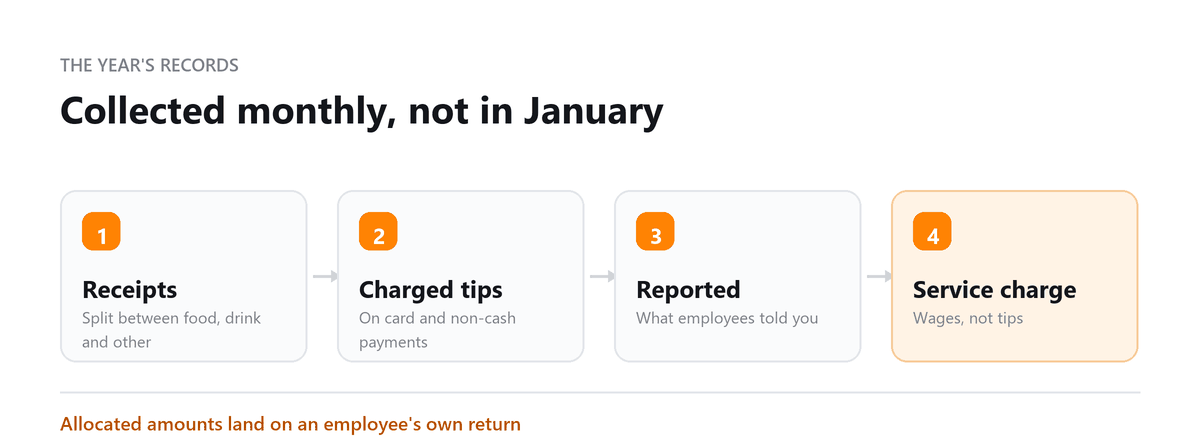
The return reports figures that have to come from records kept through the year. Reconstructing them afterwards is close to impossible and is the usual reason a filing is late or wrong.
- Gross receipts, split between those from food and drink and anything else
- Charged tips recorded on card and other non-cash payments
- Charged receipts on which those tips appeared
- Tips reported to the employer by employees, which is a separate record from what was charged
- Service charges, which are treated as wages rather than tips and are a distinct category
The last one is the most frequently miscategorised. A mandatory charge added to a bill is generally not a tip, and treating it as one affects payroll, reporting and the allocation calculation together.
Employee Reporting Is a Year-Round Obligation
The annual return depends on employees reporting their tips to the employer through the year, and that process is where most establishments are weakest.
The obligation runs both ways: employees have a duty to report, and employers have a duty to collect, to withhold on what is reported and to keep the records. Where reporting is patchy, the employer's figures are wrong before the return is even started.
A simple monthly routine works better than anything elaborate: a standard form or system entry per employee per period, collected with the same discipline as a timesheet, retained with the payroll records. It also protects the employee, since under-reported tips affect their own tax position and their social security record.
Allocation and What It Means for Staff
Where reported tips fall below the required proportion of receipts, an allocation applies, and it has real consequences for employees rather than being a paperwork exercise.
Allocated amounts appear on the employee's annual statement and affect their own return, whether or not they agree with the figure. That makes the allocation method and the underlying records something employees have a legitimate interest in, and explaining it before the statements arrive avoids a great deal of difficulty.
There are also procedures for requesting a lower rate where the circumstances of the establishment justify it. Whether that is available depends on evidence about the business, which again comes back to records kept through the year. The current rate, the allocation methods and the procedure for a reduction are in the IRS instructions for the form.
Your Point of Sale System Should Produce the Figures
Most of the data the return needs is already being captured by the till system. Whether it can be reported in the form required is a configuration question worth settling well before year end.
- Receipts split between food and drink and any other category of sale
- Charged tips separated from service charges, which are different things
- Card receipts on which tips appeared, as a distinct figure
- Reports available by period and for the full year, in a form you can keep
Where the system cannot produce the split, the answer is usually configuration rather than a new system: how items are categorised, and how a service charge is recorded against a sale. Fixing that in January for the year ahead is trivial. Reconstructing it in the following January from twelve months of transactions is not.
Book a free consultation and we will set the tip records up.
Frequently Asked Questions
Who has to file Form 8027?
Employers that operate a large food or beverage establishment must file. That generally means food or beverages are served for consumption on the premises, tipping is customary, and employees normally worked a combined total of more than 80 hours on a typical business day during the prior year. A separate form is filed for each qualifying establishment.
When is Form 8027 due?
Paper returns are generally due by the last day of February and electronic returns by March 31, moving to the next business day when the date falls on a weekend or holiday. For 2025 returns, the paper deadline moved to March 2, 2026, and the electronic deadline was March 31, 2026. Employers filing 10 or more information returns in total must generally file electronically.
What happens if employees report less than 8 percent of gross receipts in tips?
The employer generally must allocate the difference among directly tipped employees. Allocated tips appear in Box 8 of their W-2s, but no income tax or payroll taxes are withheld on them. Employees who actually received more tips than they reported must include the unreported tips on their own returns using Form 4137.
Can a restaurant use a lower tip allocation rate?
Yes. An employer, or a group of employees, can ask the IRS to approve a lower allocation rate if tips at the establishment are customarily lower than 8 percent of sales. The rate can't be reduced below 2 percent, and the request must be supported by information about actual tipping at the establishment.
Are service charges reported as tips on Form 8027?
No. Mandatory service charges, such as automatic gratuities added to large party bills, are generally treated as the employer's receipts, and amounts paid to employees are regular wages. Form 8027 reports certain service charges of less than 10 percent paid as wages separately from tips.

Written by
Ankit Sarawagi, CPA, CA, MBA
Ankit leads the finance team at Profitjets, where he has worked with 500+ businesses across the US on bookkeeping, tax and CFO-level strategy. He writes about the habits that keep small business books accurate all year. Connect on LinkedIn
Free consultation
Running a Tipped Establishment?
Book a free consultation and we will set the tip records up.