
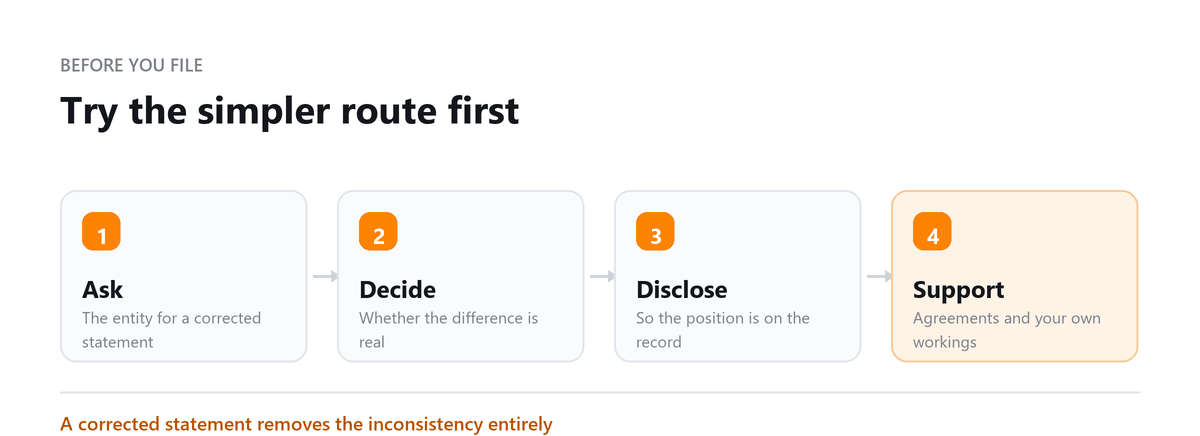
A Schedule K-1 arrives in March, and one number on it is clearly wrong. Depreciation that the partner knows was taken on the building is missing. An allocation doesn't match the operating agreement.
A distribution is reported as income when it was a return of capital. The partnership's accountant says they'll look into it, but the individual return is due next month, and waiting for a corrected K-1 may mean extending or filing with a figure the partner knows is wrong.
For partners, S corporation shareholders, and beneficiaries of estates and trusts, the default rule is consistency: report pass-through items the same way the entity reported them.
If you have a legitimate reason to report an item differently, Form 8082 is how you tell the IRS. Filed as a notice of inconsistent treatment, it identifies the entity, the items involved, how the entity reported them, how you're reporting them, and why.
Form 8082 has a second role that trips up many partnerships. Most partnerships are now subject to the centralized audit regime created by the Bipartisan Budget Act of 2015. Those partnerships generally can't fix a filed return by sending amended K-1s the way they once did. Instead, the partnership files an administrative adjustment request, and Form 8082 is part of that process. Using the wrong approach, or skipping the notice entirely, can lead to automatic IRS adjustments, penalties, and a longer fix than the original error.
This guide explains who has to file Form 8082, when inconsistent treatment is allowed, how administrative adjustment requests work for partnerships under the centralized audit regime, how to complete and file the form, deadlines, and what happens if you report inconsistently without filing notice.
What is Form 8082?
Form 8082, Notice of Inconsistent Treatment or Administrative Adjustment Request (AAR), serves two main purposes:
A notice of inconsistent treatment. Filed by a partner, S corporation shareholder, estate or trust beneficiary, or holder of a residual interest in a REMIC to notify the IRS that they're reporting an item on their return differently from the way the entity reported it.
Part of an administrative adjustment request. Used in the process a partnership follows to correct a return it has already filed.
The form identifies the filer and the entity, lists each item treated inconsistently or adjusted, shows the amount the entity reported and the amount the filer is reporting, and includes an explanation.
When Is Form 8082 Required?
Form 8082 is filed when a taxpayer treats an item on their individual return differently from how it was reported on a pass-through entity return (partnership, S corp, trust, or REMIC). It notifies the IRS of the inconsistency and provides the taxpayer's own computation. Without this form, any inconsistent treatment can be corrected by the IRS without going through normal deficiency procedures.
- When a taxpayer reports an item differently from how it was shown on a Schedule K-1 from a partnership, S corporation, trust, estate, or REMIC
- When a partner or shareholder believes the entity's reported figures are incorrect and is treating the item their own way
- For BBA partnerships (Bipartisan Budget Act partnerships): as an administrative adjustment request (AAR) when requesting an upward adjustment
- NOT required simply because the entity is late sending a K-1, only when there is actual inconsistent treatment
The most common legitimate reason a partner files Form 8082 is an allocation that doesn't follow the partnership agreement, such as a special allocation of depreciation or a preferred return that the preparer booked pro rata instead. The partner knows the K-1 is wrong, the partnership agrees but hasn't corrected it yet, and the individual return has a deadline.
Filing Form 8082 with a clear explanation and the supporting agreement protects the partner's position. What I'd caution against is using it for figures you're simply unsure about. It works best when you can show exactly why the K-1 is incorrect.
Ankit Sarawagi, CPA, CA, MBA · LinkedInStep-by-Step: Completing Form 8082
- Part I (Notice of Inconsistent Treatment): identify the pass-through entity (name, EIN, tax year); describe each item treated inconsistently; show how the entity reported it vs how you are reporting it; attach a supporting explanation
- Part II (Administrative Adjustment Request, BBA Partnerships only): used by partners requesting adjustments to partnership-level items when the entity is under the BBA centralized audit regime
- Attach Form 8082 to your annual tax return and file by the normal deadline
Filing Deadline - Form 8082
Form 8082 is attached to the annual tax return and due by the same deadline. For calendar-year individual filers (TY2025): April 15, 2026 (or October 15, 2026 with extension).
When a due date falls on a weekend or legal holiday, it moves to the next business day.
If you discover the inconsistency after you've already filed, you can attach Form 8082 to an amended return. That amended return must be filed within the normal time limits for amending.
Administrative Adjustment Request
A partnership subject to the centralized audit regime has a different deadline. It must generally file an administrative adjustment request within three years after the later of:
The date it filed the return for the year being corrected, orThe original due date of that return, not counting extensions.
An AAR also can't be filed once the IRS has mailed the partnership a notice of administrative proceeding for that year. Partnerships that find an error should file promptly rather than waiting until the end of the three-year window.
Who Files the AAR
For BBA partnerships, the AAR is filed by the partnership, acting through its partnership representative. Individual partners can't file an AAR on behalf of the partnership. A partner who disagrees with how the partnership reported an item files a notice of inconsistent treatment instead.
How an AAR is submitted depends on whether the partnership files electronically or on paper, and it typically involves Form 8082 together with other required forms and statements. Follow the current Form 8082 and Form 1065 instructions for the exact filing package.
Partnerships That Elected Out
Partnerships that validly elected out of the centralized audit regime for the year generally correct their returns by filing an amended Form 1065 and issuing corrected K-1s. Partners then amend their own returns as needed.
When and How to File Form 8082
Notices of Inconsistent Treatment
Attach Form 8082 to the tax return on which you report the item inconsistently, whether that's your original return or an amended return. It's due when that return is due, including extensions. For a calendar-year individual, that means April 15, or October 15 with an extension.
File a separate Form 8082 for each entity with items you're treating inconsistently.
Administrative Adjustment Requests
A partnership generally must file an AAR within three years after the later of the date it filed the return for the year being corrected or the return's original due date, not counting extensions. An AAR can't be filed after the IRS has mailed the partnership a notice of administrative proceeding for that year.
What Happens If You Don't File Form 8082?
If you report an item inconsistently with the entity's return and don't file notice, the consequences can be significant.
Automatic adjustment The IRS can treat the difference like a math or clerical error and adjust your return to match the entity's reporting, without first issuing a notice of deficiency. That means additional tax can be assessed without the usual process for disputing it in Tax Court.
Penalties Accuracy-related penalties can apply to the resulting underpayment. For partners in BBA partnerships, penalties on inconsistent treatment that isn't disclosed can apply without the defenses that are normally available.
Closer scrutiny An unexplained difference between your return and the entity's return is the kind of mismatch the IRS routinely flags for follow-up.
Filing Form 8082 doesn't guarantee your position will be accepted, but it preserves your ability to have it reviewed on its merits.
Form 8082 exists because pass-through entities and their owners are expected to tell the same story on their returns.
When a partner, S corporation shareholder, or beneficiary has a legitimate reason to report an item differently, filing a notice of inconsistent treatment protects their right to have the issue reviewed instead of automatically adjusted.
For partnerships under the centralized audit regime, Form 8082 is also part of the administrative adjustment request process that replaces amended returns. Know which regime applies, file notice whenever you depart from your K-1, explain every item clearly, and correct partnership errors through an AAR well within the three-year window.
Book a free consultation and we will look at the position first.
Frequently Asked Questions
What does Form 8082 do?
It notifies the IRS that you're reporting an item from a partnership, S corporation, estate, trust, or REMIC differently from how the entity reported it. It's also used in the process a partnership subject to the centralized audit regime follows to correct a return it has already filed, known as an administrative adjustment request.
When should I file Form 8082?
File it with your return whenever you report a pass-through item inconsistently with your Schedule K-1 or similar statement. It's due with that return, including extensions. Don't wait for the IRS to question the difference, since reporting inconsistently without notice allows the IRS to adjust your return automatically.
Can a partner file an administrative adjustment request?
Not for a partnership subject to the centralized audit regime. The AAR is filed by the partnership, acting through its partnership representative. A partner who believes the partnership's reporting is wrong can file a notice of inconsistent treatment on Form 8082 with their own return.
What is the deadline for a partnership to file an AAR?
Generally within three years after the later of the date the partnership filed its return for that year or the return's original due date, not counting extensions. An AAR can't be filed once the IRS has mailed a notice of administrative proceeding for that year.
Do S corporation shareholders and trust beneficiaries use Form 8082?
Yes. S corporation shareholders and beneficiaries of estates and trusts are required to report items consistently with the entity's return. If they report an item differently, they file Form 8082 as a notice of inconsistent treatment. The administrative adjustment request process applies to partnerships, not S corporations or trusts.

Written by
Ankit Sarawagi, CPA, CA, MBA
Ankit leads the finance team at Profitjets, where he has worked with 500+ businesses across the US on bookkeeping, tax and CFO-level strategy. He writes about the habits that keep small business books accurate all year. Connect on LinkedIn
Free consultation
Disagree With a K-1?
Book a free consultation and we will look at the position first.