
Most home buyers assume they have to deal with two tax issues at closing - the prorated property taxes and transfer fees. The title company then inquires if the seller is a foreign person, where a new set of guidelines gets triggered. If the seller is a nonresident alien individual, a foreign corporation, or any other foreign entity the buyer might be required to withhold large portions of the purchase price and remit them to the IRS within 20 days.
And the buyer is personally liable if he is not able to do so.
This requirement is in place based on the Foreign Investment in Real Property Tax Act (FIRPTA). This Act requires that a withholding be made on the sale or exchange of US real property interests from a foreign person, since the IRS cannot easily collect the tax from foreign sellers.
This tax withholding at closing secures the tax against losses through the sale, as it provides immediate liquidity to the IRS. The report and payment of the withholding is done on form 8288 while 8288-A allows the foreign seller to claim a credit for tax withheld against his US income tax.
The liability risk is mainly on the buyers as a result of the tax withholding. Buyers who fail to withhold when required are at risk of having to pay the tax that should have been withheld, on top of penalties and any interest due.
The foreign seller on the other hand is faced with large tax withholdings, that are often larger than the tax owed, tying up funds unnecessarily for months. The best way to avoid these issues is to plan FIRPTA tax withholding requirements long before the contract closing takes place, and not leave it to the closing table.
This guide explains when FIRPTA withholding applies, who is responsible for it, the withholding rates and exemptions, how the amount realized is calculated, how to file Form 8288 and Form 8288-A, how reduced withholding certificates work, and what foreign sellers do to recover excess withholding.
What is FIRPTA Withholding?
FIRPTA requires withholding when a foreign person disposes of a US real property interest. A US real property interest includes land, buildings, and other improvements located in the United States, as well as interests in certain US corporations whose assets consist mainly of US real estate.
The withholding isn't an additional tax. It's a prepayment toward the foreign seller's actual US income tax on the sale. The seller reports the sale on a US tax return, calculates the real tax owed, and claims a credit for the amount withheld. If the withholding exceeds the tax, the seller receives a refund.
FIRPTA Withholding Rate, Three Tiers
| Sale Price | Buyer's Intended Use | Withholding Rate |
|---|---|---|
| $300,000 or less | Buyer (or member of buyer's family) will use as primary residence for at least 50% of personal use days in each of the first 2 years post-purchase | 0%, no withholding required |
| $300,001 to $1,000,000 | Buyer (or family member) will use as principal residence (same test as above) | 10% of amount realized |
| Any amount | Investment, commercial use, or not used as primary residence by buyer | 15% of amount realized |
'Amount realized' = total consideration including assumed debt. Example: foreign seller sells for $800,000, buyer assumes $200,000 mortgage. Amount realized = $1,000,000; 15% withholding = $150,000.
Who Is Responsible for Withholding?
The transferee, meaning the buyer, is responsible for withholding and remitting the tax. In practice, a closing agent, title company, or attorney often calculates the amount and files the forms, but the legal obligation remains with the buyer.
Withholding is required when the seller is a foreign person, which includes:
Nonresident alien individuals.
Foreign corporations, other than those that have elected to be treated as domestic corporations for these purposes.
Foreign partnerships, trusts, and estates.
US citizens, green card holders, and individuals treated as US residents for tax purposes aren't foreign persons for FIRPTA. A single-member LLC that's a disregarded entity is looked through to its owner, so an LLC owned by a nonresident alien is treated as a foreign seller.
Certification of Non-Foreign Status
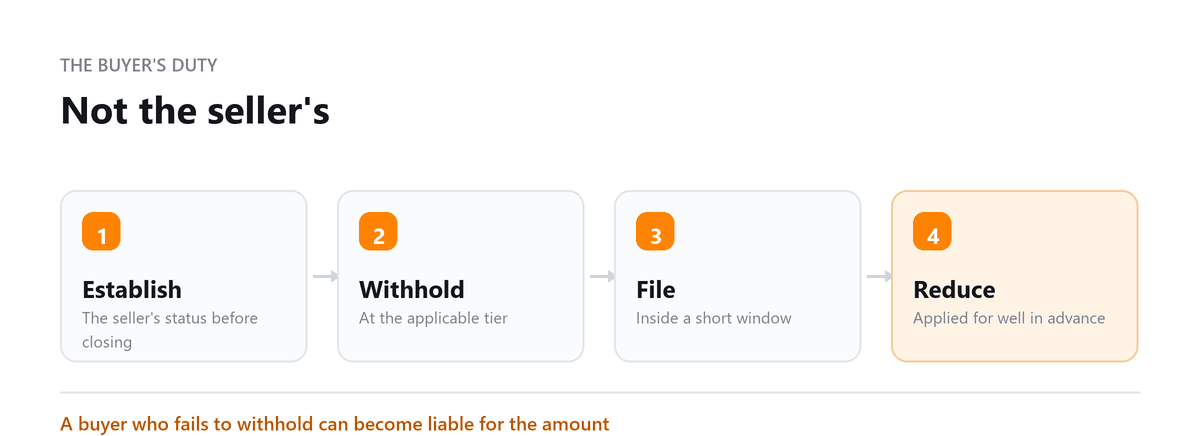
Buyers usually protect themselves by getting a signed certification from the seller, under penalties of perjury, stating that the seller isn't a foreign person and including the seller's US taxpayer identification number. If the buyer receives a valid certification and has no reason to believe it's false, the buyer generally isn't required to withhold.
The most common FIRPTA mistake buyers make is assuming someone else checked whether the seller is foreign. The title company, the agent, or the seller's side may raise it, but the legal obligation to withhold sits with the buyer.
If the seller is foreign and nothing is withheld, the IRS can come after the buyer for up to 15 percent of the amount realized, plus penalties and interest, even though the seller received all the money.
Getting a signed certification of non-foreign status from the seller, or confirming withholding is being handled at closing, is the single most important protection a buyer has.
Ankit Sarawagi, CPA, CA, MBA · LinkedInFiling Deadline: 20 Days After Transfer
Form 8288 must be filed within 20 days of the property transfer date. File with the IRS service center at: IRS, P.O. Box 409101, Ogden, UT 84409. Verify this address at IRS.gov before filing, IRS mailing addresses change periodically.
Requesting Reduced Withholding: Form 8288-B
If the seller believes the actual tax liability is less than the standard withholding amount (e.g., because the property was purchased near its current value and the gain is minimal), they can apply for a withholding certificate via Form 8288-B before the closing. If approved, the withholding is reduced to the actual expected tax. The buyer cannot close using a reduced rate without the IRS certificate in hand.
The Buyer's Liability for Failing to Withhold
If a buyer is required to withhold and doesn't, the buyer can be held liable for the tax that should have been withheld, along with applicable penalties and interest. The liability generally applies even though the buyer paid the full price to the seller.
Buyers can reduce this risk by:
Getting a signed non-foreign certification from every seller.
Asking the closing agent in writing to confirm how FIRPTA is being handled.
Documenting the residence use test when relying on the reduced or zero withholding exemption.
Keeping copies of Forms 8288 and 8288-A, proof of payment, and any withholding certificates.
Related Forms
| Form | Purpose |
|---|---|
| Form 8288-A | Buyer prepares 2 copies, one is certified by IRS and returned to the seller; seller uses it as a withholding credit on their U.S. tax return |
| Form 8288-B | Application for withholding certificate, seller uses to request reduced withholding before closing |
Profitjets has supported more than 20 FIRPTA transactions, helping foreign-person sellers and US buyers calculate the required FIRPTA withholding, coordinate Form 8288 filings, and obtain the required withholding certificates.
I was involved in a FIRPTA transaction as a foreign seller, and we needed to determine the correct withholding amount before closing. Profitjets calculated the withholding, coordinated the Form 8288 filing timeline, and followed up on the Form 8288-A certification so we had the documentation needed to support the withholding credit.
Book a free consultation before the transaction closes.
FAQs
What is the FIRPTA withholding rate?
The rate depends on the amount realized and how the buyer will use the property. No withholding is required when the buyer will use the property as a residence and the amount realized is $300,000 or less. The rate is 10 percent when the buyer will use it as a residence and the amount realized is more than $300,000 but not more than $1 million. In all other cases, including investment properties and sales above $1 million, the rate is generally 15 percent.
When is Form 8288 due?
The buyer generally must file Form 8288 and pay the withheld tax by the 20th day after the date of transfer. If a withholding certificate application on Form 8288-B was submitted on or before the transfer date, the buyer can generally wait to remit until 20 days after the IRS mails its decision on that application.
Does the buyer or the seller file Form 8288?
The buyer files Form 8288 and Form 8288-A, although a closing agent or attorney often prepares them. The seller uses the stamped Form 8288-A from the IRS to claim credit for the withholding on their own US tax return and may file Form 8288-B to request reduced withholding.
Can a foreign seller get FIRPTA withholding refunded?
Yes. The seller files a US tax return reporting the sale and claims credit for the amount withheld. If the withholding is more than the actual tax owed, the difference is refunded. A seller can get excess withholding released earlier by obtaining a withholding certificate on Form 8288-B.
What happens if the buyer doesn't withhold under FIRPTA?
A buyer who was required to withhold but didn't can be held liable for the tax that should have been withheld, plus penalties and interest. Buyers can generally avoid that liability by obtaining a valid certification of non-foreign status from the seller or by confirming that withholding was properly handled at closing.

Written by
Ankit Sarawagi, CPA, CA, MBA
Ankit leads the finance team at Profitjets, where he has worked with 500+ businesses across the US on bookkeeping, tax and CFO-level strategy. He writes about the habits that keep small business books accurate all year. Connect on LinkedIn
Free consultation
Buying From a Foreign Seller?
Book a free consultation before the transaction closes.