
Getting the corporate return filed starts with having the right version of the right form, which sounds trivial and is a genuine source of wasted work.
Forms and their instructions change between years. Copies circulating on third-party sites are often a year behind, and a return prepared on a superseded version of a form that has been revised is slow to unpick.
This covers where to obtain the current form and instructions, what has to be assembled before you start, how the return is submitted, and the checks worth doing before it goes.
Form 1120 is the U.S. Corporation Income Tax Return filed by C-corporations to report their income, gains, losses, deductions, and credits. If you are looking to download the blank form, understand what goes where, or know what attachments are required, this guide covers all of it.
Where to Download Form 1120
- IRS.gov: Navigate to Forms, Instructions and Publications, then search '1120'. The current-year form and instructions are always posted here.
- Tax software: TurboTax Business, H&R Block Business, TaxAct Business, Drake Tax, UltraTax, ProSystem fx, Lacerte, these all include Form 1120 and populate it from your data entry
- IRS Free File Fillable Forms: Available at IRS.gov for corporations that want to type directly into the PDF and e-file without paying for software
Take the form and its instructions from the tax authority's own site for the year you are reporting on. Copies circulating elsewhere are frequently a year behind, and a return prepared on last year's version of a form that has changed is a slow problem to unpick.
Ankit Sarawagi, CPA, CA, MBA · LinkedInKey Sections of the Blank Form
| Section / Page | What It Covers |
|---|---|
| Page 1, Income section | Gross receipts, cost of goods sold, gross profit, dividends received, interest, royalties, capital gains, other income |
| Page 1, Deductions section | Compensation, salaries, repairs, bad debts, rents, taxes, interest, charitable contributions, depreciation, amortization, other deductions |
| Page 1, Tax computation | Taxable income, tax at 21% flat rate, credits, estimated tax payments, amount owed or refund |
| Schedule C (page 2) | Dividends and special deductions, dividends received deduction (DRD) from domestic corporations |
| Schedule J (page 3) | Tax computation details, AMT, LIFO recapture, foreign taxes, base erosion payments |
| Schedule K (page 3) | Other information, business activity, product/service description, affiliated groups |
| Schedule L (page 4) | Balance sheet per books, beginning and ending assets, liabilities, shareholders' equity |
| Schedule M-1 (page 4) | Reconciliation of income per books to income per tax return |
| Schedule M-2 (page 4) | Analysis of unappropriated retained earnings per books |
| Schedule M-3 (separate form) | For corporations with total assets of $10M+; replaces M-1 |
| Schedule D | Capital gains and losses; usually filed as a separate form (Form 1120 Schedule D) |
| Schedule G | Information on certain persons owning more than 20% of the corporation's voting stock |
| Schedule PH | Personal holding company tax, if applicable |
| Schedule UTP | Uncertain tax positions, for applicable large corporations |
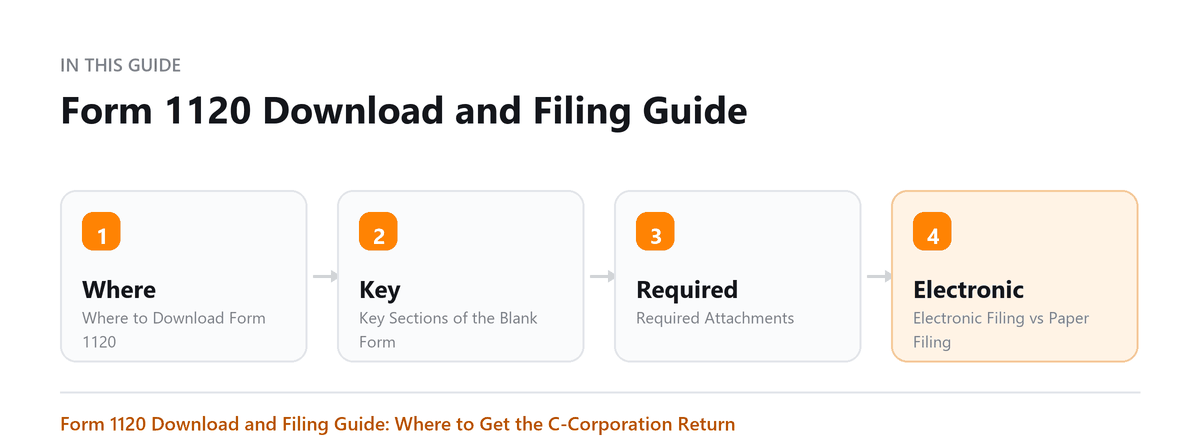
Required Attachments
The following forms and schedules must be attached to Form 1120 when applicable:
- Form 4562 (Depreciation and Amortization), always required if the corporation has depreciable property
- Form 4797 (Sales of Business Property), if any Section 1231 assets were sold
- Schedule D (Capital Gains and Losses), if any capital assets were sold
- Form 1125-A (Cost of Goods Sold), if the corporation has inventory
- Form 1125-E (Compensation of Officers), if gross receipts are $500,000 or more
- Form 3800 (General Business Credit), if claiming general business credits
- Form 4136 (Credit for Federal Tax Paid on Fuels), if applicable
- Form 8050 (Direct Deposit of Corporate Tax Refund), if requesting direct deposit
- Form 926, 5471, 5472, 8865, for foreign transactions and entities
Electronic Filing vs Paper Filing
The IRS strongly prefers electronic filing for corporations. E-filing:
- Is mandatory for corporations with total assets of $10 million or more
- Provides faster processing and acknowledgment within 24-48 hours
- Reduces data entry errors through built-in validation
- Allows direct deposit of refunds
Paper filing is still accepted for corporations below the $10M asset threshold, but the IRS processes paper returns significantly slower (up to 6 months in high-volume periods).
E-File Mandate Details
Corporations that are part of a consolidated group: the common parent must e-file if total assets of the consolidated group meet or exceed the threshold.
Authorized E-File Providers
You must e-file through an IRS-authorized e-file provider or IRS-approved software. You cannot upload a PDF directly to the IRS website. Your tax software transmits the return electronically to the IRS and provides an acknowledgment.
Pro Tip: If you self-prepare on tax software and your software offers both e-file and print options, always choose e-file unless you have a compelling reason not to. You will receive an official acknowledgment you can keep as proof of timely filing.
Book a free consultation and we will take the return off your desk.
Frequently Asked Questions
Can I just download the PDF and fill it in?
You can fill in the PDF, but you cannot upload it to the IRS. You must either mail it (paper filing) or use IRS-authorized software to e-file.
Is Form 1120 the same as Form 1120-S?
No. Form 1120 is for C-corporations. Form 1120-S is for S-corporations. The key difference is that S-corps are pass-through entities; their income flows to shareholders' personal returns via K-1.
Where do I find the current 1120 instructions?
IRS.gov, search 'Instructions for Form 1120'. The instructions are a separate document from the form itself and run 30+ pages.
Do LLCs use Form 1120?
Only if the LLC has elected to be treated as a corporation for tax purposes (Form 8832) and then elected C-corp status. Most LLCs file as disregarded entities (Schedule C) or partnerships (Form 1065).
What if I made an error on a filed 1120?
File Form 1120-X (Amended U.S. Corporation Income Tax Return) to correct errors. The statute of limitations for most refunds is 3 years from the due date of the return.

Written by
Ankit Sarawagi, CPA, CA, MBA
Ankit leads the finance team at Profitjets, where he has worked with 500+ businesses across the US on bookkeeping, tax and CFO-level strategy. He writes about the habits that keep small business books accurate all year. Connect on LinkedIn
Free consultation
Want the Filing Handled?
Book a free consultation and we will take the return off your desk.