
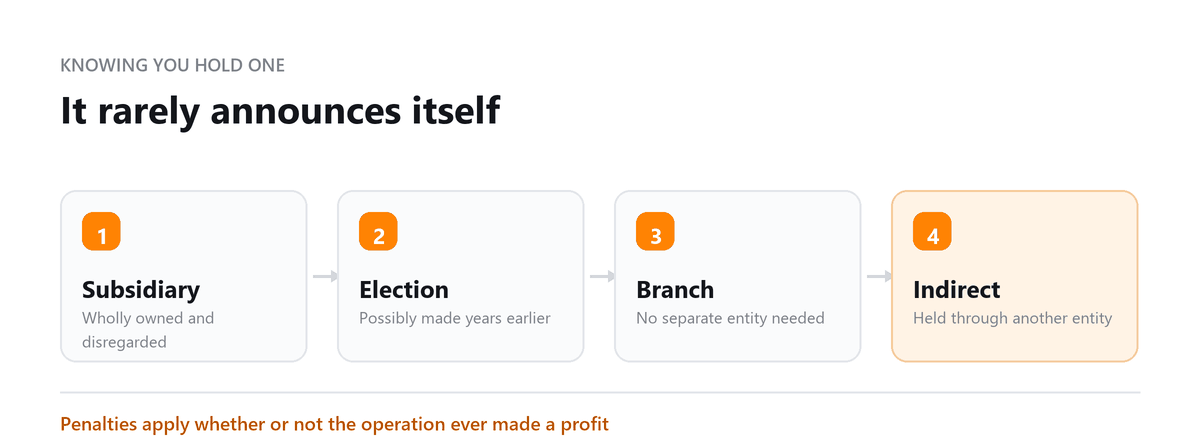
A US founder opens a company abroad to hire local staff, and their advisor files an election so the new entity is ignored for US tax purposes, making the income flow straight onto the founder's return. A US consultant moves overseas and keeps running the same business there without forming a company at all. Both setups are common, and both can create a US reporting obligation most people never hear about until a tax preparer asks where the Form 8858 is.
Form 8858 is the information return for foreign disregarded entities and foreign branches. A foreign disregarded entity is a foreign business entity that the US treats as not separate from its owner. A foreign branch is a business operation outside the US that keeps its own books but isn't a separate entity.
In both cases, the income is already taxed on the owner's return. Form 8858 gives the IRS the extra detail behind those numbers: the entity's income statement, balance sheet, currency translation, taxes paid, and transactions with its owner.
Missing the form is expensive. The penalty starts at $10,000 per year for each entity or branch, can grow after an IRS notice, may reduce foreign tax credits, and can leave the statute of limitations open.
And because the obligation often begins with a classification election or a business decision made years earlier, many owners only discover it when they're already several years behind.
This guide explains what counts as a foreign disregarded entity or foreign branch, who has to file Form 8858, what the form reports, how it connects to Forms 5471 and 8865, filing deadlines, penalties for failing to file, and practical steps to stay compliant.
What Is a Foreign Disregarded Entity?
A foreign disregarded entity (FDE) is a foreign business entity that is treated as disregarded for U.S. tax purposes, meaning its income flows directly to the U.S. owner. Common examples:
- A foreign single-member LLC (where the U.S. person owns 100%)
- A foreign entity that has elected to be treated as disregarded on Form 8832
- A controlled foreign corporation (CFC) that is a disregarded entity for certain purposes
Most people don't realize they've created a Form 8858 obligation, because it usually starts with a decision that seemed unrelated to reporting. An advisor files Form 8832 to make a foreign company disregarded so its losses or income flow through, or a US owner simply runs their business from another country without incorporating.
Either way, the foreign operation is now a disregarded entity or a branch, and Form 8858 is due every year alongside the return. What surprises many founders is that a foreign company with limited liability is usually treated as a corporation by default, so it's often the election, not the formation, that creates the Form 8858 filing.
Ankit Sarawagi, CPA, CA, MBA · LinkedInWho Must File Form 8858?
Form 8858 is an information return filed by U.S. persons who own foreign disregarded entities (FDEs) or who have interests in foreign branches of U.S. corporations. It provides the IRS with information about the foreign entity's income, deductions, and assets, similar to a tax return for the foreign structure but filed as an attachment to the U.S. person's return.
| Filer | Situation |
|---|---|
| U.S. person | Directly owns a foreign disregarded entity |
| U.S. person | Indirectly owns a foreign disregarded entity through another disregarded entity or a flow-through entity |
| U.S. corporation | Operates through a foreign branch (a qualified business unit) |
| U.S. tax owner of a controlled foreign corporation (CFC) | CFC owns a foreign disregarded entity, the U.S. CFC owner files |
Penalty for Failure to File
Penalties for Failing to File Form 8858
Monetary Penalties
If Form 8858 isn't filed when required, or is filed with incomplete or incorrect information, the basic penalty is $10,000 for each annual accounting period of each FDE or FB.
If the failure continues more than 90 days after the IRS mails a notice, an additional $10,000 penalty can apply for each 30-day period, or part of one, that the failure continues, up to a maximum additional penalty of $50,000.
Reduced Foreign Tax Credits
A failure to file can also reduce the foreign taxes available for the foreign tax credit, which can increase the US tax owed on foreign income.
Open Statute of Limitations
When required Form 8858 information isn't provided, the statute of limitations for assessing tax on the related return generally stays open until the information is filed. If the failure was due to reasonable cause, the extended period is limited to the items related to the missing information.
Reasonable Cause
Penalties may be waived if the failure was due to reasonable cause and not willful neglect. A reasonable cause statement should explain the facts clearly and show what steps were taken to comply once the obligation was discovered.
Filing Deadline
Form 8858 is attached to the U.S. person's annual tax return (Form 1040, 1120, or 1065) and due by the same deadline, including extensions. For calendar-year individual filers (TY2025): April 15, 2026 (or October 15, 2026 with extension).
Step-by-Step: Completing Form 8858
- Part I: Basic information, name of FDE, country of incorporation, EIN or foreign tax ID, U.S. owner information
- Part II: U.S. dollar financial statements, income statement and balance sheet in U.S. dollars at applicable exchange rates
- Part III: Income statement (functional currency), report income, deductions, and net income in the entity's functional currency
- Part IV: Balance sheet (functional currency), assets, liabilities, and equity in functional currency
- Part V: Transactions between FDE and its U.S. tax owner, intercompany payments, loans, services rendered
- Schedule M: Additional reconciliation schedule for certain large FDEs
- Attach to the U.S. person's annual return
Profitjets has managed more than 30 Form 8858 reporting engagements for US businesses with foreign operations, covering foreign disregarded entities across Singapore, the UK, Canada, and other international markets.
“We formed a Singapore subsidiary for our e-commerce business and didn't realize it created a separate Form 8858 reporting requirement for our US company. Profitjets identified the obligation, mapped the foreign entity's transactions to the US reporting requirements, and set up a recurring reporting process so the information could be captured and reconciled each year.”
Book a free consultation and we will establish the classification.
Frequently Asked Questions
What is Form 8858 used for?
It reports information about foreign disregarded entities and foreign branches owned or operated by US persons, including their income, balance sheets, foreign taxes, currency details, and transactions with their owners. The income itself is reported on the owner's return. Form 8858 provides the supporting detail.
Is a foreign single-owner company automatically a disregarded entity?
Usually not. Most foreign entities whose owners have limited liability are treated as corporations by default for US tax purposes, and some foreign entity types are always corporations. A single-owner foreign entity with limited liability generally becomes disregarded only if it elects that treatment on Form 8832.
What is the penalty for not filing Form 8858?
The basic penalty is $10,000 for each annual accounting period of each foreign disregarded entity or foreign branch. If the failure continues more than 90 days after an IRS notice, additional penalties of $10,000 per 30-day period can apply, up to $50,000. Foreign tax credits may also be reduced, and the statute of limitations can remain open.
When is Form 8858 due?
It's attached to the related return and due by that return's due date, including extensions. That may be Form 1040, 1120, 1065, or 1120-S, or it may be attached to Form 5471 or Form 8865 when a controlled foreign corporation or partnership owns the FDE or branch.
Do individuals have to file Form 8858 for a business run abroad?
They may. Foreign branch reporting applies to US persons generally, not only corporations. A US individual who conducts a trade or business outside the United States through a separate unit that keeps its own books may have a foreign branch that requires Form 8858.

Written by
Ankit Sarawagi, CPA, CA, MBA
Ankit leads the finance team at Profitjets, where he has worked with 500+ businesses across the US on bookkeeping, tax and CFO-level strategy. He writes about the habits that keep small business books accurate all year. Connect on LinkedIn
Free consultation
Operating Through a Foreign Entity?
Book a free consultation and we will establish the classification.