
An investor buys into a limited partnership, and the first K-1 shows a large loss. The partnership used borrowed money to buy equipment, the depreciation is substantial, and the investor expects to deduct that loss against salary or other income.
Then the preparer asks how much the investor actually put in, and whether they're personally responsible for any of the partnership's debt. The answer turns out to decide how much of the loss can be deducted this year.
That's the job of the at-risk rules. Under Section 465, you can generally deduct losses from a business or income-producing activity only up to the amount you could actually lose. Cash you contributed counts.
Debt you're personally liable for usually counts. Borrowing where the lender can look only to the property, guarantees that protect you from loss, and loans from people with an interest in the activity usually don't. Form 6198 is where that at-risk amount and the deductible loss are calculated.
The at-risk rules are only one of several limits that can stand between a paper loss and a deduction. Basis limits come first, passive activity rules follow, and the excess business loss limit can apply last. Each has its own form and its own carryforward, and losses disallowed under one rule don't automatically become deductible when another rule is satisfied. Tracking them separately is what keeps suspended losses from being lost or claimed too early.
This guide explains how the at-risk rules work, what is and isn't at risk, how real estate financing is treated, who has to file Form 6198, the order of the loss limitation rules, how suspended losses and recapture work, and how to complete the form.
What Is the At-Risk Rule?
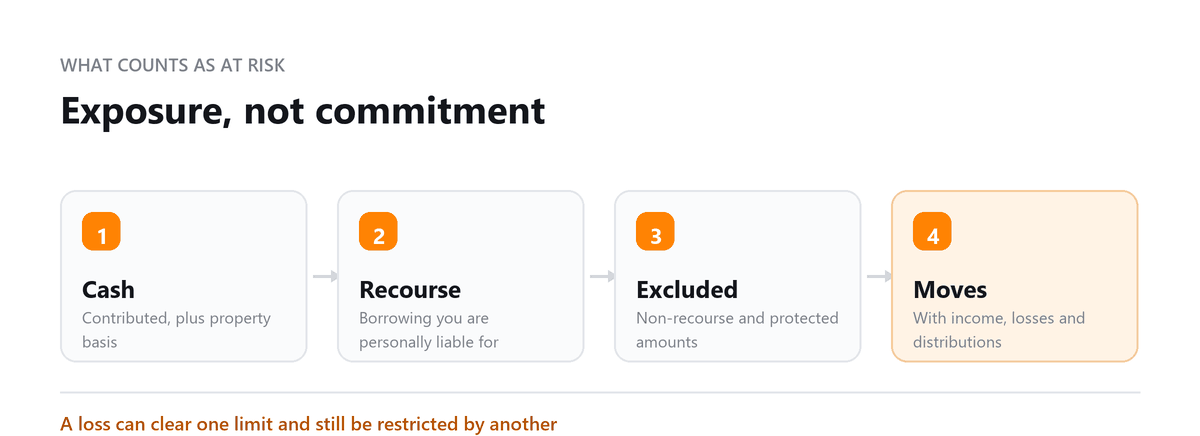
Form 6198 calculates the portion of a business or investment loss that you are allowed to deduct under the at-risk rules (IRC Section 465). You are 'at risk' for amounts you actually invest and amounts you personally borrowed not for non-recourse financing or amounts protected by guarantees. Losses in excess of your at-risk amount are disallowed and carried forward. The at-risk rule limits your deductible business loss to the amount you could actually lose. You are at risk for:
- Cash and property contributed to the activity
- Borrowed amounts for which you are personally liable (recourse debt)
- Borrowed amounts secured by property NOT used in the activity (certain non-recourse financing)
NOT at risk:
- Non-recourse financing (where the lender's only recourse is the property pledged)
- Amounts protected against loss through guarantees, stop-loss agreements, or similar arrangements
- Borrowed amounts from a person with an interest in the activity
The at-risk rules surprise investors most when a deal is heavily financed with nonrecourse debt outside real estate. The investor sees a large loss on the K-1 and assumes their share of the entity's borrowing gives them room to deduct it.
But if the lender can only look to the project and the investor isn't personally liable, that debt generally doesn't count, and most of the loss gets suspended. Real estate investors usually have more room, because qualified nonrecourse financing can count as at risk, but the loan has to meet the requirements.
Ankit Sarawagi, CPA, CA, MBA · LinkedInWho Must File Form 6198?
- Individuals, estates, trusts, and certain closely held corporations with losses from activities subject to the at-risk rules
- Common activities: real estate, oil and gas, films and TV, farming, equipment leasing, partnerships, and S corporations
- Exception: C corporations that are not closely held are exempt from at-risk rules
At-Risk vs Passive Loss: Two Separate Limits
At-risk and passive loss are two separate limitations that apply sequentially:
| Step | Test | Form Used |
|---|---|---|
| 1 | Is the loss limited by the at-risk rules? (Is your at-risk amount ≥ loss?) | Form 6198 |
| 2 | Is the remaining allowed loss limited by passive activity rules? (Do you materially participate?) | Form 8582 |
A loss must pass BOTH tests to be currently deductible. At-risk disallowed losses are separate carryforwards from passive loss carryforwards, they are tracked and released differently.
Filing Deadline
Form 6198 is filed with the annual tax return. For calendar-year individual filers (TY2025): April 15, 2026 (or October 15, 2026 with extension).
Step-by-Step: Completing Form 6198
Form 6198 is generally organized into four parts.
Part I: Current Year Profit or Loss
Report the income, gains, deductions, and losses from the activity for the year, drawn from Schedules C, E, or F, Forms 4797 or 4835, or a Schedule K-1. Include any prior-year losses disallowed under the at-risk rules. The result is the activity's current year profit or loss.
Part II: Simplified Computation of Amount at Risk
Most taxpayers can use the simplified computation, which starts with your adjusted basis in the activity and adjusts it for amounts that aren't at risk. It's generally available if you aren't engaged in the activity in a way that requires the detailed method.
Part III: Detailed Computation of Amount at Risk
If the simplified method doesn't fit, such as when at-risk amounts changed significantly during the year or certain types of financing are involved, you track the at-risk amount in more detail, starting from the prior year's at-risk amount and adjusting for increases and decreases during the year.
Part IV: Deductible Loss
The deductible loss is the smaller of the activity's loss or your amount at risk. The deductible amount is carried to the form or schedule where the loss is reported, and any excess is suspended and carried forward.
Work from the current revision of Form 6198 and its instructions, since line numbers and methods are updated periodically.
Profitjets has managed more than 35 at-risk limitation engagements, helping investors calculate their allowable losses and track suspended losses subject to at-risk and passive activity limitations across multiple tax years.
“I invested in a limited partnership and initially expected to deduct the full loss, but Profitjets determined that both the at-risk and passive activity limitations restricted the amount I could claim. They calculated the allowable loss, tracked the suspended amounts year to year, and identified the tax year when the losses became available as my at-risk amount and passive activity income changed.”
Book a free consultation and we will work out which rule applies.
Frequently Asked Questions
What does Form 6198 limit?
It limits the loss you can deduct from an activity to your amount at risk in that activity. That generally includes cash and property you contributed, debt you're personally liable for, and certain other amounts. Losses above your at-risk amount are carried forward and can be deducted in later years when your at-risk amount increases.
Do the at-risk rules apply to real estate?
Yes. Holding real property is subject to the at-risk rules. However, qualified nonrecourse financing secured by the real property and borrowed from a qualified lender, such as a bank or government, counts as at risk. That makes the rules less restrictive for most leveraged real estate than for other activities, although seller financing generally doesn't qualify.
How is the at-risk limit different from the passive activity loss limit?
They're separate rules applied in order. The at-risk rules look at how much you could actually lose in an activity. The passive activity rules look at whether you materially participate. A loss must clear the at-risk limit first, then the passive activity limit, and each rule keeps its own separate carryforward.
What happens to losses disallowed under the at-risk rules?
They're carried forward indefinitely and treated as losses from the same activity in the next year. They become deductible as your at-risk amount increases, such as when you contribute more money, take on personal liability for debt, or earn income from the activity, including gain when the activity is sold.
Can I have to report income because of the at-risk rules?
Yes. If your at-risk amount drops below zero at year-end, for example because of distributions or because recourse debt becomes nonrecourse, you generally must recapture the negative amount as income, up to the losses you previously deducted. The recaptured amount can be deducted in later years if your at-risk amount increases again.

Written by
Ankit Sarawagi, CPA, CA, MBA
Ankit leads the finance team at Profitjets, where he has worked with 500+ businesses across the US on bookkeeping, tax and CFO-level strategy. He writes about the habits that keep small business books accurate all year. Connect on LinkedIn
Free consultation
Losses Being Disallowed?
Book a free consultation and we will work out which rule applies.