
A partner opens their mail in 2026 and finds a statement from a partnership they invested in years ago. The IRS audited the partnership's 2022 return, adjusted several items, and the partnership chose to push those adjustments out to the people who were partners in 2022.
The partner now owes tax, and interest, on income from a year that closed long ago, and they have to report it on this year's return.
That's how the centralized partnership audit regime works for partnerships that don't elect out of it. The IRS audits and adjusts at the partnership level. By default, the partnership pays an imputed underpayment calculated at high rates.
Alternatively, the partnership can elect to push the adjustments out to its reviewed-year partners, who then take them into account on their own returns. Form 8978 is the form those partners use to calculate the resulting tax and interest.
The push-out also comes up outside audits. A partnership that corrects its own filed return through an administrative adjustment request can push those corrections out the same way. In either case, the partner doesn't amend the old return.
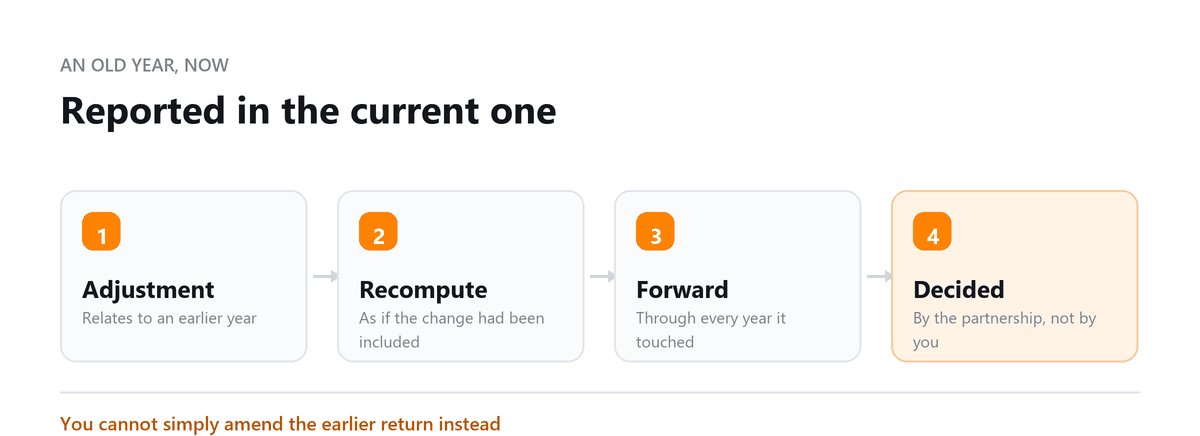
Instead, they recompute what their tax would have been and report the net change in the year they receive the statement. Understanding the timing, the interest, and the records involved makes a surprise statement much easier to handle.
This guide explains how the centralized partnership audit regime works, when adjustments are pushed out to partners, the key terms, how partners calculate their additional reporting year tax on Form 8978, how tiered partnerships are handled, and what records partners should keep.
What Is the BBA Centralized Partnership Audit Regime?
Form 8978 is filed by a partner to report and pay their share of 'imputed underpayment' resulting from a centralized partnership audit under the Bipartisan Budget Act (BBA) regime. When the IRS audits a partnership under BBA and determines an adjustment, each partner uses Form 8978 to calculate and pay the resulting tax on their individual or entity return for the year the audit is resolved, not the original year under audit.
The Bipartisan Budget Act of 2015 overhauled how the IRS audits partnerships. Under the BBA regime (effective for partnership tax years beginning after December 31, 2017):
- The IRS audits the partnership at the entity level, not at the individual partner level
- Any tax resulting from an audit adjustment is assessed against the partnership itself in the year the audit is resolved (the 'adjustment year') not in the original audited year
- The partnership designates a 'Partnership Representative' (PR) who has sole authority to act on behalf of all partners during the audit
- Default rule: the partnership pays the 'imputed underpayment', but partners can elect to 'push out' the adjustment to partners
How the Additional Reporting Year Tax Is Calculated
A partner doesn't simply pay their share of the partnership's imputed underpayment. Instead, they recompute their own tax as if the adjustments had been reported correctly in the first place.
Step 1: Recompute the First Affected Year
Using the adjustments on Form 8986, the partner recalculates tax for the first affected year, at their own tax rates, and determines the increase or decrease in tax.
Step 2: Recompute Intervening Years
Adjustments often ripple into later years. For example, an increase in depreciation in one year reduces depreciation available later, or a change in income affects a loss carryforward. The partner recomputes the tax for each intervening year to reflect those effects.
Step 3: Total the Changes
The increases and decreases for the first affected year and intervening years are totaled. A net increase is added to the partner's tax for the reporting year. A net decrease generally reduces the reporting year tax.
Step 4: Add Interest and Penalties
For audit push-outs, interest is generally calculated on each year's increase from the due date of that year's return, at the underpayment rate plus two percentage points. Penalties determined at the partnership level can also pass through to partners. Different interest and penalty rules apply to push-outs from administrative adjustment requests, so review the current instructions for the type of push-out you received.
The partner doesn't amend the returns for the reviewed year or intervening years. All of the recomputed tax, interest, and penalties are reported in the reporting year.
Push-out statements create cash flow surprises often after the partner has sold their interest or the fund has wound down. Interest on an audit push-out also runs at a rate two percentage points higher than the normal underpayment rate. Partners should keep every K-1, their own returns for each year they held the interest, and a copy of the partnership agreement from day one. Recomputing tax for a reviewed year and every year after it is far easier when those records are already in one place.
Ankit Sarawagi, CPA, CA, MBA · LinkedInWhen Is Form 8978 Filed?
Form 8978 is used when the partnership elects to 'push out' audit adjustments to the partners rather than paying the imputed underpayment at the partnership level. Each affected partner:
- Receives a 'pull-in' statement from the partnership (similar to a Form K-1) showing their share of the adjustment
- Uses Form 8978 to calculate their 'additional reporting year tax', the tax owed by the partner on their share of the adjustment
- Files Form 8978 with their individual return for the year the partnership notifies them (not the originally audited tax year)
- Pays an interest charge from the original reviewed year to the filing date of the adjustment year return
Key Terms
| Term | Meaning |
|---|---|
| Reviewed year | The partnership tax year that was audited by the IRS |
| Adjustment year | The partnership tax year in which the audit is resolved and adjustments are pushed out |
| Imputed underpayment | The total tax deficiency calculated at the partnership level using the highest applicable tax rate |
| Push-out election | Partnership elects to have partners pay the adjustment rather than the partnership |
| Partnership Representative | The individual (or entity) designated to represent the partnership in all BBA proceedings, unlimited authority |
| Additional reporting year tax | The partner's share of the adjustment, calculated on Form 8978, plus an interest charge |
Completing Form 8978
- Part I: Identify the partner and the partnership; list each reviewed year covered by the push-out statement
- Part II: Calculate the additional reporting year tax, the partner's allocable share of the imputed underpayment recalculated at the partner's actual tax rate (which may be lower than the highest rate used in the imputed underpayment calculation)
- Line 14: Transfer the additional tax to Schedule 2, Line 17 (Form 1040) for the adjustment year return
- Pay interest on the additional tax, interest runs from the due date of the reviewed year return to the due date of the adjustment year return
Why This Matters for Partners
Partners in BBA partnerships must understand that:
- They may receive a push-out statement years after the original tax year being audited
- Their cash flow obligations depend on whether the partnership elects to push out, if it does not, the partnership pays and may seek contribution from partners separately
- The Partnership Representative's decisions bind ALL partners, including those who disagree
- Interest accrues from the reviewed year, which may be 2 to 4 years before the adjustment year
Profitjets has supported more than 15 partnership audit engagements under the Bipartisan Budget Act (BBA), including reviewing push-out adjustments and helping partners determine their individual reporting and payment obligations.
“I was a limited partner in a fund that went through a BBA partnership audit, and about three years later I received a push-out statement showing an additional tax adjustment. Profitjets prepared Form 8978, calculated the resulting additional tax and interest, and helped me complete the payment and reporting process.”
Book a free consultation and we will run the recomputation.
Frequently Asked Questions
What does Form 8978 do?
It lets a partner report the effect of partnership adjustments pushed out to them under the centralized audit regime. The partner recomputes their tax for the affected years, totals the increase or decrease, adds any interest and penalties, and reports the result on their return for the year they received the partnership's statement.
Who has to file Form 8978?
Reviewed-year partners, and certain others, who receive a Form 8986 statement from a partnership that pushed out audit or AAR adjustments. Partners that are themselves partnerships or S corporations generally don't file Form 8978. They use Form 8985 and either pay an imputed underpayment or push the adjustments further to their own owners.
Which tax year do I file Form 8978 for?
The reporting year, which is your tax year that includes the date the partnership furnished the Form 8986 statement. You attach Form 8978 to that year's return. You don't amend the return for the year that was originally audited or corrected.
How is interest calculated on pushed-out audit adjustments?
For push-outs following an IRS audit, interest on increases in tax is generally calculated from the due date of each affected year's return, at the normal underpayment rate plus two percentage points. Different rules apply to push-outs from administrative adjustment requests, so check the current instructions for your situation.
What's the difference between a push-out and a pull-in?
In a push-out, the partnership furnishes statements to reviewed-year partners, who take the adjustments into account on Form 8978 instead of the partnership paying. In a pull-in, reviewed-year partners file amended returns and pay their share as part of a modification request, which reduces the imputed underpayment the partnership itself pays.

Written by
Ankit Sarawagi, CPA, CA, MBA
Ankit leads the finance team at Profitjets, where he has worked with 500+ businesses across the US on bookkeeping, tax and CFO-level strategy. He writes about the habits that keep small business books accurate all year. Connect on LinkedIn
Free consultation
Received a Partnership Adjustment?
Book a free consultation and we will run the recomputation.