
Form 8990 calculates the limitation on business interest expense under IRC Section 163(j). If your business has annual gross receipts above $31 million (TY2025 threshold), you may not be able to deduct all of your interest expense in the current year. Form 8990 calculates how much interest you can deduct now and how much must be carried forward.
Most business owners assume the interest on a business loan is simply deductible. For many small businesses, it is. But once a business grows past a certain size, or falls under certain rules like being treated as a tax shelter, the deduction for business interest can be capped. Any interest above the cap can't be deducted that year and carries forward instead.
That cap comes from Section 163(j). It generally limits the business interest you can deduct to your business interest income, plus 30 percent of your adjusted taxable income, plus any floor plan financing interest.
Form 8990 is where the calculation happens. For partnerships and S corporations, part of the calculation is done at the entity level and passed through to owners, which adds another layer of tracking.
Expert Perspective
The Form 8990 issue I see most often is a business that doesn't realize it's no longer exempt. The small business exemption is based on average gross receipts over the prior three years, and related businesses under common control generally have to be combined. A company that's growing quickly or owns several entities can cross the threshold without anyone noticing, and by then the interest deduction is already limited.
Ankit Sarawagi, CPA, CA, MBA · LinkedInThe rules have also shifted recently. Legislation passed in 2025 restored the add-back for depreciation, amortization, and depletion when calculating adjusted taxable income, generally for tax years beginning after 2024, which makes the limit more generous for capital-intensive businesses. Carry forwards, special elections for real estate and farming businesses, and partnership-level tracking still make this a form that highly leveraged businesses should model well before year-end.
What Is Section 163(j)?
Section 163(j) limits a business's deduction for business interest expense to the sum of:
- Business interest income for the year, PLUS
- 30% of Adjusted Taxable Income (ATI), a modified EBITDA/EBIT measure, PLUS
- Floor plan financing interest (auto/equipment dealers only)
Any business interest expense above this limit is carried forward to the next tax year as 'disallowed business interest expense carryforward.'
Who Must File Form 8990?
Any taxpayer with business interest expense subject to Section 163(j) limitation must file Form 8990. However, there is a small business exemption:
| Category | 163(j) Applies? |
|---|---|
| Average annual gross receipts > $31M (TY2025) | YES, must complete Form 8990 |
| Average annual gross receipts ≤ $31M (TY2025) | EXEMPT, small business exception; no Form 8990 required |
| Tax shelter (any size) | YES, small business exemption does not apply to tax shelters |
| Partnership with C-Corp partner | Depends, complex rules apply at entity and partner level |
| Certain regulated utilities | Exempt under specific rules |
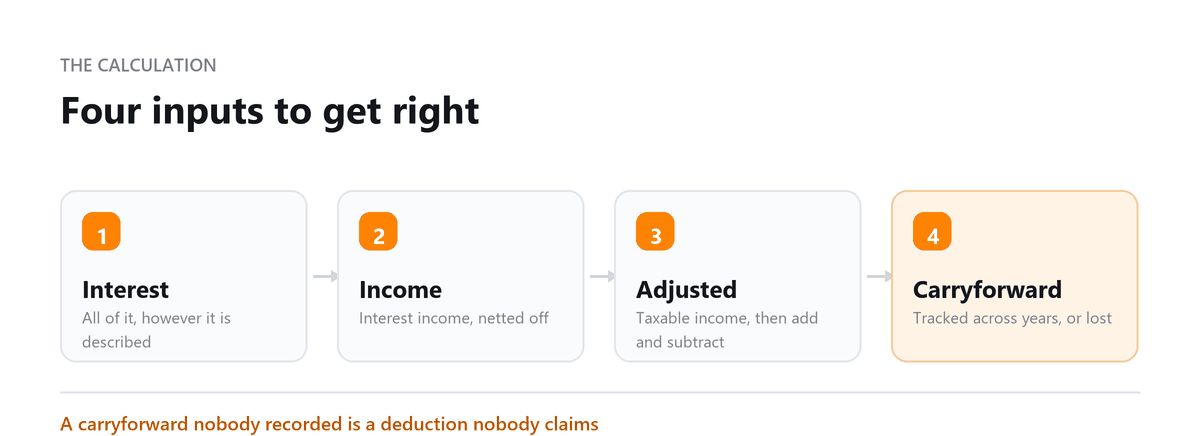
Adjusted Taxable Income (ATI): The Key Figure
The 30% limit is applied to ATI, not gross income. ATI is calculated differently depending on the tax year:
- For tax years beginning before January 1, 2022: ATI = EBITDA-like measure (depreciation and amortisation added back to taxable income)
- For tax years beginning after December 31, 2021: ATI = EBIT-like measure (depreciation and amortisation are NOT added back)
The shift from EBITDA to EBIT in 2022 made the limitation significantly more restrictive for capital-intensive businesses. A business with $10M of depreciation had a much larger ATI before 2022.
Step-by-Step: Completing Form 8990
Part I: Determine Deductible Business Interest Expense
- Line 1: Current year business interest expense
- Line 2: Business interest income
- Line 3: Adjusted taxable income (ATI)
- Line 5: 30% of ATI (the deductibility cap)
- Line 30: Total current year deductible business interest expense (limited to sum of interest income + 30% ATI + floor plan financing)
Part II: Carryforward
- Line 31: Disallowed business interest expense (excess over the limit)
- Carryforward: carries to next year with no expiration; must be tracked each year
Part III: Allocations (Partnerships and S Corps)
- Partnerships must separately track 163(j) items for each partner on Schedule K-1 (Box 13, Code K)
- Partners apply the limitation again at the partner level
Common Mistakes
- Confusing Form 8990 (163(j) interest limitation) with Form 8995/8995-A (QBI deduction), these are entirely different calculations
- Failing to track carryforward amounts from prior years, the disallowed interest from year 1 becomes available in year 2
- Incorrectly classifying personal interest or investment interest as business interest
- Missing the small business exemption, many businesses under $31M file unnecessarily
Profitjets has handled more than 30 Section 163(j) interest-deduction reviews, helping businesses recalculate adjusted taxable income, identify disallowed interest, and track carryforwards.
Across these engagements, clients have identified an average of approximately $120,000 in additional deductible interest through corrected calculations and carryforward planning.
Our business generated roughly $40 million in annual revenue, but after the Section 163(j) limitation changed from an EBITDA-based calculation to an EBIT-based calculation, a significant portion of our interest expense was no longer deductible in the current year. Profitjets recalculated our adjusted taxable income and identified approximately $450,000 of disallowed interest to carry forward, then incorporated the carryforward into our multi-year tax and cash-flow projections so we could plan future debt payments and tax obligations more accurately.
Book a free consultation and we will work through the limitation.
FAQs
Who has to file Form 8990?
Taxpayers with business interest expense that's subject to the Section 163(j) limit generally must file Form 8990. That includes businesses carrying forward previously disallowed interest, and partners and S corporation shareholders who've been allocated excess business interest expense. Businesses that qualify for the small business exemption and have no carryforwards generally don't need to file.
What is the small business exemption?
A business is generally exempt from the limit if its average annual gross receipts for the three prior tax years are at or below an inflation-adjusted threshold and it isn't a tax shelter. Gross receipts of related businesses under common control are generally aggregated for this test, so a group of smaller companies can exceed the threshold together even when none does alone.
How is adjusted taxable income calculated?
Adjusted taxable income starts with taxable income and removes items such as business interest expense and income, net operating loss deductions, the qualified business income deduction, and income not related to a business. For tax years beginning after 2024, depreciation, amortization, and depletion are generally added back as well, which raises adjusted taxable income and increases the amount of interest that can be deducted.
What happens to business interest that's disallowed?
For corporations and individuals, disallowed business interest carries forward to future years with no expiration, where it can be deducted if there's room under the limit. For partnerships, the disallowed amount is allocated to partners as excess business interest expense, which they can generally deduct only when the same partnership later allocates them excess taxable income or excess business interest income.
Can a real estate or farming business avoid the limit?
An electing real property trade or business or electing farming business can choose to be excluded from the limit. The election is irrevocable, and the business must use the alternative depreciation system for certain property. That generally means longer recovery periods and losing bonus depreciation on that property, so the trade-off should be modeled before electing.

Written by
Ankit Sarawagi, CPA, CA, MBA
Ankit leads the finance team at Profitjets, where he has worked with 500+ businesses across the US on bookkeeping, tax and CFO-level strategy. He writes about the habits that keep small business books accurate all year. Connect on LinkedIn
Free consultation
Interest Deduction Restricted?
Book a free consultation and we will work through the limitation.