
Ask any brand new sole proprietor or LLC owner how they pay themselves and the answer is likely to be something along the lines of, "I just transfer myself money when I need it." And indeed it should be, it's their money after all, sitting in their business account doing nothing because they don't have a payroll system to tell them otherwise.
But then the first tax season comes around and they learn the hard way that the income tax is levied at the profit amount - regardless if it's in the owner's personal possession or not.
Which is why many people mistakenly believe they misunderstand owner's draws. A draw in itself is not a salary or subject to taxation.
It's easy to see with sole proprietors (as well as partnerships and some LLCs) the income tax is based on the business's profits regardless if the proprietor takes all the money or leaves it. Take less than you earn and the government will still tax you on the full amount, take more and you're depleting your own equity with the process.
For the most part owner's draws are a rather simple matter. Pick out an amount you know your business can afford on a regular basis, put aside money for quarterly taxes and keep clear records of each transfer to yourself.
Failure to do so will result in many small business owners finding themselves in dire financial situations; be it by having to file taxes for an amount greater than their profits or finding that the IRS will take a bite out of their personal funds to make up for the difference.
This guide explains what an owner's draw is, who can take one, how draws are taxed under each business structure, how they work in an LLC, and how to manage them sensibly.
What Is an Owner's Draw?
An owner's draw (also called a draw or a capital withdrawal) is a transfer of money from the business to the owner for personal use. It is available to:
- Sole proprietors: the most common draw structure, any profit in the business is the owner's income; draws are simply moving that money from the business account to personal
- Partners in a partnership: each partner can take draws against their capital account balance
- LLC members: in a single-member or multi-member LLC taxed as a partnership, members take draws rather than salaries
C-corporation shareholders must take a salary if they work in the business (IRS requirement) and may also receive dividends, but cannot take draws in the same way. S-corporation owner-employees must take a reasonable salary and can take additional distributions, but those distributions are not draws in the traditional sense.
The most common mistake I see with owner's draws is treating the money you take out as your taxable income. Owners draw $60,000, assume that's what they'll be taxed on, and don't set anything aside. Then the business shows $100,000 in profit, the tax bill is based on that, and they've also missed their quarterly estimates, so there's an underpayment penalty on top. The fix is simple: set aside tax on profit, not on draws, and pay it every quarter.
Ankit Sagatani, MBA, B.Com · LinkedInHow Are Owner's Draws Taxed?
Owner's draws are not a tax deduction for the business, unlike salaries, they do not reduce taxable business income. The owner pays taxes on business profit, not on draws. This means: if a sole proprietor earns $100,000 in business profit and takes $80,000 in draws, they owe income tax on the full $100,000, plus self-employment tax (15.3% on the first $176,100 for 2025, 2.9% above that), not just on the $80,000 drawn.
| Structure | How Owner Is Paid | Tax Treatment |
|---|---|---|
| Sole proprietorship | Draws from business account | SE tax (15.3%) + income tax on all net profit |
| Single-member LLC (default) | Draws from member account | SE tax + income tax on all net profit (same as sole prop) |
| Multi-member LLC (default) | Draws from partner capital account | SE tax + income tax on allocated share of profit |
| S-corp | Reasonable salary + distributions | Payroll taxes on salary; income tax only on distributions (no SE tax) |
| C-corp | Salary + dividends | Payroll taxes on salary; double taxation on dividends |
Owner's Draw in an LLC
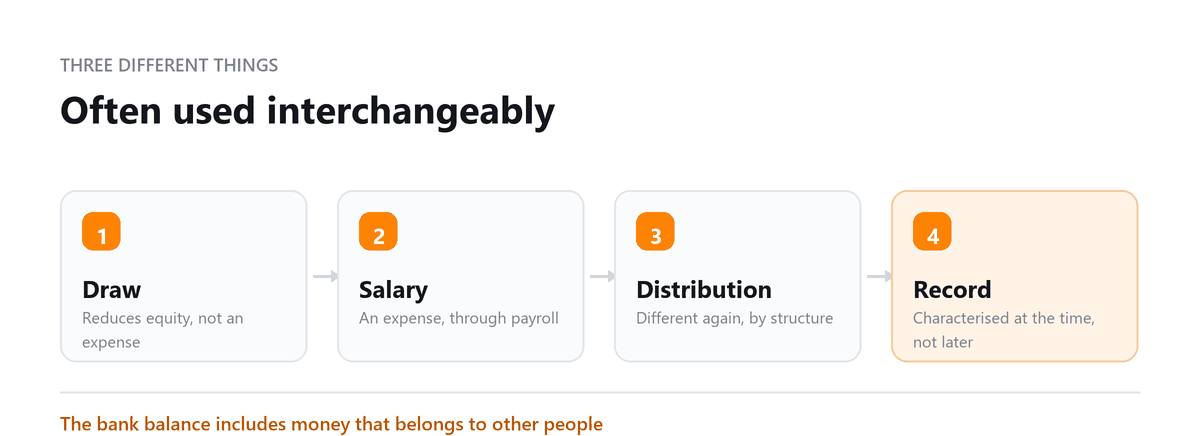
In a single-member LLC, the owner takes draws rather than a salary. The draw reduces the member's capital account (equity in the business). Example: if a single-member LLC has $100,000 in profit for the year and the member takes $70,000 in draws, the member's capital account increases by $30,000 (retained earnings). The member pays income tax and SE tax on the full $100,000 profit, not just the $70,000 drawn.
Multi-member LLCs allocate profit (and loss) among members per the operating agreement. Each member pays tax on their allocated share regardless of whether they take a draw. Draws do not change the tax allocation, they change the capital account balance.
Best Practices for Managing Owner's Draws
Pay Yourself on a Regular Schedule
Treat your draw like a paycheck. Set a regular monthly amount the business can reliably support, instead of withdrawing whenever the bank balance looks comfortable. It makes both your personal budget and the business's cash flow far more predictable.
Set Aside Money for Quarterly Taxes
Because you're taxed on profit and no taxes are withheld from draws, you'll usually need to make quarterly estimated tax payments. The federal due dates are generally April 15, June 15, September 15, and January 15 of the following year. Setting aside a percentage of profit in a separate account each month makes those payments much easier and helps you avoid underpayment penalties.
Keep Business and Personal Accounts Separate
Every draw should be a clear transfer from the business account to your personal account. Paying personal expenses directly with a business debit card blurs the line, makes bookkeeping harder, and can weaken the legal protection an LLC is meant to provide.
Record Draws Correctly
Draws should be recorded in an owner's draw or distributions account in your books, never as a business expense. Recording them as expenses understates your profit and leads to inaccurate tax returns.
Put a Draw Policy in Writing
If you have partners or co-owners, document the draw policy in your operating or partnership agreement. Cover how much can be drawn, how often, and any conditions, such as keeping a minimum cash balance in the business before draws are taken.
Include Draws in Your Budget
Draws don't appear on your profit and loss statement, but they still take cash out of the business. Include your planned draws in your cash flow budget so their impact is expected, not discovered at the end of the month.
Conclusion
An owner's draw is the simplest way for sole proprietors, partners, and most LLC owners to pay themselves, but simple doesn't mean casual. You're taxed on the business's profit, not on what you withdraw, so the amount you draw and the amount you set aside for taxes are two separate decisions. Pay yourself on a steady schedule, keep enough in the business to run it and weather a slow month, record every draw correctly, and make your quarterly tax payments on time.
Do that, and draws become a reliable paycheck rather than a source of surprises.
Book a free consultation and we will set it up properly.
Frequently Asked Questions
How much should I pay myself as a business owner?
Start with what the business can sustain. Your draw should cover your personal needs while leaving enough in the business for operating expenses, loan payments, taxes, a cash reserve, and planned reinvestment. Many owners set a fixed monthly draw below their average monthly profit, then take an additional draw after the year's results are clear.
Can an LLC owner take a salary instead of a draw?
Only if the LLC has elected to be taxed as an S corporation or C corporation. With an S corp election, the owner must be paid a reasonable salary through payroll and can take distributions on top of it. Without an election, owners of single-member and multi-member LLCs generally can't be paid a W-2 salary from their own LLC. Members of a multi-member LLC can, however, receive guaranteed payments for their services, which work differently from draws for tax purposes.
Are owner's draws considered income?
Not directly. For sole proprietors, partners, and default LLC owners, your taxable income is your share of the business's profit, whether or not you withdraw it. The draw itself is just a movement of money you've already been taxed on, or will be taxed on, through the business's profit.
Can I take a draw if my business isn't profitable?
You can, but it reduces your equity in the business. If draws consistently exceed profit, your capital account can turn negative, meaning you've taken out more than you've put in and earned. It also drains the cash the business needs to operate, so it's usually only sustainable for short periods.
Do I need to make estimated tax payments if I take owner's draws?
In most cases, yes. Because no tax is withheld from draws, most owners who expect to owe at least $1,000 in federal tax for the year need to make quarterly estimated payments. Missing them can lead to an underpayment penalty, even if you pay the full balance when you file.

Written by
Ankit Sagatani, MBA, B.Com
Ankit works with business owners across the US on industry-specific bookkeeping, from real estate to construction and retail. He writes about what each trade's books actually need. Connect on LinkedIn Connect on LinkedIn
Free consultation
Unsure How to Pay Yourself?
Book a free consultation and we will set it up properly.