
This area is moving. Central and state rules under the codes were still being notified when this was written. Confirm the current position with the Ministry of Labour and Employment, or with an adviser, before acting on any of it.
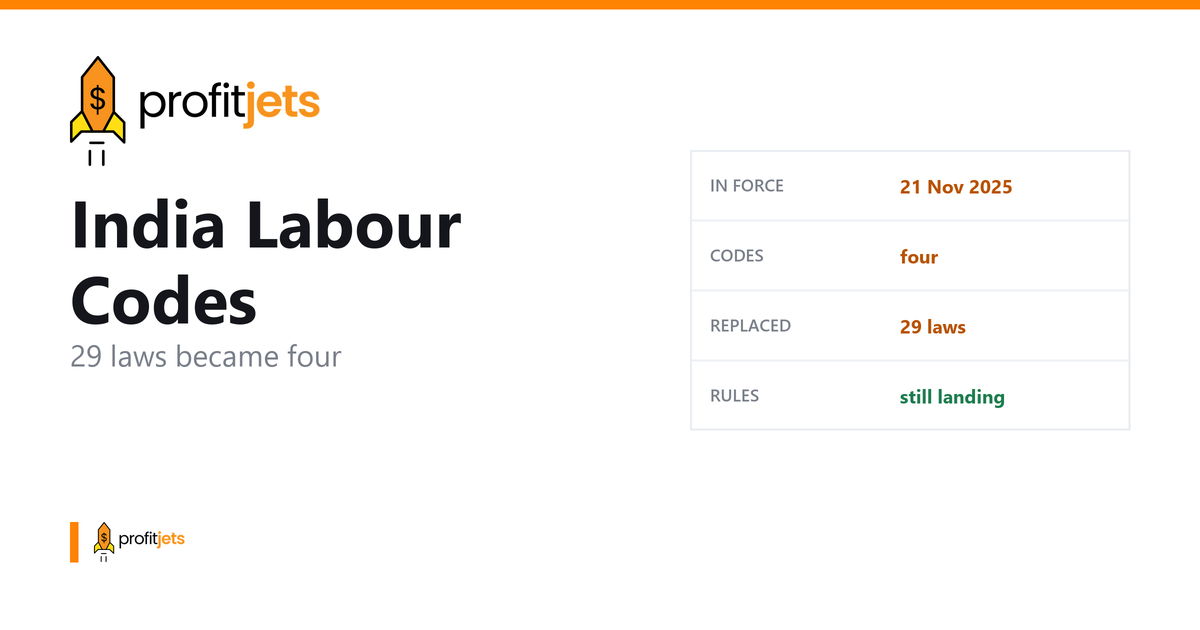
On 21 November 2025 India brought its four labour codes into force, replacing 29 separate labour laws with a single framework. It is the largest change to Indian employment law in decades.
If you employ people in India, or are thinking about it, the headline is not the consolidation. It is what happened after it.
What actually changed on 21 November 2025
Twenty nine existing labour laws were folded into four codes:
| Code | What it covers |
|---|---|
| Code on Wages | A single definition of wages, minimum wages, and timely payment |
| Industrial Relations Code | Dispute resolution, fixed term employment, standing orders, strikes |
| Code on Social Security | Social security, extended to gig, platform and unorganised workers |
| Occupational Safety, Health and Working Conditions Code | Safety and welfare, working hours, health protections |
The single definition of wages in the first of those is the one with the widest reach, because so many other calculations hang off it. Provident fund, gratuity and the statutory bonus are all computed on a wage base, so changing how wages are defined changes what employers owe, without anyone changing a single rate.
The part that matters most: the rules are still landing
A code sets the framework. The rules underneath it make it operable, and in India those rules come from both the centre and each state.
Draft central rules followed on 30 December 2025. States have been notifying their own. Until a given set is final, the position is that the earlier acts and their rules continue to apply alongside the new code, and parts of the codes are being brought into effect in stages rather than all at once.
So the practical answer to "what applies to my Indian employee today" is: it depends on which provision, and it depends on which state they sit in. That is not a permanent state of affairs, but it is the state of affairs now.
The questions we get are not about the codes themselves, they are about which rule applies in Karnataka this month versus Maharashtra. That is the real work, and it is the part that does not fit into a foreign HR team's week.
Anu Gupta, CA, EA, B.Tech · LinkedInWhat this means if you employ in India from abroad
If you run your own Indian entity
The obligation is yours, and it is live. Practically that means watching for the final central rules, watching the notifications in each state where you have people, and checking that your salary structure still works under a single definition of wages rather than the one it was designed around.
None of that is unmanageable. It is simply attention, every month, on a jurisdiction most foreign finance teams do not otherwise follow.
If you employ through an employer of record
The obligation sits with the EOR that employs your team rather than with you. Tracking the notifications, adjusting structures and keeping filings current is their job rather than yours.
This is the clearest argument for an employer of record service that exists at the moment, and it is not a sales argument. It is the observation that a framework in mid-transition, varying by state, is a poor thing to track from another timezone for one or two employees.
If you use contractors in India
Worth a second look rather than a shrug. The Code on Social Security extends benefits to gig and platform workers, which signals a direction of travel: the gap between a contractor and an employee is being narrowed, not widened. An arrangement that looked defensible a few years ago deserves re-examining on its facts.
What to do now
Find out which states you actually employ in
Rules are being notified state by state, so the answer to every question starts with where the person sits.
Look at your salary structure against the wage definition
A structure built to minimise a contribution base under the old acts may not behave the same way under a single definition of wages.
Check who is responsible for watching this
If it is your own entity, name the person. If it is a provider, ask them directly what they have changed since November 2025.
Re-examine long running contractor arrangements
Not because they are automatically wrong, but because the direction of travel is towards more protection, not less.
Diarise a review
Final central rules and the remaining state notifications are the trigger. This is not a one-off reading.
The short version
India consolidated 29 labour laws into four codes on 21 November 2025. The codes are in force, the rules underneath them are still being notified centrally and by each state, and until they are final the older acts continue to apply alongside.
If you employ in India through your own entity, that tracking is yours. If you employ through an employer of record, it is theirs. Either way it is worth knowing which, because right now it is a moving target rather than a settled rulebook.
A foreign founder with one employee in Bangalore shouldn’t have to spend time in another time zone figuring out India’s changing labour requirements. For companies without a local HR team, understanding how the four labour codes affect payroll, wages, social security, and employee benefits add another layer of complexity to hiring in India.
So to resolve this we at Profitjets look at the employment and payroll requirements that apply to each employee’s location and help businesses manage their statutory responsibilities as requirements evolve.
Frequently Asked Questions
When did India's four labour codes come into effect?
The four codes were brought into force on 21 November 2025, consolidating 29 earlier labour laws. The rollout is staged, so not every provision started on that date, and the rules underneath the codes were still being notified afterwards.
What are the four labour codes?
The Code on Wages, the Industrial Relations Code, the Code on Social Security, and the Occupational Safety, Health and Working Conditions Code. Between them they replace 29 separate labour laws.
Do the old labour laws still apply?
In part, and it depends on the provision and the state. The government's notification indicated that the relevant provisions of the existing acts and their rules continue to remain in force until the corresponding rules under the codes are finalised. That is why the current position has to be checked rather than assumed.
How do the labour codes affect a foreign company employing in India?
If you run your own Indian entity, the obligation to track and comply is yours, including watching state notifications where your people sit. If you employ through an employer of record, it sits with the entity that employs your team. The single definition of wages is the change with the widest reach, because provident fund, gratuity and bonus are calculated on a wage base.
Do the codes change provident fund or gratuity rates?
The codes change the framework and introduce a single definition of wages, which affects the base those contributions are calculated on even where the rate itself is unchanged. Because rules are still being notified, current rates and the applicable base should be confirmed against the latest position rather than taken from a guide.
What should I do about contractors in India?
Review them on their facts. The Code on Social Security extends benefits to gig and platform workers, which points towards narrowing the gap between contractor and employee rather than widening it. A long running arrangement where you direct daily work is the one most worth looking at.

Written by
Anu Gupta, CA, EA, B.Tech
Anu works with US businesses on tax and entity questions at Profitjets, from choosing a structure to the filings that follow it. She writes about the decisions owners make once and then live with for years. Connect on LinkedIn
Free consultation
Employing in India While the Rules Move?
We employ teams in India through our own entity and track this for a living. Tell us what you are trying to do and we will tell you what it takes.