
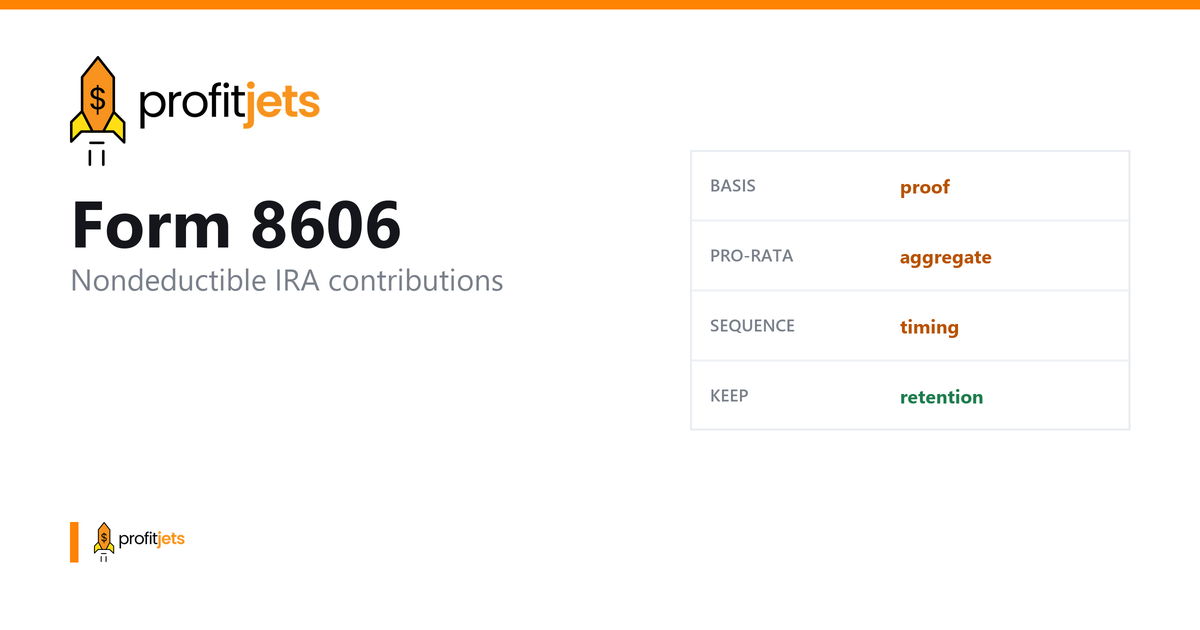
A high earner finds out that they make too much to contribute to a Roth IRA, but that they can do a "backdoor Roth" by funding a traditional IRA (with no deduction) and then converting to Roth.
They do this several times, and then when a new preparer asks for Forms 8606, they find that they don't have any, and that nobody has been reporting the after-tax contributions, and nobody has kept track of the old rollover IRA at another brokerage, resulting in their conversions to Roth being non-taxable events.
The IRS doesn't know about the basis in their traditional IRA so it's all taxable income to them.
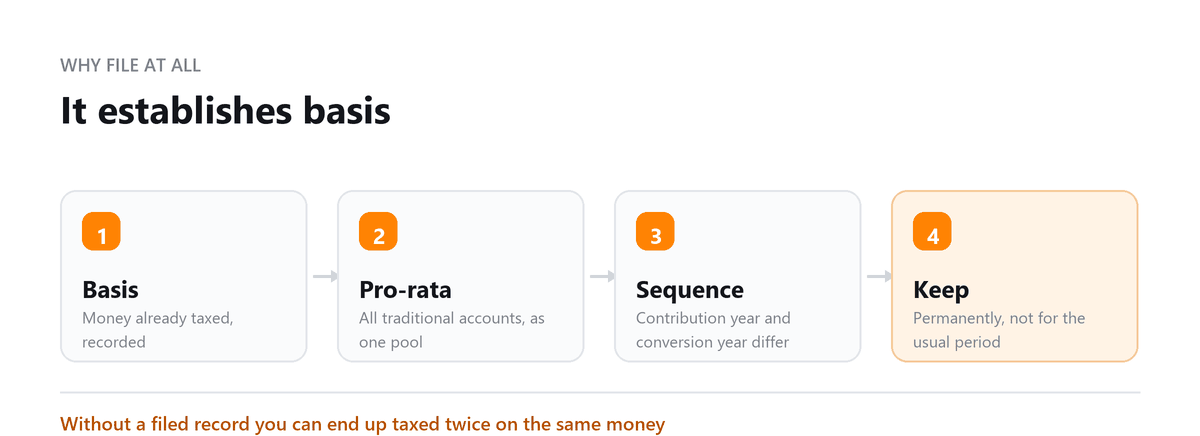
The Form 8606 serves as a record that allows the IRS to know about the existence of basis in an IRA. Basis is money that has already been taxed, most often nondeductible contributions to a traditional IRA.
Once money is distributed from the IRA, the basis is distributed tax-free, and the rest is taxed as income. The IRS has no knowledge of the existence of the basis unless the taxpayer reports it with Form 8606, and the default assumption is that all distributions are taxable. The form is also what reports Roth conversions and calculates certain distributions from Roth IRAs.
This guide explains who has to file Form 8606, how IRA basis works, the contribution and income limits, how the pro-rata rule applies to distributions and conversions, how to do a backdoor Roth correctly, how Roth IRA distributions are taxed, deadlines and penalties, and what to do if you missed prior years.
What is Form 8606?
Form 8606 tracks after-tax (non-deductible) contributions to traditional IRAs and governs the taxation of IRA distributions and Roth conversions. Filing it correctly prevents double taxation ensuring you don't pay tax again on money that was already taxed when contributed. It also applies when you take distributions from a Roth IRA that include both contributions and earnings.
Form 8606, Nondeductible IRAs, is used to:
Report nondeductible contributions to traditional IRAs and track your total basis.
Figure the taxable and nontaxable parts of distributions from traditional, SEP, and SIMPLE IRAs when you have basis.
Report conversions from traditional, SEP, and SIMPLE IRAs to Roth IRAs.
Figure the taxable part of certain Roth IRA distributions and track your basis in Roth contributions and conversions.
Form 8606 is generally filed for each spouse separately, since IRAs and IRA basis belong to one person, even on a joint return.
The relevant rules for conversions aren't obvious either. The IRS will consider all IRAs as one giant account, so you can't convert just the after-tax portion of your IRA if you have any pre-tax money in any SEP, SIMPLE, or traditional IRA.
The conversions are always calculated based on the IRA balances at the end of the year, not the time of the conversion. And a single missed form can cost much more than the small penalty for neglecting to report basis, because the IRS may end up taxing the same income twice, once when the money went into the IRA and again when it's distributed many years later.
Who Must File Form 8606?
- Made non-deductible contributions to a traditional IRA for the year
- Received a distribution from a traditional, SEP, or SIMPLE IRA and have a basis from prior non-deductible contributions
- Converted a traditional IRA to a Roth IRA (Roth conversion)
- Received a distribution from a Roth IRA where basis tracking is needed
Anyone doing backdoor Roth conversions needs to file Form 8606 every year, because the form is the only proof that the money going into the Roth was already taxed. When clients skip it for several years, their basis effectively disappears from the IRS's view.
They either end up paying tax on conversions that should have been tax-free, or we have to rebuild years of contributions from old Forms 5498 and brokerage statements to prove what they put in. The other mistake I see is a forgotten rollover IRA.
If there's pre-tax money in any traditional IRA on December 31, most of the conversion becomes taxable, no matter how carefully the contribution was made.
Ankit Sarawagi, CPA, CA, MBA · LinkedInTY2025 IRA Contribution Limits
| Age | 2025 IRA Contribution Limit |
|---|---|
| Under 50 | $7,000 |
| 50 or older (catch-up) | $8,000 |
Note: income limits apply to Roth IRA direct contributions (phase-out: $150,000 to $165,000 single; $236,000 to $246,000 MFJ for TY2025). Above these limits, high earners use the 'backdoor Roth' strategy, make a non-deductible traditional IRA contribution then convert to Roth.
The Pro-Rata Rule: Critical for Backdoor Roth
If you have both deductible (pre-tax) and non-deductible (after-tax) IRA funds in ANY traditional IRA at year-end, you cannot convert only the non-deductible portion tax-free. The IRS treats all your traditional IRA funds as a single pool. The taxable portion of any conversion or distribution is calculated as:
Taxable % = (Total Pre-Tax IRA Balance) / (Total IRA Balance) x Distribution Amount
Example: $50,000 non-deductible contribution, $50,000 pre-tax rollover in same IRA = $100,000 total. Convert $50,000 to Roth: 50% taxable = $25,000 taxable, $25,000 tax-free. To cleanly do a backdoor Roth, the pre-tax IRA balance must be $0 at year-end (e.g. roll pre-tax funds into a 401(k) that accepts rollovers).
Penalties for Failing to File Form 8606
The $50 Failure-to-File Penalty
If you're required to file Form 8606 to report a nondeductible contribution to a traditional IRA and you don't, the IRS can charge a $50 penalty for each failure. The penalty doesn't apply if you can show the failure was due to reasonable cause.
The $100 Overstatement Penalty
If you overstate your nondeductible contributions on Form 8606, the IRS can charge a $100 penalty for each overstatement. This penalty also doesn't apply if you can show reasonable cause.
The Real Cost: Lost Basis
These penalties are small, and the IRS rarely assesses them. The bigger risk is what happens to your basis when Form 8606 isn't filed.
Form 8606 is the only record that shows the IRS you've already paid tax on part of your IRA. Without it, distributions and Roth conversions are generally treated as fully taxable. That means you can end up paying tax twice on the same money, once in the year you earned it and again when you take it out.
The problem often doesn't surface for years. Someone who made nondeductible contributions in their 30s may not take distributions until their 60s or 70s, by which point the records needed to prove basis, such as Forms 5498 and old brokerage statements, can be hard to find.
If You've Missed Filings
For years when you made nondeductible contributions but didn't take distributions or convert, you can generally file the missing Form 8606 on its own without amending that year's return. If you took distributions or converted and paid tax on money that should have been nontaxable, you may need to file amended returns, subject to the normal time limits for claiming refunds. Either way, rebuilding your basis history now is far easier than trying to prove it decades later.
Filing Deadline
Form 8606 is filed with the annual tax return (Form 1040/1040-SR) by April 15, 2026 for TY2025 (October 15, 2026 with extension). It can also be filed by itself (without a tax return) if you only need to report non-deductible contributions, due by the return due date including extensions.
Profitjets has managed Form 8606 IRA basis reporting for more than 40 clients, helping taxpayers reconstruct historical nondeductible contributions and maintain accurate basis records for future distributions.
“I had made nondeductible IRA contributions for several years but hadn't filed Form 8606, so my IRA basis wasn't properly documented. Profitjets reconstructed my contribution history, prepared the necessary amended returns, and documented the basis so the same income wouldn't be taxed twice when I eventually withdrew the funds.”
Book a free consultation and we will check the pro-rata position.
Frequently Asked Questions
Why is Form 8606 important?
It tracks your basis in traditional IRAs, meaning money you've already paid tax on. Without it, the IRS has no record of that basis, and distributions or conversions can be treated as fully taxable, so you end up paying tax twice on the same money.
What is the pro-rata rule?
When you take a distribution or convert to a Roth, all your traditional, SEP, and SIMPLE IRAs are treated as a single account. You can't choose to take only after-tax money. The nontaxable portion is based on your total basis compared with the combined value of those accounts on December 31, plus distributions and conversions during the year.
Do I need to file Form 8606 if I convert to a Roth but have no basis?
Yes. Any conversion from a traditional, SEP, or SIMPLE IRA to a Roth IRA must be reported on Form 8606, even if you have no basis and the entire conversion is taxable.
Can I fix years when I didn't file Form 8606?
Usually. For years where you made nondeductible contributions but had no distributions or conversions, you can generally file the missing Form 8606 on its own. If distributions or conversions were taxed incorrectly, you may need to file amended returns, subject to the normal time limits for claiming refunds.
What happens if I contribute for 2025 but convert in 2026?
The nondeductible contribution is reported on your 2025 Form 8606, and the conversion is reported on your 2026 Form 8606. The pro-rata calculation for the conversion uses your IRA balances on December 31, 2026.

Written by
Ankit Sarawagi, CPA, CA, MBA
Ankit leads the finance team at Profitjets, where he has worked with 500+ businesses across the US on bookkeeping, tax and CFO-level strategy. He writes about the habits that keep small business books accurate all year. Connect on LinkedIn
Free consultation
Doing a Backdoor Roth?
Book a free consultation and we will check the pro-rata position.