
Grandparents give a child shares of stock, a custodial account slowly grows over a decade, or a family moves a chunk of savings into a teenager's name thinking the child's low tax bracket will keep the tax small.
For small balances, that works. But once a child's investment income passes a couple of thousand dollars a year, a set of rules known as the kiddie tax steps in, and a good share of that income is taxed as if the parent had earned it.
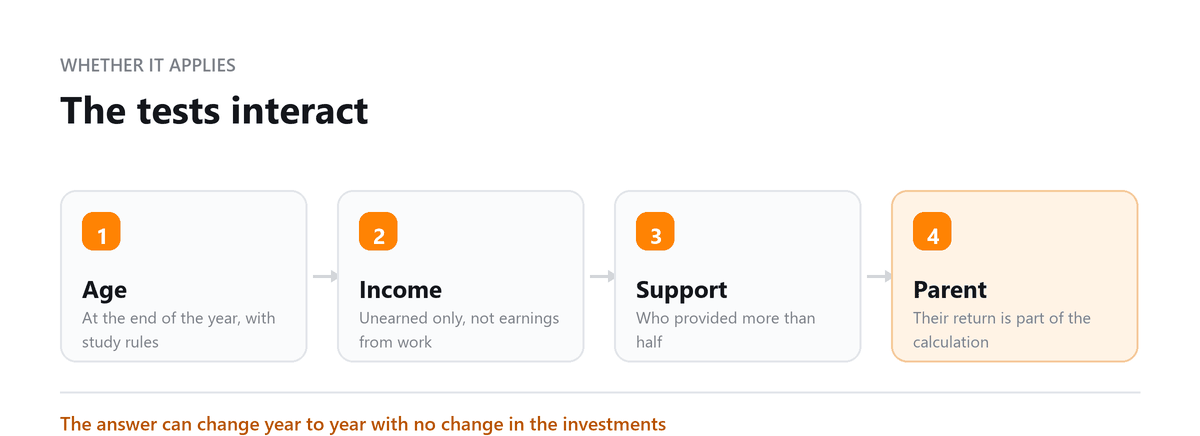
The kiddie tax exists to stop families from shifting investment income to children just to use their lower brackets. It applies to children under 18, and to many 18-year-olds and full-time students through age 23 who don't support themselves with their own earnings.
A child's first slice of unearned income is covered by their standard deduction, the next slice is taxed at the child's rate, and everything above that is taxed at the parent's rate. Form 8615 is where that calculation happens, and it's attached to the child's own tax return.
The child's return needs the parent's taxable income and filing status, and sometimes the investment income of the child's siblings. When the parent's return isn't finished, the child's return may have to wait or be amended later.
This guide explains which children are subject to the kiddie tax, the 2025 thresholds, what counts as unearned income, how Form 8615 calculates the tax, whose tax rate is used, how it compares with the Form 8814 election, and legitimate ways to reduce the tax.
What is Form 8615?
Form 8615, Tax for Certain Children Who Have Unearned Income, calculates the tax on a child's unearned income that exceeds the annual threshold. That excess, called net unearned income, is taxed at the parent's tax rates instead of the child's own rates.
Form 8615 is attached to the child's Form 1040 or 1040-NR. It isn't filed with the parent's return. If a parent makes the Form 8814 election instead, the child doesn't file a return and Form 8615 isn't needed.
Who Is Subject to the Kiddie Tax?
All of the following must be true:
- The child has net unearned income above the threshold
- The child is required to file a tax return
- The child is under age 19 at the end of the year, OR is a full-time student age 19 to 23 who does not provide more than half of their own support through earned income
- At least one parent is alive at the end of the year
When a child has significant investment income, the most effective planning usually changes what kind of income the account produces rather than how it's reported. Growth investments that pay little in dividends, tax-exempt bonds, and holding off on selling appreciated assets until the child ages out of the kiddie tax can all shrink the income subject to the parent's rate.
For children with a job, wages from genuine work don't count as unearned income at all, and funding a Roth IRA with those earnings moves future growth out of reach of the kiddie tax entirely. What rarely works is simply moving more money into the child's name, since that's exactly what the rules were written to catch.
Ankit Sarawagi, CPA, CA, MBA · LinkedInTY2025 Threshold
| Child's Net Unearned Income | Tax Rate Applied |
|---|---|
| $0 to $1,300 | No tax (exempt) |
| $1,301 to $2,600 | Child's own tax rate |
| Over $2,600 | Parent's marginal tax rate (kiddie tax) |
What Is Unearned Income?
- Taxable interest and dividends
- Capital gains distributions from mutual funds
- Net capital gains from investment sales
- Taxable Social Security benefits (if applicable to child)
- Income from trusts, including income distributed from a grantor trust
NOT unearned income (exempt from kiddie tax):
- Wages, salary, tips from employment
- Self-employment income
- Certain disability income
Filing Deadline for Form 8615
Form 8615 doesn't have its own deadline. It's attached to the child's federal income tax return, Form 1040 or 1040-NR, and is due when that return is due.
| Return | Due Date | Extended Due Date |
|---|---|---|
| Child's Form 1040 or 1040-NR, calendar year | April 15 | October 15 with Form 4868 |
When a due date falls on a weekend or legal holiday, it moves to the next business day. A child living abroad on the due date may qualify for the automatic two-month extension to June 15 that applies to other taxpayers outside the United States.
An extension gives the child more time to file, not to pay. Any tax owed on the child's return is still due by April 15.
Filing Before the Parent's Return Is Final
Form 8615 needs the parent's filing status and taxable income. If the parent's return isn't finished, the child's return can be filed on time using a reasonable estimate of the parent's taxable income, or extended until the parent's figures are available.
If the child's return is filed with an estimate and the parent's final taxable income turns out to be different, file an amended return for the child using Form 1040-X to correct the kiddie tax. The same applies if the parent's taxable income later changes because of an amended return or an IRS adjustment.
Children With More Than One Sibling Filing Form 8615
When several children of the same parent file Form 8615, the tentative tax depends on the combined net unearned income of all of them. It's easiest to prepare the children's returns together, so a change to one child's income is reflected in the others' calculations before any of them are filed.
Step-by-Step: Completing Form 8615
How the Kiddie Tax is Calculated
Form 8615 is generally completed in three parts.
Part I: Child's Net Unearned Income
Start with the child's total unearned income, subtract the threshold amount, and limit the result to the child's taxable income. This is the child's net unearned income, the amount taxed at the parent's rate.
Part II: Tentative Tax Based on the Parent's Tax Rate
Add the child's net unearned income, and that of any other children of the same parent who also file Form 8615, to the parent's taxable income. Calculate the tax on that combined amount, then subtract the tax on the parent's taxable income alone. The difference is the tentative tax, allocated among the children based on their share of the net unearned income.
Capital gains and qualified dividends keep their character in this calculation, so they're taxed at the parent's capital gains rates rather than ordinary rates.
Part III: Child's Tax
The child's taxable income that isn't net unearned income is taxed at the child's own rates. That tax is added to the child's share of the tentative tax. The result is compared with the tax on all of the child's taxable income at the child's own rates, and the larger amount is the child's tax.
The final figure is carried to the tax line of the child's return.
Getting the Parent's Information
Form 8615 needs the parent's name, identifying number, filing status, and taxable income. When the child's return is prepared separately from the parent's, that information has to be shared with whoever is preparing the child's return.
If the parent's return isn't finished by the child's filing deadline, the child's return can use a reasonable estimate and be amended once the parent's figures are final. Changes to the parent's taxable income later, including from an IRS adjustment, can also require the child's return to be amended.
Election to Include Child's Income on Parent's Return
If the child's only income is interest, dividends, and Alaska Permanent Fund dividends (and meets other conditions), the parent may elect to include the child's income on the parent's Form 1040 using Form 8814 instead of filing a separate return for the child. Compare the tax cost of each approach sometimes Form 8814 creates more tax than a separate return with Form 8615.
Legal Ways to Reduce the Kiddie Tax
Understanding which children are covered, what income counts, and how the rates apply makes it much easier to plan investments in a child's name and avoid surprises at filing time.
Invest for growth instead of income. Holdings that pay little in interest or dividends produce less unearned income each year. Unrealized gains aren't taxed until sold.
Use tax-exempt investments. Interest from most municipal bonds isn't taxable, so it doesn't count toward the kiddie tax.
Time sales of appreciated assets. Selling after the child is no longer subject to the kiddie tax lets gains be taxed at the child's own rates, which may be 0 percent for long-term gains.
Use a 529 plan for education savings. Growth inside a 529 plan isn't taxed each year, and qualified withdrawals are tax-free, so earnings don't flow to the child's return.
Pay reasonable wages for real work. A child who works in a family business earns wages, not unearned income. For older children, earned income that covers more than half of their support can take them out of the kiddie tax entirely.
Fund a Roth IRA with the child's earnings. A child with earned income can contribute up to the lesser of their earnings or the annual limit. Growth inside the Roth isn't taxable, so it never becomes unearned income.
Coordinate gifts. Moving large amounts of income-producing assets into a young child's name often increases the family's tax rather than reducing it.
Profitjets has reviewed kiddie tax situations for more than 35 families, helping parents evaluate how children's investment income is taxed and structure investment accounts with future tax implications in mind.
“We had several investment accounts in our child's name and didn't realize the kiddie tax could apply as the account generated more taxable income. Profitjets reviewed the UTMA holdings, helped us time planned transfers appropriately, and suggested shifting part of the portfolio toward growth-oriented investments with lower dividend distributions, which reduced the child's current taxable investment income and gave us a more tax-conscious structure.”
Book a free consultation and we will check the position before year end.
FAQs
What is the kiddie tax threshold for 2025?
For 2025, a child's unearned income above $2,700 is generally taxed at the parent's rate. The first $1,350 is usually covered by the child's standard deduction, and the next $1,350 is taxed at the child's own rate. The threshold is adjusted for inflation each year.
Until what age does the kiddie tax apply?
It applies to children under 18 at the end of the year. It also applies to children who are 18 if their earned income didn't exceed half of their own support, and to full-time students aged 19 to 23 if their earned income didn't exceed half of their own support.
Does a child's job income count toward the kiddie tax?
No. Wages, salaries, tips, and net self-employment income are earned income, not unearned income, so they're taxed at the child's own rates. Earned income can also matter for the support test that determines whether older children are subject to the kiddie tax.
Whose tax rate is used on Form 8615?
If the parents file jointly, their joint return is used. If they file separately, the parent with the higher taxable income is used. If the parents are unmarried, divorced, or separated, the custodial parent's return is generally used.
Should I use Form 8615 or Form 8814?
It depends on the child's income and your family's return. Form 8814 is only available when the child's income is limited to interest and dividends, and it adds income to the parent's return, which can affect credits and the net investment income tax. Form 8615 keeps the income on the child's return and can use the child's lower rates on part of it. Comparing both is the safest approach.

Written by
Ankit Sarawagi, CPA, CA, MBA
Ankit leads the finance team at Profitjets, where he has worked with 500+ businesses across the US on bookkeeping, tax and CFO-level strategy. He writes about the habits that keep small business books accurate all year. Connect on LinkedIn
Free consultation
Holding Investments for a Child?
Book a free consultation and we will check the position before year end.