
Many parents open up a brokerage or savings account for a child, whether it's a custodial account funded with birthday money or a gift from grandparents or a small portfolio meant for college.
This account balance typically grows slowly and nobody thinks about taxes. It grows to the point of a small dividend or a year of higher interest rates, pushing the child's income past a few thousand dollars in one year and now the question emerges - does the child even need their tax return?
Sometimes the answer is no. The tax return can be reported on a parent's tax return with
Form 8814, the parents election to report the interest and dividend income of a child. It's an easier option for families who find that their children have only a small amount of investment income, nothing else.
None of the first $1,050 of the child's income are taxed. The rest up to $2,100 are taxed at a flat tax rate and any income above that is included in the parent's income.
Expert Perspective
Form 8814 makes the most sense when a child's investment income is modest, mostly ordinary interest, and the parents' income is comfortably below the thresholds where a higher AGI starts to cost them credits or trigger the net investment income tax.
Once parents are near those phase-outs, or the child's income is mostly qualified dividends that could be taxed at 0 percent on the child's own return, filing a separate return for the child usually wins. The tax on the child's income itself often comes out similar either way.
What changes is everything else on the parents' return that depends on AGI.
Ankit Sarawagi, CPA, CA, MBA · LinkedInEasier isn't always cheaper though. The child's income included in a parent's tax return increases the parent's adjusted gross income and can decrease credits and deductions, increase income taxed by the net investment income tax or create other changes in a state's tax code.
It may make more sense to file a separate tax return for the child, with the kiddie tax in the form of form 8615 calculated, than to report the child's income on a parent's return. The calculations should be done for both options before making an election.
This guide explains who can make the Form 8814 election, the income thresholds, how the tax is calculated, which parent files, how the election compares with filing a separate return using Form 8615, and the situations where it can increase your family's total tax.
Eligibility for the Form 8814 Election
All conditions must be met:
- The child was under age 19 (or under 24 if full-time student) at the end of the year
- The child's only income was interest, dividends, and capital gain distributions (Alaska Permanent Fund dividends also qualify)
- The child's gross income was less than $12,500 (TY2024 figure)
- The child had no estimated tax payments and no withholding credit
- The child is not filing a joint return with a spouse
TY2025 Thresholds
| Threshold | TY2024 Amount |
|---|---|
| Child's gross income limit to use Form 8814 | $12,500 |
| Base amount (exempt from parent's tax) | $1,300 (first $1,300 is excluded) |
| Second tier (taxed at child's rate on parent's return) | $1,300 to $2,600 |
| Threshold above which inclusion adds tax at parent's rate | $2,600 |
How the Tax Is Calculated on Form 8814
When you include your child's income on your return via Form 8814:
- The first $1,300 (or verified TY2025 base) of the child's investment income is excluded, no tax
- The next $1,300 ($1,301 to $2,600) is taxed at 10% on the parent's return (a flat 10%, regardless of the parent's rate)
- Any child income above $2,600 is added to the parent's income and taxed at the parent's marginal rate
Form 8814 vs Form 8615: When to Use Each
| Situation | Better Choice |
|---|---|
| Child's income is under $2,600 and parent wants simpler filing | Form 8814 (parent's return), avoids separate child return |
| Child's income is $2,600+ and parent's rate is lower than child's effective rate | Form 8615 (child's separate return) may produce lower total tax |
| Child has capital gain distributions or qualified dividends | Run both calculations, qualified dividend rates on a separate return may outperform Form 8814's flat 10% |
| Child has any other income (wages, self-employment) | Must file child's separate return, Form 8814 not available |
Filing Deadline
Form 8814 is filed with the parent's Form 1040 by April 15, 2026 for TY2025 (or October 15, 2026 with extension).
Profitjets has reviewed Form 8814 elections and Form 8615 filings for more than 30 families, comparing the tax impact of reporting a child's investment income on the parent's return versus filing a separate return for the child.
“Our child's investment income was about $18,000, and we initially expected to use Form 8814 to report it on our return. Profitjets compared both approaches and found that filing a separate Form 8615 would reduce our family's federal tax by approximately $2,400 for the year, so we used the separate-return approach instead.”
Convenience Against Cost
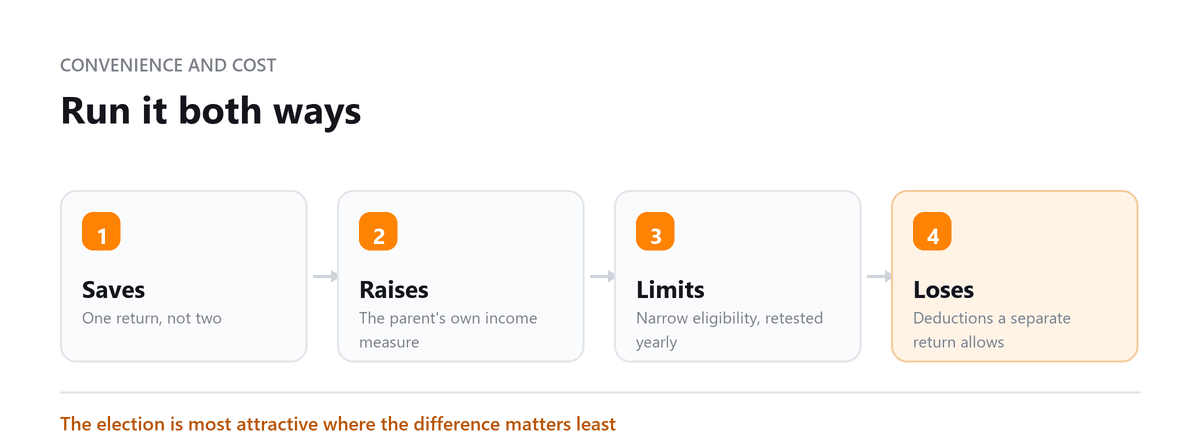
This election exists to save a separate return for a child, and the convenience is genuine. Whether it is the better answer is a calculation rather than a preference.
- The child's income is added into the parent's return, raising the parent's own income measure
- That measure governs eligibility for a number of other deductions and credits, so the effect can reach beyond the tax on the child's income
- Certain items and deductions available on a separate return for the child may not be available under the election
- Where more than one child is involved, the effect compounds across them
Run it both ways before choosing. The election is attractive precisely when the amounts are small, and small amounts are where the difference between the two methods is least likely to justify the loss of flexibility.
Eligibility Is Narrow
The election is available only where the child's income falls within defined limits and is of particular types. A child with income outside those categories, or above the limits, cannot be included and must file separately.
Some of the conditions are easy to overlook: the nature of the income, whether any tax was withheld from it, and whether the child made estimated payments. Any of these can remove the option even where the amount looks modest.
Because eligibility is retested each year, a family that used the election last year may not be able to this year, often because a single distribution pushed the income over a limit. Checking the conditions before assuming continuity avoids preparing a return that then has to be redone.
Once the Child Files, Keep Filing
Where a child does file separately, that becomes their own tax history, and it is worth treating it properly rather than as an administrative nuisance.
A filed return establishes their identity with the tax authority, records basis in investments held in their name, and creates continuity that matters later when they have earnings of their own. Gaps in that history are the kind of thing that produces queries years afterwards.
It is also a reasonable point to involve an older child in understanding their own position, particularly where the account will become theirs outright at a defined age. Current rules on which children must file and on the alternatives are published by the IRS.
When a Child Should File in Their Own Name
Even where the election is available, there are reasons a separate return can be the better answer beyond the arithmetic.
A child with earned income as well as investment income will generally need to file anyway, which removes the convenience argument entirely. A child with amounts withheld at source needs a return to recover them. And where basis in investments needs to be established for the future, a filed return in the child's own name is the cleaner record.
There is also a non-financial consideration. An older teenager approaching the age at which a custodial account becomes theirs outright benefits from understanding their own position, and a return in their name is a reasonable way to start that. It is a small thing, and families who do it generally find the handover easier when it comes.
Book a free consultation and we will run both versions.
FAQs
Can I include my child's investment income on my own tax return?
Yes, if your child was under 19, or under 24 and a full-time student, had only interest and dividend income, including capital gain distributions, had gross income under $13,500 for 2025, and had no withholding or estimated tax payments. You make the election by attaching Form 8814 to your return.
Does using Form 8814 always save tax?
No. The tax on the child's income is often similar to filing a separate return, but including it on your return raises your AGI, which can reduce credits and deductions or trigger the net investment income tax. A separate return can also tax qualified dividends at the child's lower rates. Compare both before choosing.
What's the difference between Form 8814 and Form 8615?
Form 8814 is the parent's election to report a child's interest and dividends on the parent's return. Form 8615 is filed with the child's own return to calculate the kiddie tax, which taxes the child's unearned income above the annual threshold at the parent's rate.
Can I use Form 8814 if my child has a part-time job?
No. The election is only available when the child's income consists entirely of interest and dividends, including capital gain distributions and Alaska Permanent Fund dividends. If the child had wages or any other type of income, the child must file their own return.
Do I need a separate Form 8814 for each child?
Yes. If you're making the election for more than one child, complete a separate Form 8814 for each child and attach all of them to your return.

Written by
Ankit Sarawagi, CPA, CA, MBA
Ankit leads the finance team at Profitjets, where he has worked with 500+ businesses across the US on bookkeeping, tax and CFO-level strategy. He writes about the habits that keep small business books accurate all year. Connect on LinkedIn
Free consultation
Deciding How to Report a Child's Income?
Book a free consultation and we will run both versions.