
A credit card company agrees to settle a $22,000 balance for $8,000. A lender forgives part of a mortgage after a short sale. A supplier writes off an overdue invoice for a struggling small business. It feels like relief, and it is. Then a Form 1099-C arrives in January reporting the forgiven amount, and the tax software treats all of it as income, on top of a year that was already financially difficult.
That's the general rule. When a debt is cancelled for less than you owe, the forgiven amount is usually treated as income, because you received money or property you no longer have to repay. But the tax code recognizes that people and businesses who can't pay their debts often can't pay tax on their forgiveness either.
Form 982 is how you claim the exclusions that apply when debt is discharged in bankruptcy, when you're insolvent, and in a few other situations.
The exclusion isn't free. In exchange for keeping cancelled debt out of income, you generally reduce certain tax benefits you'd otherwise use later, such as loss carryforwards, credits, and the basis of your property. Getting the exclusion right means proving you qualify, calculating the amount carefully, and reducing the right attributes in the right order.
This guide explains when cancelled debt is taxable, the situations where it isn't income at all, the exclusions reported on Form 982, how to calculate insolvency, how tax attributes are reduced, and how to complete and file the form.
When Is Cancelled Debt Taxable?
When a lender cancels or forgives your debt, the cancelled amount is generally taxable income. Cancelled debt is income unless an exclusion applies. Common scenarios where a 1099-C is issued:
- Credit card debt settled for less than owed
- Mortgage modification or foreclosure with deficiency forgiveness
- Student loan discharge (some categories taxable; some now tax-free)
- Business loan forgiveness by a creditor
The most common mistake I see with a 1099-C is people assuming the full amount is taxable because the lender reported it. Someone settles credit card debt or loses a car to repossession while their overall finances are underwater, and they never check whether they were insolvent. A careful asset and liability worksheet, dated just before the cancellation, often turns a large tax bill into little or none.
Ankit Sarawagi, CPA, CA, MBA · LinkedInThe Six Exclusion Categories on Form 982
Form 982 allows you to exclude cancelled debt from income under specific circumstances: bankruptcy, insolvency, qualified principal residence debt, certain farm debt, or qualified real property business debt. It also requires you to reduce your tax attributes (net operating losses, basis of assets, credits) to reflect the exclusion.
| Exclusion | Requirement |
|---|---|
| Title 11 Bankruptcy | Debt discharged in a bankruptcy case under Title 11 of U.S. Code, no insolvency calculation needed |
| Insolvency | Taxpayer was insolvent immediately before the discharge, can exclude up to the amount of insolvency (total liabilities exceed total assets at FMV) |
| Qualified Farm Debt | Debt owed to an unrelated lender and incurred in connection with farming; taxpayer is a farmer under IRC 1017 |
| Qualified Real Property Business Debt | Debt secured by real property used in a trade or business; must reduce basis of property; election required |
| Qualified Principal Residence Debt | Mortgage on principal residence; generally applies to debt discharged in connection with a decline in value or foreclosure; up to $750,000 ($375,000 MFS), Congress has extended this on and off; verify current law |
| Student Loans (certain categories) | Student loan discharges from certain programs (e.g. public service loan forgiveness, school closure discharge) may be excludable, verify status for 2025 |
Calculating Insolvency
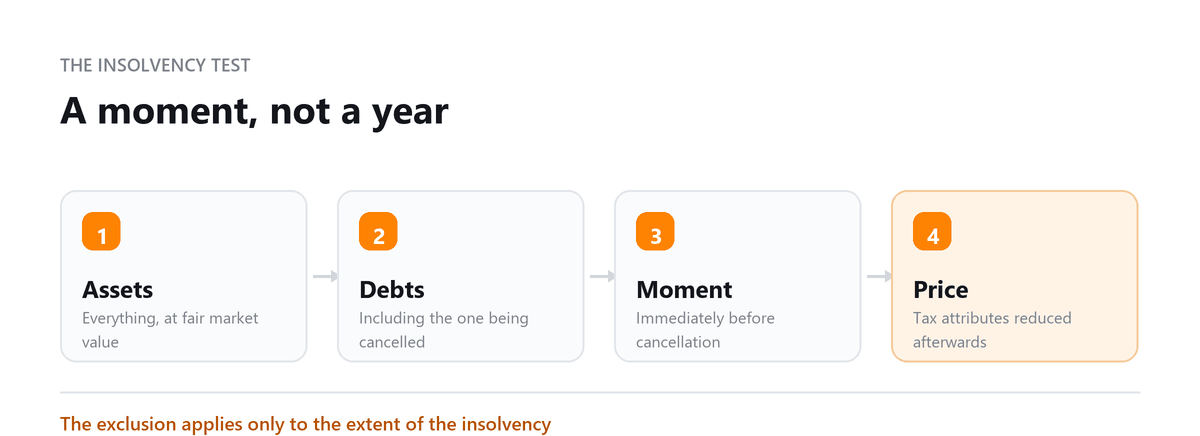
Insolvency = Total Liabilities - Total Assets (at FMV) immediately before the debt cancellation
You can exclude only up to your insolvency amount. Example: $300,000 of debt cancelled; total liabilities were $800,000; total assets were $600,000, insolvency = $200,000. Only $200,000 can be excluded; the remaining $100,000 is taxable income.
Assets include: bank accounts, investment accounts, home equity (FMV minus mortgage), vehicles (FMV), business assets, retirement accounts (some states/situations include, some don't). Prepare a complete asset/liability worksheet before completing Form 982.
Tax Attribute Reduction Requirement
If you exclude cancelled debt from income under Form 982, you must reduce your tax attributes in a specific order (Part II of Form 982):
- 1. Net operating losses (NOLs)
- 2. General business credits
- 3. Minimum tax credits
- 4. Capital loss carryovers
- 5. Basis of property (real property, personal property, inventory, patents)
- 6. Passive activity loss and credit carryovers
- 7. Foreign tax credit carryovers
Exception: for real property business debt exclusion (Line 1d), only the basis of the real property securing the debt is reduced, no other attribute reduction.
Cancelled debt is generally taxable, but it doesn't have to be when the discharge happens in bankruptcy, while you're insolvent, or in the specific farm, business real property, and principal residence situations the tax code allows.
Form 982 is where you claim those exclusions and reduce the tax attributes that pay for them.
Check first whether the cancellation is income at all, measure insolvency carefully as of the moment before the debt was cancelled, follow the required attribute reduction order, and keep your worksheet and supporting documents with your return.
Partnerships and S Corporations
The exclusions are applied differently depending on the entity:
Partnerships. Cancelled debt income passes through to the partners, and the bankruptcy and insolvency exclusions are applied at the partner level based on each partner's own situation.
S corporations. The exclusions are applied at the corporation level, and attributes are reduced at that level. Excluded amounts don't increase shareholders' stock basis.
Profitjets has handled more than 30 cancelled-debt tax engagements, helping clients review Form 1099-C reporting, calculate insolvency exclusions, and determine whether cancelled debt could be excluded from taxable income.
“I received a Form 1099-C after a credit card debt was cancelled and was concerned that the full amount would become taxable income. Profitjets completed an insolvency calculation, determined that I qualified to exclude the cancelled debt, and filed Form 982, preventing approximately $8,500 of cancelled debt from being included in my taxable income.”
Book a free consultation and we will test the exclusions.
Frequently Asked Questions
Is all cancelled debt taxable?
No. Cancelled debt is generally income, but it can be excluded if the debt was discharged in bankruptcy, while you were insolvent, or in certain qualified farm, business real property, or principal residence situations. Some cancellations, such as genuine gifts and certain student loan discharges, aren't income at all.
How do I calculate insolvency?
Add up all your liabilities and subtract the fair market value of all your assets, both measured immediately before the debt was cancelled. If liabilities are higher, you're insolvent by the difference, and you can exclude cancelled debt up to that amount. Include retirement accounts and other assets protected from creditors.
Do I have to reduce tax attributes if I exclude cancelled debt?
Generally, yes. Excluding cancelled debt usually requires reducing tax attributes such as net operating losses, credit carryovers, capital loss carryovers, and the basis of property. You can elect to reduce the basis of depreciable property first. The reductions are reported in Part II of Form 982.
Can I still exclude forgiven mortgage debt on my main home?
The qualified principal residence exclusion is temporary. Under the most recent extension, it applied to debt discharged before January 1, 2026, or under a written arrangement entered into before then, up to $750,000, or $375,000 if married filing separately. Check whether it's been extended before relying on it for later discharges.
What if I didn't file Form 982 with my return?
If you qualified for an exclusion but reported the cancelled debt as income, you may be able to file an amended return with Form 982 to claim it. Amended returns claiming a refund generally must be filed within three years from the date the original return was filed, or two years from the date the tax was paid, whichever is later.

Written by
Ankit Sarawagi, CPA, CA, MBA
Ankit leads the finance team at Profitjets, where he has worked with 500+ businesses across the US on bookkeeping, tax and CFO-level strategy. He writes about the habits that keep small business books accurate all year. Connect on LinkedIn
Free consultation
Received a 1099-C?
Book a free consultation and we will test the exclusions.