
Remediation work is largely funded by insurers rather than by the people whose property was damaged, and that single fact shapes the whole financial model.
The scope is agreed against a schedule, payment arrives well after the work is finished, and anything done beyond the approved scope is absorbed by the contractor unless a variation was approved first.
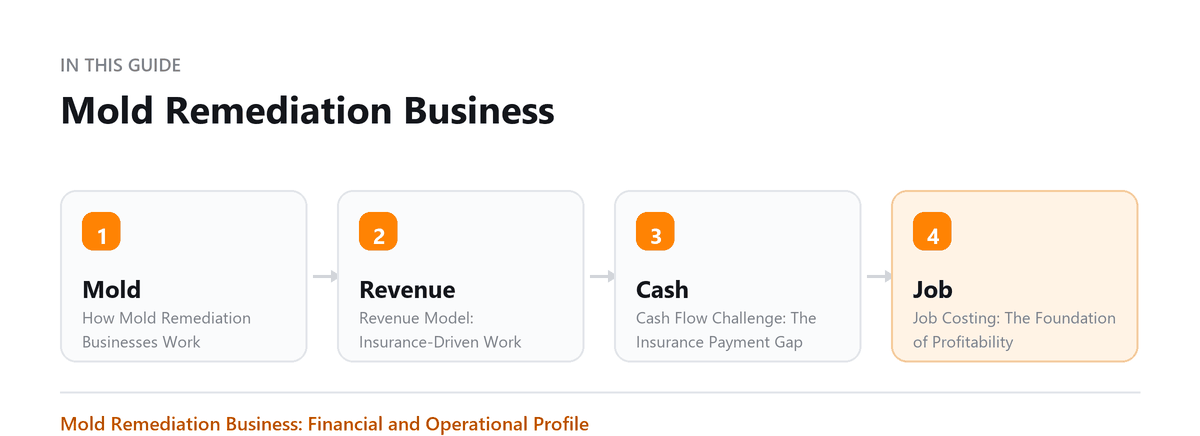
This covers how these businesses work, the revenue model, the cash gap between completing and being paid, why job costing is the core discipline, the equipment burden, and the levers that actually grow one.
How Mold Remediation Businesses Work
Mold remediation companies assess, contain, and remove mold growth from homes and commercial buildings. The business is primarily insurance-driven: the majority of mold jobs are filed as homeowner insurance claims following water damage events (burst pipes, flooding, roof leaks, HVAC failures).
Profitability on a job is decided by whether the work performed matched the work approved. Anything beyond the agreed scope is absorbed unless a variation was approved before it was done, and job costing is what makes that visible while it can still be acted on.
Abhinav Gupta, CPA, CA, MBA · LinkedInRevenue Model: Insurance-Driven Work
Understanding the insurance billing cycle is essential to running a mold remediation business:
- Homeowner files claim; adjuster inspects and assigns estimate (often using Xactimate software)
- Remediation company submits invoice based on industry pricing
- Insurance carrier reviews, negotiates, and issues payment, typically 30-90 days after job completion
- Assignment of Benefits (AOB): in some states, the homeowner can assign their right to insurance proceeds to the contractor, allowing direct billing to the carrier
Cash Flow Challenge: The Insurance Payment Gap
The core financial challenge: you mobilize crews, buy materials, and complete work, then wait 30-90 days for the insurance carrier to pay. This gap can strangle growing companies.
- Maintain a working capital line of credit sized to at least 60 days of average monthly revenue
- Negotiate payment terms with material suppliers to extend to net-30 or net-45
- Invoice immediately upon job completion, delay in submitting invoice = delay in payment
- Monitor carrier-specific payment performance: some carriers are faster than others
Pro Tip: Track days outstanding by carrier. If one carrier consistently pays slowly or disputes, factor that into your bidding and collection strategy.
Job Costing: The Foundation of Profitability
Every mold job must be costed individually. Job costing tracks the actual cost of completing a specific project against the revenue billed for that project.
| Job Cost Component | Notes |
|---|---|
| Direct labor | Hours x hourly rate for all technicians on the job |
| Materials | Containment barriers, HEPA vacuums (consumables), antimicrobial solutions, drywall, PPE |
| Equipment | Air scrubbers, dehumidifiers, fans, tracked by rental day or depreciated asset |
| Subcontractors | If you sub out drywall, HVAC cleaning, or post-remediation testing |
| Disposal fees | Dumpster rental or biohazard disposal |
| Permits | Some jurisdictions require permits for remediation work |
A healthy gross margin per job should be 40-55%. If you are consistently below 40%, examine labor productivity and materials waste first.
Equipment: A Major Overhead Category
Mold remediation requires specialized equipment that is expensive to purchase and maintain:
- HEPA air scrubbers ($2,000-$5,000 each)
- Commercial dehumidifiers ($1,500-$3,000 each)
- Negative air machines for containment
- Thermal imaging cameras for moisture detection
- Truck-mounted or portable extraction units (if offering water damage services)
Track equipment utilization rates. Equipment sitting in a warehouse costs you depreciation and insurance without generating revenue. High-utilization equipment should be purchased; lower-utilization items can be rented.
Licensing and Certification
Licensing requirements for mold remediation vary by state. Some states (Texas, Louisiana, New York, Florida) have specific mold contractor license requirements. Others have no state-level requirement but local or insurance-network credentialing matters.
- IICRC (Institute of Inspection, Cleaning and Restoration Certification): industry standard certification
- State contractor license where required
- EPA Lead-Safe Certification if working in pre-1978 homes
- Commercial general liability insurance (typically $1M/$2M minimum for insurance network approval)
- Workers compensation insurance: legally required when you have employees
Growing a Mold Remediation Business: Key Levers
Insurance Adjuster Relationships
Insurance adjusters are your most important referral source for consistent volume. Building adjuster relationships means faster approvals, fair estimates, and repeat work from the same carrier network.
Water Damage Cross-Sell
Mold almost always follows water damage. Companies that offer both water damage mitigation and mold remediation are called first when flooding occurs, and they control the entire restoration revenue stream.
Preferred Vendor Network Enrollment
Major insurance carriers (State Farm, Allstate, USAA, Travelers) maintain preferred vendor networks. Enrollment gives you direct dispatch from the carrier. Requirements include licensing, insurance, performance metrics, and Xactimate proficiency.
Book a free consultation and we will scope it with you.
Frequently Asked Questions
What is a typical revenue range for a mold remediation company?
A single-crew owner-operated company might generate $300k-$700k annually. Multi-crew regional companies with insurance network relationships can reach $2M-$5M+. Revenue scales with crew count and carrier relationships.
What is Xactimate and why does it matter?
Xactimate is industry-standard estimating software used by insurance adjusters. Your invoices must be formatted and priced in line with Xactimate's pricing guides, or adjusters will dispute your charges. Invest in Xactimate training and software.
How do I handle jobs where insurance denies the claim?
Have a clear policy upfront: notify the homeowner if there is coverage uncertainty. In some cases, the homeowner pays out-of-pocket. In others, a public adjuster can help re-negotiate the denial. Do not perform work without clarity on payment source.
What determines whether a job was profitable?
Whether the work performed matched the work that was approved and paid for. In insurance-funded work the scope is agreed against a schedule, and any labour, equipment time or materials beyond it is absorbed by the contractor unless a variation was approved before the work was done. Job costing that captures hours and equipment against each job is what makes that visible while it can still be acted on.
How should the payment gap be managed?
By forecasting it rather than absorbing it. Track the time between completion and payment by payer, because it differs materially between them, and build the average into the cash forecast rather than hoping. Where the gap is long and the pipeline is growing, the business needs working capital to support growth in the same way a stockholding business does, and that is a funding conversation rather than a collections one.

Written by
Abhinav Gupta, CPA, CA, MBA
Abhinav works with business owners across the US on industry-specific bookkeeping, from dental practices and restaurants to construction and e-commerce. He writes about what each trade's books actually need. Connect on LinkedIn
Free consultation
Want This Handled Properly?
Book a free consultation and we will scope it with you.