
Buying into an established franchise trades a lower chance of failure for an ongoing share of revenue and a set of obligations that run for years.
Restoration work has particular financial characteristics: demand that does not track the economy, equipment that has to be bought before it earns, and customers who are frequently insurers rather than the people whose property was damaged.
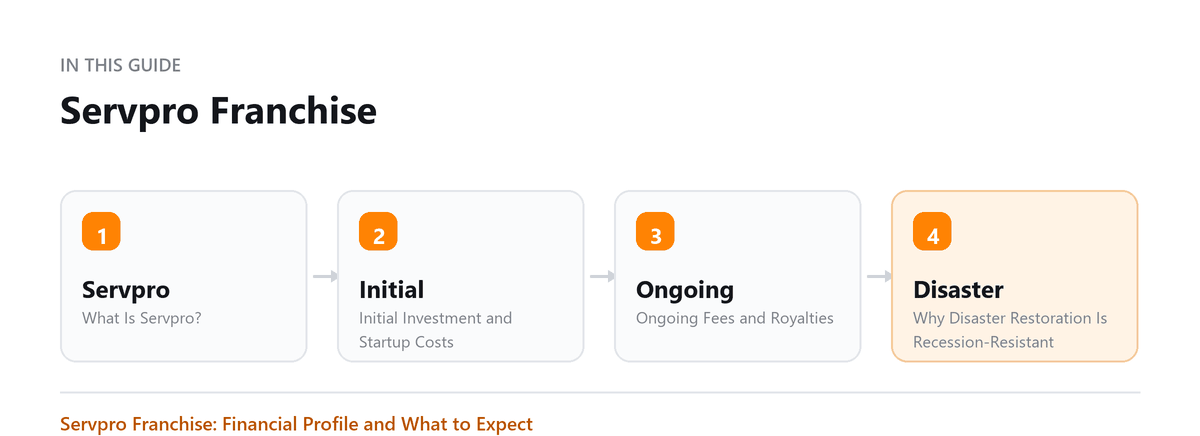
This covers what the investment involves, the ongoing fees, why the sector behaves the way it does through a downturn, the working capital pressure that follows from insurance-funded work, and the financial management that decides whether a territory succeeds.
What Is Servpro?
Servpro is one of the largest franchise networks in the disaster restoration and cleaning industry in the United States and Canada. Franchisees provide fire damage restoration, water damage mitigation, mold remediation, and commercial cleaning services under the Servpro brand.
Read the disclosure document and the agreement in full, then speak to former franchisees rather than only current ones. The document tells you what you are obliged to do and pay. The people who left tell you what it was like to do it, which no earnings figure conveys.
Anu Gupta, CA, EA, B.Tech · LinkedInInitial Investment and Startup Costs
Based on publicly available Servpro Franchise Disclosure Document (FDD) data:
| Cost Component | Estimated Range |
|---|---|
| Franchise fee | $50,000-$60,000 (initial) |
| Equipment and vehicles | $100,000-$200,000+ |
| Working capital (first year) | $50,000-$150,000 |
| Total estimated initial investment | $200,000-$500,000+ |
Higher-end estimates apply to franchisees buying an existing territory with established business vs. a startup territory.
Ongoing Fees and Royalties
- Royalty fee: typically 3-10% of gross revenue
- Advertising fund contribution: additional percentage for national marketing fund
- These fees are charged on gross revenue regardless of your profitability
Why Disaster Restoration Is Recession-Resistant
Fires, floods, and mold do not stop during recessions. Insurance-driven restoration work is one of the most recession-resistant business categories. Unlike discretionary services, restoration is necessary for the home to be habitable, homeowners do not defer it.
- Revenue tied to weather events and infrastructure age, both reliable over time
- Insurance pays the majority of invoices, recession does not reduce insurance coverage
- Servpro's brand drives call volume during local disaster events (storms, widespread flooding)
The Working Capital Challenge
The single biggest operational challenge for a Servpro franchisee is bridging the gap between doing the work and getting paid:
- Jobs often start immediately after a loss event (emergency response within hours)
- Equipment mobilization, labor, and materials are deployed and paid for immediately
- Insurance claims processing takes 30-90 days before payment arrives
- During a large regional storm event, a franchisee may work 50+ jobs simultaneously, enormous working capital requirement
Pro Tip: Negotiate a business line of credit with your bank before you need it. Lenders are much more willing to extend credit when you are not in distress. Use the Servpro FDD and your business plan as the basis for the loan package.
Equipment Financing
The large equipment requirement is a barrier to entry and ongoing cost of the business. Most franchisees finance major equipment (vehicles, trailers, air movers, dehumidifiers, extractors):
- SBA 7(a) or 504 loans for major equipment packages
- Equipment-specific lenders who understand franchise businesses
- Servpro corporate may have approved lender relationships
- Depreciate equipment over useful life for tax purposes; track by asset
Job Costing: The Core Financial Management Tool
Every job must be tracked from dispatch to final invoice paid:
| Job Costing Element | Notes |
|---|---|
| Revenue | Amount billed (using Xactimate estimates for insurance jobs) |
| Direct labor | Crew hours x fully-loaded labor rate |
| Materials | All consumables for the specific job |
| Equipment rental cost | Allocated cost of equipment on that job |
| Subcontractor costs | Any third parties brought in for the job |
| Gross profit per job | Revenue minus direct costs |
Franchisee P&L Benchmarks
Based on industry data and franchise financial performance disclosures in the FDD:
| P&L Line | Typical Range (as % of Revenue) |
|---|---|
| Gross revenue | 100% |
| Direct costs (labor + materials + equipment) | 40-55% |
| Gross margin | 45-60% |
| Royalties + advertising fund | 8-15% |
| Other operating expenses (rent, overhead, admin) | 15-25% |
| Owner's net income (pre-tax) | 10-25% |
Book a free consultation and we will scope it with you.
Frequently Asked Questions
How much can a Servpro franchise earn?
Revenue and earnings vary widely based on territory size, market density, and operator execution. Request Servpro's Item 19 FDD disclosures for actual reported franchisee revenue ranges. Do not rely on informal earnings claims from franchisors.
Do I need prior restoration experience to buy a Servpro franchise?
No prior industry experience is required. Servpro provides initial training. However, strong business management, leadership, and customer service skills matter more than technical restoration knowledge.
What are the main reasons Servpro franchises struggle financially?
Insufficient working capital (the most common early failure), failure to maintain equipment, poor crew management and job quality leading to customer complaints and insurance network removal, and underinvestment in marketing in slow periods.
Can I buy an existing Servpro franchise rather than a startup territory?
Yes. Resale franchises are available and may come with existing revenue and customers. Resale price typically reflects a multiple of the franchise's cash flow. Perform the same due diligence you would for any business acquisition.
What should anyone buying into a franchise read before committing?
The franchise disclosure document in full, the agreement itself, and the financial statements of several existing operators if the franchisor will facilitate that. Then speak to current and, more importantly, former franchisees. The document tells you what you are obliged to do and pay; the former franchisees tell you what it was like to do it. Both are more informative than any earnings figure quoted in marketing.

Written by
Anu Gupta, CA, EA, B.Tech
Anu works with US businesses on tax and entity questions at Profitjets, from choosing a structure to the filings that follow it. She writes about the decisions owners make once and then live with for years. Connect on LinkedIn
Free consultation
Want This Handled Properly?
Book a free consultation and we will scope it with you.