
Ask a business owner how the business is doing and they will most likely tell you about the revenues and the profits. Now, the profit is an important metric, but it is often interesting to take a look at another indicator, the owner’s equity. This number rarely gets discussed, but it is exceptionally telling about the business’s financial position.
After all, when all the debts are paid, this is what remains to be distributed among the owners. The changes in owner’s equity can be surprising, as the business’s profits can rarely indicate the trend. One can see the steady increase in profits and have an image of the thriving enterprise, while the owner’s equity could actually decrease due to the owner’s withdrawals.
Meanwhile, another business may show relatively low profits, but replace the debt with new investments, increasing the owner’s equity.
Not only is the owner’s equity a good metric to track, it is also of great interest to lenders, investors, and potential buyers. For the lenders, this number is crucial in determining the risk of the loan, so many instruments require a certain level of owner’s equity to be present before considering the application.
Expert Perspective
The P&L tells you whether you made money this year. Owner's equity tells you whether you've kept any of it. The thing that surprises most owners the first time we walk through their balance sheet is how little equity is left after years of profitable operations. The profit was real. It just went out the door in draws faster than the business could replace it.
Abhinav Gupta, CPA, CA, MBA · LinkedInThis guide covers what owner's equity is, what goes into it, how to calculate it, how it appears in your financial statements, and practical ways to manage and grow it.
What Is Owner's Equity?
Owner's equity (also called shareholders' equity for corporations, or net assets) represents the owners' financial claim on the business's assets after all debts are settled. The accounting equation defines it: Owner's Equity = Total Assets - Total Liabilities. Example from the live page: $500,000 in assets - $200,000 in liabilities = $300,000 in owner's equity.
Owner's equity is not a bank account or cash balance, it is an accounting measure that tells you how much of the business's asset base is funded by owners rather than creditors. High equity relative to assets (low leverage) means the business is primarily owner-funded. Low equity relative to assets (high leverage) means creditors fund most of the asset base.
Components of Owner's Equity
| Component | Description |
|---|---|
| Capital contributions / paid-in capital | Money invested by the owner(s) directly into the business, initial investment plus any subsequent equity injections |
| Retained earnings | Cumulative net profits kept in the business, not distributed to owners |
| Owner's draw / distributions | Reduces equity, withdrawals of profit by the owner for personal use |
| Net income / net loss (current period) | Increases equity (profit) or decreases it (loss) for the current accounting period |
| Other comprehensive income | Corporations only, gains/losses not on the P&L (foreign exchange, unrealised investment gains) |
How to Calculate Owner's Equity (Step-by-Step)
- Method 1 (Balance Sheet): Owner's Equity = Total Assets - Total Liabilities
- Method 2 (Changes in Equity): Beginning Equity + Net Income - Owner's Draw + Additional Capital Contributions = Ending Equity
Example calculation:
| Item | Amount |
|---|---|
| Beginning owner's equity | $250,000 |
| + Net income for the year | $75,000 |
| - Owner's draws taken | ($25,000) |
| + Additional capital contributed | $0 |
| = Ending owner's equity | $300,000 |
Role of Owner's Equity in Financial Statements
- Balance sheet: owner's equity appears on the right side (or bottom) as the residual claim on assets, it is the 'plug' that makes Assets = Liabilities + Equity
- Statement of changes in equity: tracks how equity changed over the period, net income, draws, contributions. Helps investors and lenders understand how value was created or distributed
- Cash flow statement: financing activities section shows equity-related cash flows capital contributions in, draws/dividends out
- Debt covenants: lenders often include minimum equity requirements in loan covenants falling below a specified equity level can trigger covenant violations and accelerate debt repayment
Tips for Managing and Growing Owner's Equity
- Retain profit: the most direct way to grow equity is to earn profit and keep it in the business not distribute all of it as draws
- Control draws strategically: set a sustainable draw level that leaves the business with sufficient equity to support its debt covenants and growth investment
- Invest retained earnings productively: equity that sits as idle cash earns little; deployed into assets that generate returns builds business value
- Reduce liabilities: paying down debt improves the equity position every dollar of debt retired becomes a dollar of additional equity
- Avoid equity dilution: bringing in external investors (equity financing) increases total equity but dilutes ownership percentage understand the trade-off before raising
During initial balance-sheet reviews, approximately 20% of Profitjets clients have an equity position that requires further review, including cases where liabilities exceed assets or prior-period adjustments have reduced reported owner's equity. After reconciliation and cleanup, clients have a more accurate view of owner's equity, retained earnings, and overall financial position.
Common Mistakes with Owner's Equity
| Mistake | Consequence | Fix |
|---|---|---|
| Confusing equity with cash | Owner believes they can withdraw equity; overdraws business | Show owner the balance sheet, equity ≠ cash |
| No tracking of owner's draw | Equity understated; tax position inaccurate | Record every draw as a journal entry: Debit Owner's Draw / Credit Cash |
| Excessive draws in early years | Equity goes negative; loan covenants breached | Set a draw policy based on sustainable business cash flow |
| Ignoring retained earnings | Owner doesn't know historical profit retained | Review equity section at every annual financial review |
Book a free consultation and we will talk you through both figures.
Frequently Asked Questions
Can owner's equity be negative?
Yes. Negative equity, often called a deficit, happens when a business's liabilities are greater than its assets, usually because accumulated losses and draws have outpaced contributions and profits. It's common for startups in their early years. In an established business, it's a serious warning sign, because it means the business owes more than it owns.
Is owner's equity the same as book value?
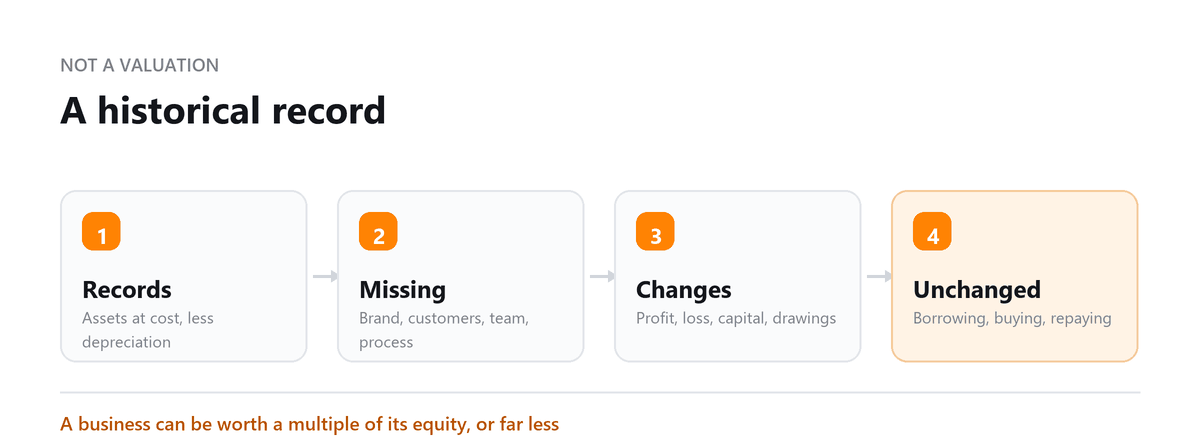
Yes. Owner's equity is the book value of the business, meaning the value of its net assets as recorded in the accounting records. Market value, or what someone would actually pay for the business, can be very different, especially when much of the value comes from things the balance sheet doesn't fully capture, like brand, customer relationships, or intellectual property.
Does paying off debt increase owner's equity?
Not directly. When you use cash to repay a loan, your assets and liabilities both fall by the same amount, so equity stays the same. Paying down debt does lower interest costs over time, which improves profit and helps equity grow gradually, and it reduces the business's financial risk.
Is an owner's draw taxable?
For sole proprietors, partners, and most LLC members, draws themselves aren't taxed separately. Owners are taxed on their share of the business's profit, whether they take that money out or leave it in the business. S corporation distributions and C corporation dividends follow different rules, so it's worth checking with a CPA based on your structure.
What's a healthy level of owner's equity?
There's no single target, because it varies by industry and business model. A useful starting point is the debt-to-equity ratio, which compares total liabilities to owner's equity. Lower ratios generally mean less financial risk, and many lenders set a maximum ratio in their loan terms. Comparing your ratio with industry benchmarks and your own trend over time is more meaningful than any fixed number.

Written by
Abhinav Gupta, CPA, CA, MBA
Abhinav works with business owners across the US on industry-specific bookkeeping, from dental practices and restaurants to construction and e-commerce. He writes about what each trade's books actually need. Connect on LinkedIn
Free consultation
Not Sure What Your Business Is Worth?
Book a free consultation and we will talk you through both figures.