
Petty cash is one of the things every office has that nobody properly manages. A small sum of money locked away in a drawer with a couple of hundred or so bucks in it. Someone gets $10 for parking, someone else buys stamps, and a few receipts end up tucked under the bills. At the end of the month, the box is $40 short and nobody remembers why.
The amounts are small, so petty cash is generally overlooked. But small, informal, and cash payments are also where the mistakes and thefts happen most easily.
Unaudited fund with no receipts and a single person being solely responsible for its management is a recipe for disaster, even in a single office with everyone trusting each other.
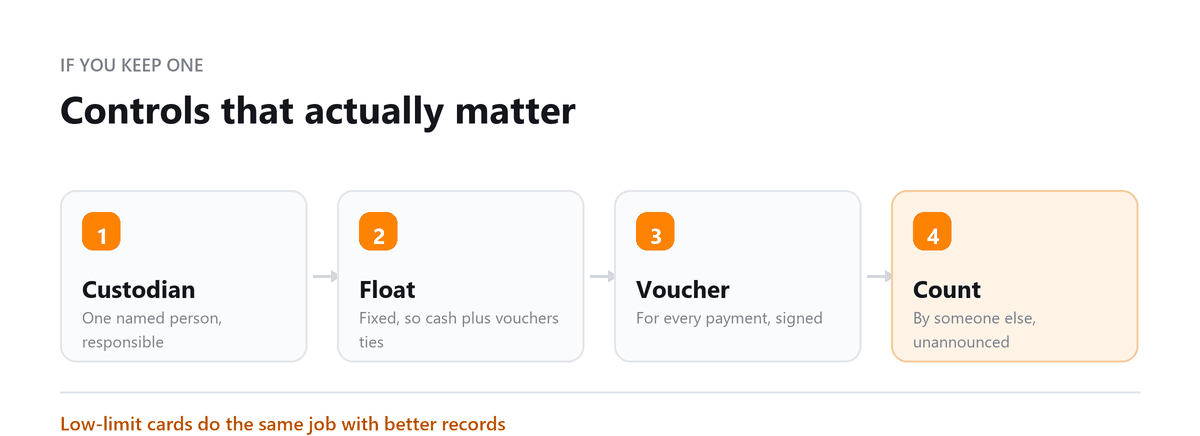
Well-governed petty cash requires almost no resources to be spent on it. Have a sum that you deem small enough, appoint a manager, require receipts on all payments, track the spent amounts on a regular basis and recount the fund without warning sounds like a decent plan for petty cash management. And for some companies, replacing the traditional petty cash fund with a prepaid expense card may be a viable option to consider.
This guide covers what petty cash should and shouldn't be used for, how to set up a fund, how to record and replenish it, the controls that keep it secure, and the digital alternatives many businesses now use instead.
What Constitutes Petty Cash?
Petty cash covers small, incidental expenses that are too minor to warrant a formal purchase order or corporate card transaction. Typical uses:
- Parking fees and small tolls
- Office supplies under $20 (pens, tape, paper clips)
- Postage and small courier costs
- Coffee or lunch for a client meeting (small amount)
- Small gratuities or tips
- Minor equipment repairs
Petty cash should NOT be used for: regular supplier payments (use AP), employee reimbursements above a threshold (use an expense report), travel costs (use a corporate card or expense report), or any payment to a vendor who should be in the AP system.
| Appropriate Petty Cash Use | NOT Appropriate |
|---|---|
| $5 parking fee | Monthly rent or utilities |
| $15 office supply run | Employee travel expenses |
| $8 postage stamps | Vendor invoices |
| $12 client coffee | Cash advances to employees |
The most common petty cash problem I see in small businesses is the fake or recycled receipt. Someone takes cash, writes up a handwritten slip or reuses an old receipt, and because nobody looks closely at replenishment time, the box always seems to balance. The simple control is having someone other than the custodian review every receipt before approving the top-up, and doing an unannounced count every so often. Once people know it gets checked, it stops.
Ankit Sagatani, MBA, B.Com · LinkedInEstablishing a Petty Cash Fund
Step 1: Determine the Fund Amount
For most small businesses, $100-$500 is sufficient. Calculate based on typical monthly petty cash spending: if you spend $80-$100/month on petty items, a $200 fund replenished monthly is appropriate. Avoid holding more than needed, excess cash in a petty cash box increases theft risk.
Step 2: Designate a Custodian
One specific person (the petty cash custodian) is responsible for the fund, holding the physical cash, approving disbursements within policy, collecting receipts, and requesting replenishment. The custodian should not also be the person who approves the replenishment cheque, segregation of duties applies even for petty cash.
Step 3: Set Up the Float
Write a cheque (or transfer from operating account) to 'Petty Cash' for the fund amount. Journal entry: Debit Petty Cash $200 / Credit Cash $200. The Petty Cash account is a current asset on the balance sheet, it represents the cash held in the fund.
Accounting for Petty Cash Transactions
When petty cash is disbursed, the custodian collects a receipt and notes the category (parking, postage, supplies). The cash is NOT recorded in the accounting system at the time of each disbursement, only when the fund is replenished.
At replenishment, the custodian submits all receipts. Journal entry: Debit [various expense accounts] for total of receipts / Credit Cash (replenishment amount). The petty cash balance returns to the original float amount.
| Receipt Category | Amount | Expense Account |
|---|---|---|
| Parking | $15 | Travel & Transportation |
| Office supplies | $22 | Office Supplies |
| Postage | $8 | Postage & Delivery |
| Coffee (client meeting) | $12 | Meals & Entertainment |
| Total replenishment | $57 | Credit Cash $57 |
Replenishing the Fund
A common approach is to top up the fund when it falls to about a quarter of its original amount, so a $200 fund would be replenished once it drops to around $50. Many businesses also replenish at month-end regardless, so expenses are recorded in the right period.
The replenishment amount should equal the total of the receipts collected since the last top-up. Before approving it, check that the cash left in the box plus the receipts adds up to the original fund amount. Once replenished, the box should be back to the full amount.
Internal Controls for Petty Cash
Require a Receipt for Every Payment
No receipt, no cash. Where a receipt isn't available, such as a parking meter, use a signed petty cash voucher showing the date, amount, and purpose.
Set a Per-Transaction Limit
Cap individual petty cash payments, often at around $50. Anything larger should go through a company card, an expense report, or your normal purchasing process.
Count the Fund Without Warning
Every so often, count the cash in the box without advance notice. The cash on hand plus receipts should always equal the original fund amount.
Separate Responsibilities
The custodian holds and hands out the cash. Someone else reviews the receipts and approves each replenishment.
Keep the Cash Secure
Store petty cash in a locked box inside a locked drawer or safe, with access limited to the custodian.
Actually Review the Receipts
Whoever approves replenishment should look at every receipt, not just add up the totals. Check that receipts are genuine, match the categories listed, and fall within policy.
Digital Alternatives to Petty Cash
Many businesses are replacing the cash box entirely with prepaid or company spend cards from providers such as Ramp, Brex, and BILL, or with virtual cards issued by their bank.
These cards remove physical cash from the office, so there's nothing to count and nothing to go missing. Receipts are captured through a mobile app, spending limits can be set by card or category, and transactions sync directly with your accounting software, so there's no manual replenishment entry. You can also see every purchase as it happens.
If your business already uses spend cards, keeping a separate physical petty cash fund often adds work without much benefit. It's worth looking at how often petty cash is really used and whether a small-limit card could handle the same purchases.
Conclusion
Petty cash doesn't have to be a loose end. Keep the fund small, give one person responsibility for it, require a receipt or voucher for every payment, record the expenses when you replenish, and have someone else review and occasionally count it. Those few controls keep your books accurate and make theft much harder. And if the cash box is causing more hassle than it saves, a prepaid spend card may be the simpler answer.
Book a free consultation and we will suggest something better.
Frequently Asked Questions
Do petty cash expenses need to be included in my business taxes?
Yes. Petty cash purchases are business expenses and can be deducted like any other, as long as they're recorded and supported by receipts or vouchers. The expense category matters: most business meals are generally 50 percent deductible, entertainment is generally not deductible, and items like parking and postage are generally fully deductible. Keep petty cash records for at least three years from the date you file the related return.
What happens if the petty cash box doesn't balance?
If the cash on hand plus receipts doesn't equal the fund amount, record the difference in a cash over and short account. Small, occasional differences usually come from rounding or minor mistakes. Large or repeated shortages should be investigated, since they're a common warning sign of misuse.
How much petty cash should a small business keep?
Usually between $100 and $500, depending on how often small cash purchases come up. A good rule is to keep roughly one month of typical petty cash spending, so the fund lasts between replenishments without holding more cash than necessary.
Who should be responsible for petty cash?
One designated custodian should hold the fund, hand out cash, and collect receipts. A different person, such as the owner, office manager, or bookkeeper, should review receipts and approve replenishments. Having two people involved is one of the most effective ways to prevent errors and theft.
Is petty cash still necessary for a modern business?
Not always. Many businesses now handle small purchases with company spend cards or employee reimbursements instead. Petty cash can still be useful for businesses that regularly deal with cash-only situations, but if it's rarely used, closing the fund and switching to a card often simplifies bookkeeping.

Written by
Ankit Sagatani, MBA, B.Com
Ankit works with business owners across the US on industry-specific bookkeeping, from real estate to construction and retail. He writes about what each trade's books actually need. Connect on LinkedIn Connect on LinkedIn
Free consultation
Still Running a Cash Tin?
Book a free consultation and we will suggest something better.