
Net income is the profit that remains after every expense, tax, and interest obligation has been paid. It is the true bottom-line measure of what a business earned, the number that flows into retained earnings on the balance sheet and drives owner distributions. A business can have strong revenue and positive gross profit but still report a net loss if overhead, debt service, or tax is excessive.
Sales were good, the employees were performing well, and the company was profitable for most of the year. However, when the accountant provided the final profit and loss statement, the net income was significantly lower than expected, or lower than the amount withdrawn by the owner.
In most cases, this is not due to an error on the accountant’s part. More often than not, expenses that seemed insignificant on a monthly basis begin to accumulate. The depreciation and interest that the owner did not expect to pay are taken into account, and a year-end audit adjusts for any discrepancies that have not been accounted for throughout the year. The bottom line is always fully inclusive of all expenses incurred.
Net income reflects the amount of profit closed by a company at the end of the year. Subtracting all expenses, including direct and overhead costs, interest, and taxes at the business level, from the total amount of revenues allows the company to determine the amount of profit that can be retained.
In other words, net income is reflected on the balance sheet in retained earnings, serves as the basis for calculating taxes, and is essential in determining the company’s profitability.
What Is Net Income and Why Does It Matter?
Net income (also called net profit, bottom line, or profit after tax) is used by:
- Lenders, to assess debt service capacity (can this business reliably cover loan repayments?)
- Tax authorities, net income is the starting point for calculating taxable income (subject to adjustments)
- Investors, to calculate return on equity (ROE) and assess whether capital deployed is generating adequate returns
- Business owners, to decide how much to reinvest vs distribute, and whether pricing and cost structures are working
The most common reason net income comes in lower than an owner expects is that they've been tracking gross profit in their heads. They know what each job brings in over its direct costs, and it looks healthy. What they haven't added up is everything below that line: admin payroll, software, insurance, vehicle costs, loan interest, depreciation on equipment bought two years ago. Operating expenses is almost always the line that explains the gap. A monthly P&L review, with each expense as a percentage of revenue, removes the year-end surprise.
Abhinav Gupta, CPA, CA, MBA · LinkedInThe Net Income Formula
Net Income = Revenue − COGS − Operating Expenses − Interest Expense − Tax Expense
Or equivalently: Net Income = Gross Profit − Operating Expenses − Interest − Taxes
Expense Categories Included in Net Income
Cost of Goods Sold (COGS)
Direct costs of producing goods or delivering services: raw materials, direct labour, direct production overhead. Gross Profit = Revenue − COGS.
Operating Expenses
All costs to run the business beyond COGS: salaries (non-production), rent, utilities, marketing, software, depreciation of assets. Operating Income (EBIT) = Gross Profit − Operating Expenses.
Interest Expense
The cost of debt, loan interest, overdraft charges, lease finance charges. Deducted below operating income.
Taxes
Income tax expense, corporate tax for companies, income tax for sole traders/partnerships. Deducted last to arrive at net income.
Net Income, Realistic Worked Example
Professional services firm (management consulting), monthly figures:
| Item | Amount |
|---|---|
| Revenue (client billings) | $200,000 |
| COGS (direct consultant labour + subcontractors) | ($80,000) |
| Gross Profit | $120,000 |
| Gross Margin | 60% |
| Operating Expenses: | |
| Staff salaries (admin + management) | ($42,000) |
| Office rent and utilities | ($12,000) |
| Software and tools | ($5,000) |
| Marketing and BD | ($8,000) |
| Depreciation | ($3,000) |
| Total Operating Expenses | ($70,000) |
| Operating Income (EBIT) | $50,000 |
| Interest Expense (business loan) | ($5,000) |
| Income Tax Expense (~30%) | ($10,500) |
| Net Income | $34,500 |
| Net Margin | 17.25% |
A 17 to 20% net margin is achievable for a lean professional services firm. For context, retail businesses typically achieve 2 to 5% net margins; SaaS companies at scale may achieve 15 to 30%.
Net Income Margin Benchmarks
| Industry | Typical Net Margin Range |
|---|---|
| SaaS / Software (scaled) | 15 to 30% |
| Professional Services (consulting, legal, accounting) | 10 to 25% |
| Healthcare / Medical | 5 to 15% |
| Manufacturing | 3 to 8% |
| E-commerce (product-based) | 2 to 8% |
| Retail | 2 to 5% |
| Restaurants | 3 to 9% |
Gross Income vs Net Income
| Gross Income | Net Income | |
|---|---|---|
| Also called | Gross profit | Net profit / bottom line |
| Formula | Revenue − COGS | Revenue − COGS − OpEx − Interest − Tax |
| What it shows | Production / delivery efficiency | Overall business profitability |
| Used for | Pricing and COGS management | Tax filing, investor returns, dividend decisions |
Connection to the Balance Sheet
Net income flows from the income statement to the balance sheet via retained earnings. Each period: Closing Retained Earnings = Opening Retained Earnings + Net Income − Dividends/Owner Drawings. A business with consistent net income builds retained earnings, increasing equity and reducing reliance on debt.
A business that consistently earns more than it distributes builds equity over time. If distributions regularly exceed net income, retained earnings shrink, even while the business is profitable.
Why Net Income Comes In Lower Than Expected
- Overhead added up gradually. Software, insurance, subscriptions, and admin costs grow quietly month by month.
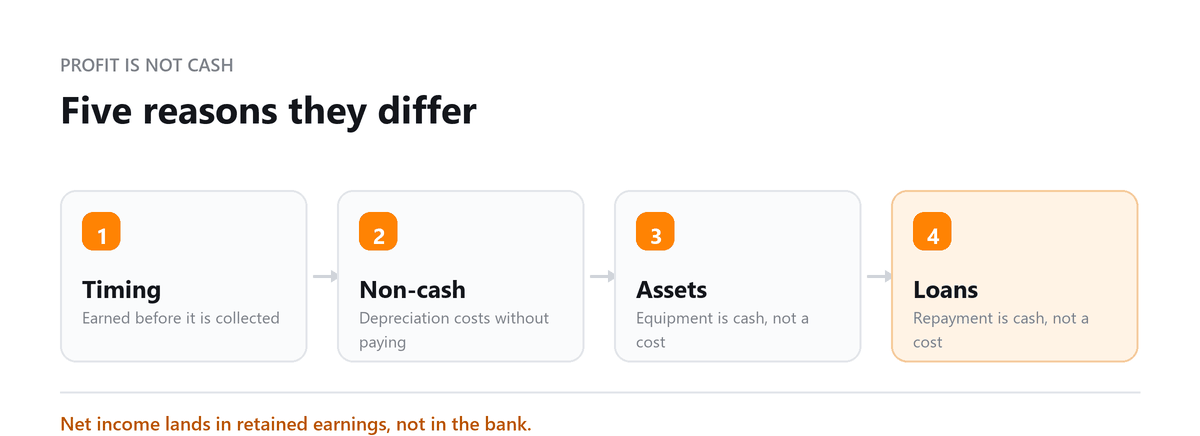
- Depreciation. Equipment bought in earlier years keeps reducing net income, even though no cash leaves the business now.
- Interest. Loan and credit line interest can be significant, especially when rates rise or borrowing grows.
- Year-end adjustments. Accruals, inventory counts, bad debt write-offs, and corrections to categories often land at the end of the year.
- Confusing cash with profit. Cash received for work not yet delivered, or supplier bills not yet paid, can make mid-year results look better than the final numbers.
Approximately 30% of new Profitjets clients have bookkeeping adjustments that materially change reported net income during the initial review, most commonly due to misclassified expenses, missing accruals, or incorrect COGS entries.
Uses of Net Income
- Owners: decide how much to reinvest and how much to distribute, and whether pricing and costs are working.
- Lenders: start from net income, adding back items such as interest and depreciation, to judge how much debt the business can carry.
- Tax preparation: net income is the starting point, with adjustments for differences between accounting and tax rules.
- Investors and buyers: use it to measure returns, such as return on equity, and as a starting point for valuing the business.
CLIENT QUOTE:
We expected our net income to be much higher based on our sales, but the actual numbers came in well below what we had estimated. Profitjets found that contractor and payroll costs had increased significantly, along with several expenses that hadn't been properly tracked in our internal reports. We adjusted our spending plan, reviewed contractor costs, and started comparing actual expenses with our budget each month.
Book a free consultation and we will show you where it went.
FAQs
What is a good net income margin?
It depends heavily on the industry. Professional services and software businesses usually earn higher net margins than retail, restaurants, or construction. Your own margin trend over time matters more than a single benchmark. The guide to small business profit margins covers typical ranges.
Can net income be higher than gross profit?
Yes, though it's uncommon. It can happen when a business records large other income, such as a gain on selling equipment or property, or a tax benefit that outweighs its operating expenses and interest. In normal operations net income is lower than gross profit, because overhead, interest, and taxes are subtracted from it.
Is net income the same as taxable income?
No. Net income follows accounting rules, while taxable income follows IRS rules. They differ because of things like faster tax depreciation, meals and entertainment limits, and timing differences between when income and expenses are recognised for books and for tax. Your CPA reconciles the two at tax time.
Why doesn't my net income match my bank balance?
Net income records revenue when earned and expenses when incurred, not when cash moves. Unpaid invoices, inventory purchases, loan principal repayments, equipment purchases, and owner draws all change cash without matching changes in net income. The balance sheet and cash flow statement show where the difference went.
Do owner draws reduce net income?
No. Draws and distributions are payments to owners out of profit, not business expenses, so they reduce equity instead of net income. Salaries paid to owner-employees of S corporations and C corporations are different. They're wages, recorded as expenses, and they do reduce net income.

Written by
Abhinav Gupta, CPA, CA, MBA
Abhinav works with business owners across the US on industry-specific bookkeeping, from dental practices and restaurants to construction and e-commerce. He writes about what each trade's books actually need. Connect on LinkedIn
Free consultation
Made a Profit With Nothing in the Bank?
Book a free consultation and we will show you where it went.