
Most startups open a QuickBooks Online account the week they incorporate, link a bank account, and forget about it until an investor asks to see financials. Founders discover too late that the books tell a story of inflows and outflows but not one of revenue per type and spend by department, deferred revenue, and a reliable sense of burn rate.
None of this requires prohibitively expensive software or deep finance teams. What is needed is a QBO that's been set up to tell the story its executive officers want to tell its investors. Plus, a month-end accounting and reporting rhythm to keep that narrative fresh. A startup that thinks through both these areas will be able to pull together clean financials for a VC or PE partner in days rather than weeks of reconstructing a year's worth of transactions.
QuickBooks Online is the accounting software of choice for most US-based startups, and most US-based CPAs, bookkeepers, and fractional CFOs are comfortable with it. This post covers the setup decisions and month-end rhythms needed to make a startup's QBO file investor-ready for due diligence.
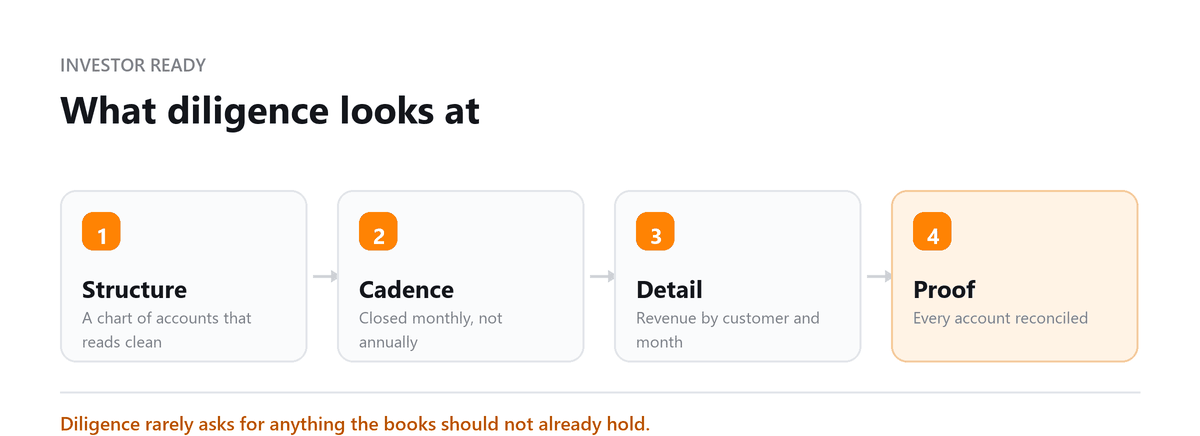
The setup mistake I see most in startup QBO files is a chart of accounts that only works for taxes. Every dollar of revenue sits in one line, expenses are grouped the way a tax return groups them, and nothing is tagged by department.
The books aren't wrong, but they can't answer the questions a diligence team asks first: how much is recurring revenue, what is the real gross margin, and how much of the burn is R&D versus sales. Rebuilding that history during a raise is slow and expensive. Setting up revenue accounts and department tracking in the first month costs almost nothing.
Ankit Sagatani, MBA, B.Com · LinkedInWhy QuickBooks Online for Startups?
- Investor familiarity, most investors and their financial advisors work with QBO data; sending a QBO export shortens due diligence
- CPA ecosystem, the vast majority of US CPAs and startup bookkeepers are QBO-trained
- Integrations, QBO connects to Gusto (payroll), Stripe, Shopify, Brex, Mercury, and most startup tools via Zapier or direct integration
- Audit trail, every transaction has a full edit history; investors and auditors can verify any number
- Scalable, grows from pre-revenue to Series B+ without a platform switch for most startups
Essential QBO Setup for Investor-Ready Financials
| Setup Step | Why It Matters for Investors |
|---|---|
| Chart of Accounts | Set up COA to match standard startup P&L structure, Revenue, COGS, Gross Profit, then operating expenses by department (R&D, Sales, G&A). Investors compare against standard startup benchmarks. |
| Classes or Locations | Use QBO Classes to tag transactions by department (Engineering, Marketing, Sales, G&A), enables department-level P&L that investors expect |
| Bank Feeds Connected | Connect all bank, credit card, and loan accounts, never let reconciliation fall behind more than 30 days |
| Revenue Recognition | For SaaS or subscription startups: ensure monthly recurring revenue is recognised monthly, not when received, deferred revenue must be tracked correctly |
| Burn Rate Tracking | Configure a custom report showing monthly cash burn and runway, this is the first number any investor asks for |
| Payroll Integration | Connect Gusto or QBO Payroll, payroll is typically 60 to 80% of a pre-revenue startup's costs; clean payroll data is critical |
| Startup Costs | Capitalise or expense correctly under IRS Section 195 (organisational costs, start-up costs), incorrect treatment distorts early financials |
Monthly Accounting Discipline for Startups
- Reconcile all accounts within 5 business days of month-end, never leave reconciliation more than one month behind
- Review the QBO P&L vs prior month and vs budget, catch errors and anomalies before they compound
- Run and review the accounts receivable ageing, unpaid invoices older than 30 days need follow-up
- Update your cash runway forecast, how many months of runway remain at current burn rate?
- Ensure payroll is posted and categorised correctly in QBO, payroll errors are among the most common audit findings
Common QBO Mistakes Startups Make
| Mistake | Consequence | Fix |
|---|---|---|
| Using personal bank account for business transactions | 'Pierces the corporate veil' for LLCs; impossible to separate personal from business expenses at tax time | Open a separate business bank account immediately; Mercury and Relay are popular for startups |
| Recording all revenue as a single 'Revenue' line | Investors cannot see MRR vs NRR vs one-time revenue; impossible to model growth accurately | Set up revenue sub-accounts: Subscription Revenue, Professional Services Revenue, One-Time Fees |
| Expensing all software/equipment immediately | May understate assets and distort monthly P&L for large purchases | Capitalise items above your company's capitalisation threshold (typically $500 to $2,500) and depreciate |
| Not reconciling monthly | Errors compound; reconciliation takes exponentially longer after 3+ months of backlog | Assign a bookkeeper or Profitjets to perform monthly reconciliation, non-negotiable |
| No department tagging | Cannot produce department P&L; investors cannot assess R&D vs G&A spend | Enable Classes in QBO Advanced or Plus; tag every expense on entry |
Investor due diligence exposed several issues in our QBO file that we hadn't realized were there, including unreconciled months, inconsistent revenue recognition, and no department-level tracking. Profitjets went through the books, corrected the historical entries, rebuilt the reporting structure, and got everything cleaned up before our funding round closed.
Approximately 40% of startup clients onboarding with Profitjets require some level of QBO restructuring, with due-diligence cleanups typically taking 3 to 6 weeks depending on the number of unreconciled periods and reporting issues involved.
Book a free consultation and we will get your books diligence ready.
FAQs
When should a startup switch from cash to accrual accounting?
Before the first institutional round at the latest, and ideally as soon as there's meaningful revenue. Investors and diligence teams expect accrual financials, where revenue and expenses are recorded when earned or incurred. Starting on accrual avoids a painful retroactive conversion later. Your tax return may still be filed on a different basis, which your CPA can advise on.
Can a non-accountant founder set up QuickBooks Online?
A founder can handle the basics, such as connecting bank accounts and sending invoices. Investor-ready structure is different: the chart of accounts, department tracking, revenue accounts, and deferred revenue are much easier to get right with an accountant's help. A few hours of setup support usually costs far less than cleaning up the file before a raise.
What do investors actually ask for from our books?
Usually monthly P&Ls and balance sheets, revenue broken down by type, burn and runway, and supporting detail for major accounts such as deferred revenue and payroll. Later-stage investors may also want reviewed or audited statements. Having those reports ready and reconciled shortens diligence considerably.
How often should a startup close its books?
Monthly. A regular close keeps burn and runway accurate, catches errors while they're still easy to fix, and means financials are always ready when an investor or board member asks for them.
When does a startup outgrow QuickBooks Online?
Usually when it has multiple legal entities to consolidate, complex revenue recognition, significant inventory, or a finance team that needs advanced approvals and reporting. Many startups stay on QBO well past their first rounds, and moving to a larger system is a planned project, not an emergency.

Written by
Ankit Sagatani, MBA, B.Com
Ankit works with business owners across the US on industry-specific bookkeeping, from real estate to construction and retail. He writes about what each trade's books actually need. Connect on LinkedIn Connect on LinkedIn
Free consultation
Raising Soon?
Book a free consultation and we will get your books diligence ready.