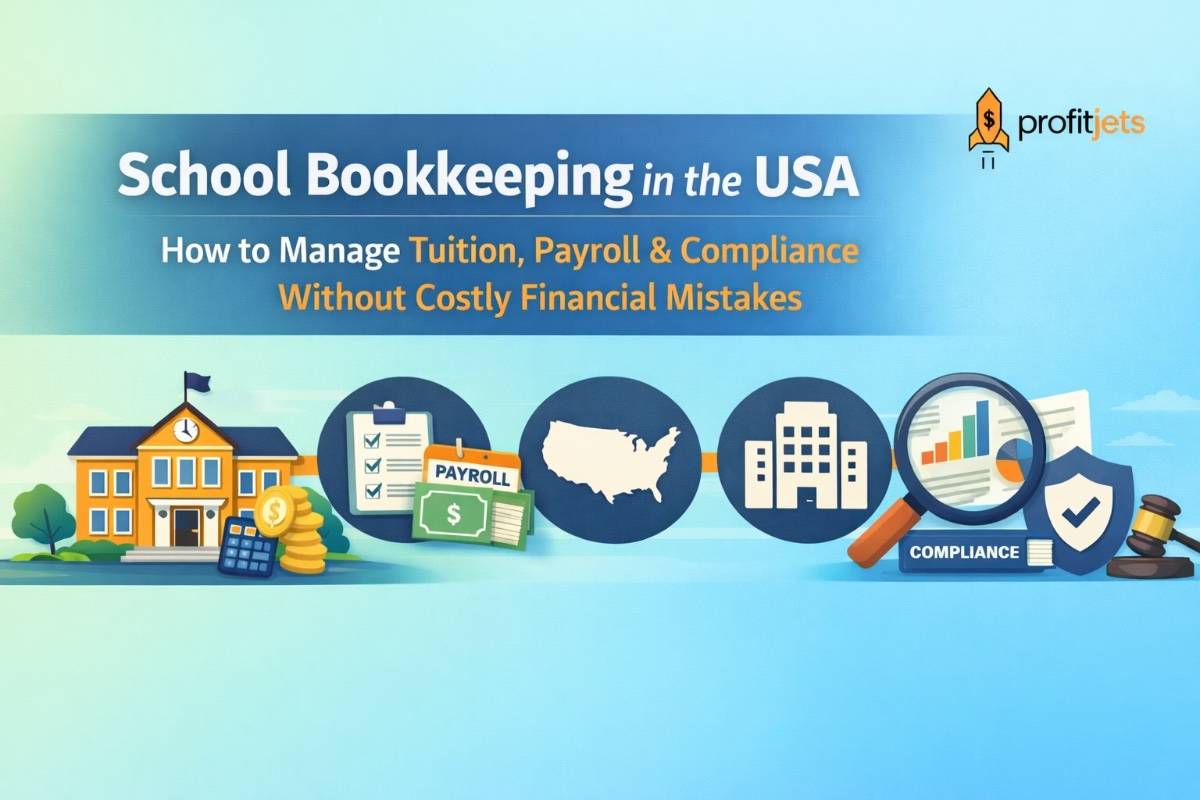
School bookkeeping is the process of recording, tracking, and managing all financial transactions of a school, including tuition payments, payroll, vendor expenses, grants, and compliance reporting. In the USA, proper financial management is not just about balancing the books it’s about avoiding IRS penalties, state audit issues, payroll errors, and cash flow disruptions. Whether you run a private school, charter school, or nonprofit educational institution, accurate bookkeeping ensures financial transparency, protects funding, and supports long-term growth.
Many school administrators struggle with tuition tracking, managing teacher salaries, handling restricted funds, and meeting regulatory deadlines. Without proper systems in place, financial mistakes can quickly turn into compliance risks. This guide explains how to manage tuition, payroll, reporting, and compliance efficiently while avoiding costly financial errors. If you’re searching for reliable solutions tailored to U.S. schools, this article provides the clear answers you need.
Why School Bookkeeping Is Critical for U.S. Educational Institutions
Schools operate differently from typical businesses. Revenue often comes from multiple sources such as tuition, government funding, donations, grants, and fundraising activities. Expenses include payroll, facilities, technology, transportation, and classroom supplies.
Proper school bookkeeping helps administrators:
- Maintain accurate tuition records
- Track restricted vs unrestricted funds
- Process payroll accurately
- Prepare audit-ready financial statements
- Ensure IRS and state compliance
Without structured accounting for educational institutions, schools risk budget mismanagement, audit findings, and even funding loss.
Managing Tuition Without Revenue Leakage
Implementing a School Tuition Management System
Tuition is often the primary income source for private and charter schools. Errors in billing or collections can severely impact cash flow.
A reliable school tuition management system helps:
- Automate billing schedules
- Track installment payments
- Monitor overdue accounts
- Generate financial summaries
Integrating tuition software with school accounting services ensures accurate reporting and reconciliation.
Preventing Tuition Tracking Errors
Manual spreadsheets often cause:
- Missed payments
- Duplicate entries
- Incorrect family balances
Professional bookkeeping for private schools ensures revenue is recorded properly and reconciled monthly.
Payroll Compliance for Teachers and Staff
Why School Payroll Is Complex
Schools must manage:
- Salaried teachers
- Hourly support staff
- Contract-based instructors
- Benefit contributions
- Retirement plans
Errors in payroll tax filing or benefit calculations can trigger IRS penalties.
Using specialized school payroll management services ensures:
- Accurate tax withholding
- On-time payroll processing
- Proper W-2 and 1099 issuance
- State compliance
Payroll is typically the largest expense category, so precision is essential in school bookkeeping.
Expense Tracking & Budget Control
Using School Expense Tracking Software
Schools incur recurring and variable costs. Without organized tracking, budgets can quickly spiral.
Effective school expense tracking software helps monitor:
- Utilities
- Classroom materials
- Vendor payments
- Transportation costs
- Technology expenses
This improves education sector financial management and ensures spending aligns with approved budgets.
Budget Planning for Academic Year Stability
Unlike traditional businesses, schools operate on academic cycles. Budget forecasting must align with enrollment projections and funding schedules.
Professional accounting for educational institutions provides:
- Cash flow forecasting
- Budget variance analysis
- Long-term financial planning
Nonprofit & Charter School Financial Compliance
Nonprofit School Accounting Requirements
If your school operates as a nonprofit, financial reporting standards are stricter. You must properly track:
- Grants
- Donor-restricted funds
- Program expenses
- Administrative overhead
Accurate nonprofit school accounting ensures compliance with federal and state regulations.
Bookkeeping for Charter Schools
Charter schools receive public funding and must maintain high transparency standards.
Specialized bookkeeping for charter schools ensures:
- Funding allocation tracking
- Compliance with state education boards
- Audit-ready documentation
- Timely reporting
Financial Reporting & Audit Readiness
School Financial Reporting and Compliance
Annual audits and board reporting require organized financial statements, including:
- Income statements
- Balance sheets
- Cash flow reports
- Budget comparison reports
Proper school financial reporting and compliance reduces audit stress and strengthens board confidence.
Timely and accurate school bookkeeping ensures administrators can make informed decisions based on reliable data.
Common Financial Mistakes Schools Must Avoid
- Mixing restricted and unrestricted funds
- Poor tuition reconciliation
- Payroll tax miscalculations
- Lack of financial forecasting
- Delayed vendor payments
- Inadequate documentation for audits
Avoiding these errors protects your institution’s reputation and financial stability.
Why Outsourcing School Bookkeeping Makes Sense
Outsourcing professional school accounting services provides:
- Experienced education-sector accountants
- Cost savings compared to in-house staff
- Compliance assurance
- Advanced reporting tools
- Scalability as enrollment grows
Instead of reacting to financial issues, schools can proactively manage budgets and growth strategies.
If you’re looking for expert School Bookkeeping support tailored to U.S. educational institutions, explore our services here:
Need personalized financial guidance?
Contact us today
FAQs
What is school bookkeeping?
School bookkeeping is the process of recording and managing all financial transactions of a school, including tuition, payroll, expenses, grants, and compliance reporting to ensure financial accuracy and legal compliance.
Why is school bookkeeping important in the USA?
It ensures IRS compliance, accurate payroll processing, proper grant tracking, audit readiness, and financial transparency for boards and regulatory agencies.
How do private schools manage tuition accounting?
Private schools use a school tuition management system integrated with accounting software to automate billing, track payments, reconcile accounts, and generate financial reports.
What accounting method do nonprofit schools use?
Nonprofit schools follow fund accounting, which separates restricted and unrestricted funds to ensure compliance with donor and government requirements.
Should schools outsource bookkeeping services?
Yes, outsourcing provides access to education-sector accounting experts, reduces compliance risks, improves reporting accuracy, and saves administrative costs.