
Although small business owners have a budget (usually a psychological one) it is often a wishful thinking. The amount of cash in the bank is the only indicator of whether an expense is justified. This leaves the owner exposed to surprises, such as one month's payroll or a large tax payment or a customer's default, which may leave the account empty and cause the owner to curtail new hires or equipment purchases.
A budget is a spending plan. It is prepared at the beginning of the year and defines the revenue expectations, spending goals, and desired ending balances for each month.
By having a budget you have a frame of reference for every spending decision and an opportunity to make conscious decisions about where and how much to spend the firm's money. More importantly, the process of comparing the budget to the reality each month can help to identify trends, uncover problems and opportunities that need to be addressed.
It is not the fancy spreadsheet that makes a budget valuable, rather it is the insights to be gained by comparing it to reality.
This guide covers what goes into a small business budget, how to build one step by step, how forecasting keeps it current, and the habits that make budgeting actually useful.
What Is a Small Business Budget?
A small business budget is a forward-looking financial plan, typically covering 12 months, that estimates revenue, maps planned expenses by category, and projects the resulting profit or loss for each period (monthly, quarterly, or annual). It is built before the period begins and compared to actual results throughout the year to identify variances and inform decisions.
| Budget Component | What It Covers |
|---|---|
| Revenue forecast | Expected sales by product, service line, or customer segment, based on historical data and growth assumptions |
| Fixed costs | Costs that do not change with sales volume: rent, salaries, insurance, software subscriptions |
| Variable costs | Costs that scale with revenue: COGS, delivery, commissions, production supplies |
| Semi-variable costs | Costs with a fixed floor that rises at certain volume thresholds: utilities, part-time staffing |
| Capital expenditure | Planned purchases of long-lived assets: equipment, vehicles, leasehold improvements |
| Owner's draw / distributions | Planned withdrawals by owner, must be budgeted like any other cash outflow |
| Debt service | Loan repayments, principal and interest, due in the period |
The most common budgeting mistake I see is building the budget once and never looking at it again. Owners put real effort into the plan in January, file it away, and only find out in December that revenue was running 15 percent behind since spring. A budget that isn't compared to actual results every month isn't a management tool. It's just a document.
Ankit Sagatani, MBA, B.Com · LinkedInHow to Create a Business Budget
Step 1: Gather Historical Financial Data
Start with the last 12 months of actual income and expenses from your accounting software. This is your baseline. If the business is new, use industry benchmarks and your best conservative estimates, and flag them clearly as estimates.
Step 2: Forecast Revenue
Project revenue by segment, not as a single number. Break it down by product/service line, sales channel, or customer type. Apply conservative, base, and optimistic scenarios. Example from the live page: $150,000 projected vs $145,000 actual, a $5,000 unfavourable variance. Build in a variance analysis process from day one.
Step 3: Plan Fixed Expenses
List every expense that recurs at a fixed amount regardless of sales: rent, insurance, subscriptions, minimum staffing, loan payments. These are your floor costs, the minimum the business must earn to break even.
Step 4: Estimate Variable Expenses
Variable costs scale with revenue. Calculate them as a percentage of expected revenue based on historical margins. If COGS has historically been 40% of revenue, build that into the variable cost budget. Flag any categories where the ratio is expected to change (new supplier pricing, process improvements).
Step 5: Project Net Profit
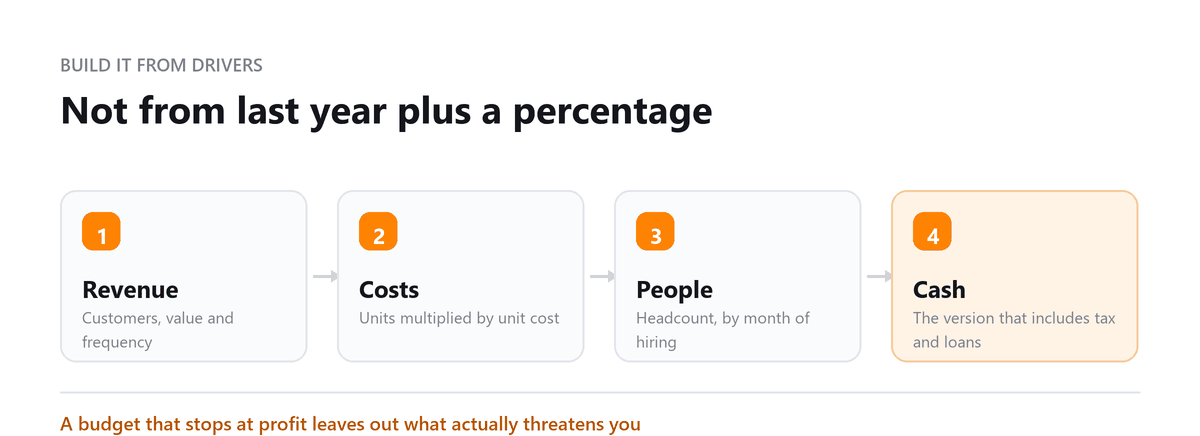
Net profit projection = Revenue forecast - Fixed expenses - Variable expenses - Debt service - Owner's draw. Example: $150,000 projected revenue - $80,000 fixed costs - $30,000 variable costs = $40,000 projected net profit. Compare this against your actual: $145,000 revenue - $80,000 fixed - $30,000 variable = $35,000 actual, the $5,000 variance is entirely in revenue, which means cost control was on target.
The first four items build your profit and loss budget. Capital purchases, loan principal, and owner's draws don't appear as expenses on the P&L, but they still take cash out of the business. That's why many owners pair their budget with a simple cash flow budget, so profit on paper and cash in the bank don't drift apart.
Role of Financial Forecasting in Budgeting
A budget is a plan. A forecast is a live update to that plan based on actual results to date. Best practice: review the budget vs actual monthly, then update the rolling forecast for the remaining months. A business that is 20% behind revenue in Q1 should update Q2-Q4 revenue projections immediately, not wait until year-end to discover the full-year miss.
Best Practices for Small Business Budgeting
- Build the budget before the year starts, not mid-year when the decisions are already made
- Involve the team: department heads know their cost drivers better than a spreadsheet does
- Use zero-based budgeting for discretionary expense categories, justify every line item from scratch each year
- Review monthly: compare actuals to budget within 5 business days of month-end
- Track variance, not just totals: a budget that matches on total but not on mix is hiding problems
- Build a contingency reserve: 5-10% of the expense budget held for unplanned needs without derailing the plan
Book a free consultation and we will build one with you.
Frequently Asked Questions
How often should I review my small business budget?
At least monthly. Within the first five business days after month-end, compare actual results to budget and update your forecast for the rest of the year. Every quarter, take a deeper look at whether your annual assumptions about revenue and costs still hold up or need revising.
What's the difference between a budget and a forecast?
A budget is the plan you set before the year starts, and it stays fixed as your benchmark. A forecast is updated regularly based on actual results, showing where the business is realistically heading. You need both: the budget to measure performance, and the forecast to plan ahead.
How much of my revenue should go to expenses?
It depends heavily on your industry and business model. Product businesses carry significant cost of goods sold, while service businesses spend more of their revenue on people. Instead of aiming for a generic percentage, track your own gross margin and operating costs over time and compare them against benchmarks for your specific industry.
What should a new business with no financial history use to build a budget?
Use industry benchmarks, quotes from suppliers and landlords, and conservative estimates for revenue. Budget fixed costs as accurately as possible, since those are the easiest to pin down, and assume sales will take longer to build than you hope. Revisit the budget after the first two or three months of real results.
What happens if my business keeps missing its budget?
Look at the pattern first. If you're consistently off in the same direction, your assumptions may simply be unrealistic and need resetting. If the misses are random, the issue is more likely inconsistent tracking or unexpected costs. Either way, the monthly variance review is where you find the cause and decide whether to change the plan or change how the business operates.

Written by
Ankit Sagatani, MBA, B.Com
Ankit works with business owners across the US on industry-specific bookkeeping, from real estate to construction and retail. He writes about what each trade's books actually need. Connect on LinkedIn Connect on LinkedIn
Free consultation
No Budget to Work From?
Book a free consultation and we will build one with you.