
Most of the companies budgets are traditionally designed in the same way and based on the same premise. Usually, it is enough to add a certain percentage of inflation and growth for the current year to the figures of the previous year. This way is justified since it enables to reflect the costs at which the companies operate.
However, this approach has some significant drawbacks since it does not take into account costs not accounted for in the past and at the same time includes those that seemed beneficial but are actually no longer relevant.
Zero-based budgeting is another concept that is apparently different from the traditional one. On the one hand, it is more complicated since it requires more attention from the managers.
On the other hand, it is more accurate since it implies examining each line item as if there was a zero balance. Therefore, each cost should be justified and have an explanation of why it is needed.
The method is actually good to determine the most persuasive expenditures that the company needs most. However, at the same time, it can cause some important investments to be cut off as well. Therefore, the main challenge in implementing it is connected with its importance, which may not always be justified by managers.
This guide covers the advantages of zero-based budgeting, when it makes sense, how to implement it, how it compares with traditional budgeting, and how smaller businesses can apply it without getting buried in the process.
What is Zero-Based Budgeting?
Zero-based budgeting, or ZBB, is a method where every expense must be justified from scratch each budget period. Nothing is carried over automatically from the previous year.
Traditional incremental budgeting asks how much more or less you should spend than last year. ZBB asks whether you should spend on something at all, and if so, how much it's genuinely worth. That shift forces a deliberate review of every cost and stops outdated or inefficient spending from surviving simply because it was in last year's budget.
Advantages of Zero-Based Budgeting
- Eliminates cost creep: recurring expenses that have grown incrementally over years get scrutinised and often cut when ZBB forces a justification for each line item from scratch
- Improves resource allocation: budget is distributed based on current priorities, not historical inertia, fast-growing areas get more; declining areas get less
- Increases accountability: department heads must justify their budgets rather than defending a carry-forward from the prior year
- Identifies redundant spend: subscriptions, vendors, and activities that no longer add value are typically caught in a ZBB review and eliminated
- Better alignment with strategy: because every dollar is justified against current-year priorities, the budget reflects where the business is going, not where it was
Why You Need Zero-Based Budgeting
Incremental budgeting preserves every inefficiency from the year before and then adds new ones on top. Over time, budget growth drifts away from the value that spending actually creates.
ZBB is especially useful in a few situations. The business is restructuring or resetting its strategy. You need to reduce costs and want to do it thoughtfully rather than cutting every department by the same percentage. Or you've noticed that managers spend their full budget every year whether they need it or not.
It's also worth understanding the risks. Kraft Heinz is one of the best-known examples. After the 2015 merger backed by 3G Capital, the company used zero-based budgeting aggressively to drive down costs.
Margins improved in the short term, but the company was later widely criticized for underinvesting in its brands, and in 2019 it wrote down billions of dollars in brand value. The lesson isn't that ZBB doesn't work. It's that cost discipline has to be balanced with continued investment in what drives future growth.
The precondition for zero-based budgeting to work in a small business is clean, categorized spending data. You can't justify every line from scratch if you don't know what's actually in each line. When ZBB fails, it's usually because owners treat it as a cost-cutting exercise instead of a prioritization exercise. They cut marketing and training because those are easy to question, and six months later they're wondering why growth stalled.
Ankit Sagatani, MBA, B.Com · LinkedInHow to Adopt Zero-Based Budgeting
| Step | What to Do |
|---|---|
| 1. Define budget units | Break the business into discrete cost centres or decision packages, each must be justified independently |
| 2. Build from zero | For each cost centre, list all expenses and justify each one: what value does this create, what happens if we cut it? |
| 3. Rank spending priorities | Rank justified expenses by strategic value, essential, important, nice-to-have. Allocate budget starting from the top |
| 4. Approve at the right level | High-value cost centres get senior management review; routine lower-value items can be approved at department level |
| 5. Monitor and compare | Track actuals against the justified budget monthly, ZBB only works if the approved budget is actually enforced |
ZBB vs Traditional Budgeting
| Factor | Traditional (Incremental) | Zero-Based Budgeting |
|---|---|---|
| Starting point | Prior year budget + % increase | Zero, every expense justified from scratch |
| Time required | Low, incremental adjustments | High, full justification per cost line |
| Cost discipline | Weak, prior inefficiencies carry forward | Strong, nothing passes without a rationale |
| Flexibility | High, easy to adjust | Low, changes require re-justification |
| Best for | Stable businesses in stable markets | Cost-reduction programmes, restructuring, post-acquisition integration |
Where the 50/30/20 Rule Fits In
The 50/30/20 rule is a personal finance framework: 50 percent of after-tax income goes to needs, 30 percent to wants, and 20 percent to savings. It sometimes comes up in small business budgeting as a simple way for owner-operators to think about spending.
It isn't a substitute for a real business budget, though, and it has little in common with zero-based budgeting. Business costs don't sort neatly into needs and wants, and margins vary widely by industry. For any business with more than a handful of cost categories, a detailed line-item budget is far more useful.
Conclusion
Zero-based budgeting is one of the most effective ways to stop paying for things that no longer earn their keep. By making every expense justify itself, it cuts waste, sharpens priorities, and ties spending directly to strategy. It also takes more time than traditional budgeting and can do real damage if it's used only to cut rather than to prioritize.
For most small and mid-size businesses, the smartest approach is to apply zero-based thinking to the largest and most discretionary costs, protect the investments that drive growth, and keep the budget under monthly review.
Book a free consultation and we will work through it line by line.
Frequently Asked Questions
Is zero-based budgeting practical for a small business?
For very small businesses with one or two people and simple costs, a full ZBB process often takes more time than it saves. A selective approach works better. Apply zero-based thinking to your largest and most discretionary expense categories, which usually make up most of your spending, and use incremental budgeting for the rest.
How is zero-based budgeting different from activity-based budgeting?
Zero-based budgeting starts every expense at zero and requires a justification for all of it. Activity-based budgeting ties spending to specific business activities and the output they're expected to produce. In short, ZBB asks why you spend the money, while activity-based budgeting asks what that spending produces. The two can work well together.
How often should a business do zero-based budgeting?
Some large companies run it every year. For most small and mid-size businesses, a full zero-based review every two to three years, or around a major change like a restructuring or acquisition, is more realistic. In the years between, a lighter zero-based review of the biggest discretionary costs keeps waste from creeping back in.
Which expenses should I review first with zero-based budgeting?
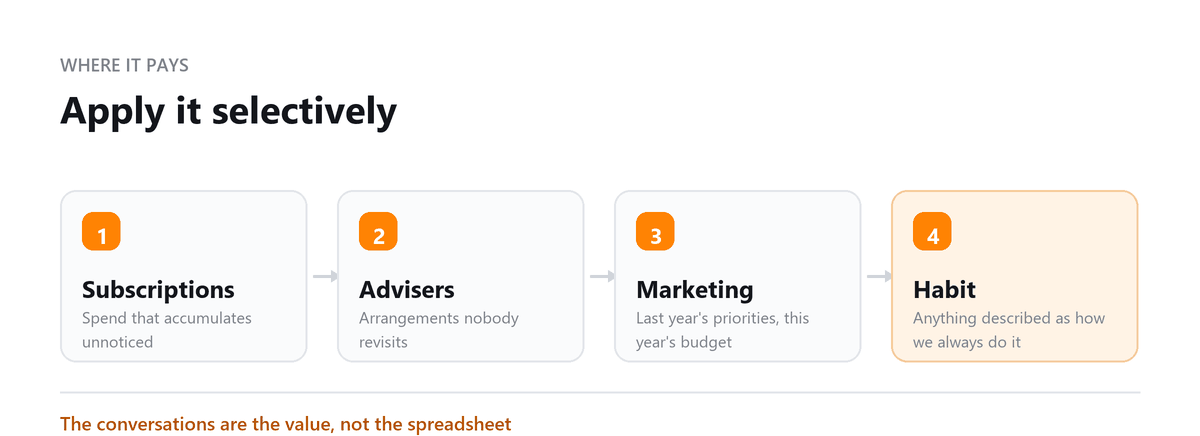
Start with discretionary and fast-growing costs, such as software and subscriptions, marketing, outside contractors and consultants, travel, and professional fees. These tend to accumulate unnoticed and are the easiest to adjust. Fixed commitments like rent and loan payments are harder to change in the short term.
What are the main risks of zero-based budgeting?
The biggest risk is cutting spending that looks optional but supports long-term growth, like marketing, training, product development, or brand investment. It can also absorb a lot of management time and cause friction if managers feel they're defending their budgets every year. Clear priorities and a focus on value, not just savings, help avoid both problems.

Written by
Ankit Sagatani, MBA, B.Com
Ankit works with business owners across the US on industry-specific bookkeeping, from real estate to construction and retail. He writes about what each trade's books actually need. Connect on LinkedIn Connect on LinkedIn
Free consultation
Spending You Cannot Explain?
Book a free consultation and we will work through it line by line.